What are you currently exploring in your artistic practice that excites you the most?
What excites me the most in my current practice is the evolution from the flat canvas into three-dimensional constructivist reliefs that physically interact with light and architectural space. I am currently exploring how to construct multi-tiered surfaces using different shapes and sizes of canvas and canvas board where the lines of the Fibonacci ratio and the Divine Proportion aren’t just drawn, but physically built. What truly fascinates me about this shift is the role of natural, changing light. In Theosophy, light is the ultimate symbol of spirit and life force. By creating reliefs, the artwork ceases to be static. As the sun moves throughout the day, or as a viewer shifts positions in the room, the shadows move, the vibrant color fields catch new reflections, and the geometry itself seems to breathe. I am essentially trying to create a dynamic, ever-changing portal of universal harmony that proves cosmic order is a living, continuous vibration.
Is there a particular artwork on your Singulart profile that best represents your practice today? Tell us why you chose it.
If I had to choose one piece on my Singulart profile that perfectly distills my practice, it would be ‘The Pleroma – The Symmetries of the Soul’, as it marks my defining transition into three-dimensional constructivist reliefs. I chose this artwork because it is the ultimate synthesis of my Constructivist training and my Theosophical beliefs. In mystical traditions, the Pleroma signifies divine fullness—a primordial unity that I have physically built here through layered, multi-tiered geometric planes. The composition features a sacred star polygon radiating from a luminous central pentagram, anchored by two heavily textured, silver-white celestial spheres that project outward into the room. Influenced by British constructivists like Victor Pasmore and Mary Martin, this relief format allows the artwork to actively dialogue with changing light and architecture. As the viewer moves, the physical geometry catches new reflections and casts evolving shadows, transforming the sacred matrix into a dynamic, living portal of cosmic harmony.
What experiences, places or moments have had the greatest influence on the artist you are today?
During my studies at the Byam Shaw School of Art in London, the tutor in charge of the abstract painting section was a constructivist artist. She introduced me to both historical and contemporary constructivist work, as she felt my own practice was naturally moving in that direction. I had the opportunity to meet several prominent UK constructivist artists (Jeffrey Steele, Peter Lowe and Kenneth Martin), who visited the school, and I completely fell in love with their work. After completing my diploma, I was accepted into a Constructivism Forum in London, an artist collective where we held monthly meetings and regular exhibitions.
Is there a story about your artistic journey that people don’t usually know, but that has shaped who you are as an artist today?
I have wanted to be an artist ever since I first picked up a coloured pencil at six years old. Growing up Catholic in Italy, my creative spark was unexpectedly ignited by the beautifully illustrated prayer cards handed out in church, which gave me my very first glimpse into classical masterworks like those of Raphael. However, opportunities to pursue formal art education in Italy were closed to me at the time. My true artistic breakthrough happened when I moved to London to learn English. There, I finally gained access to adult education art classes. Around that same time, I experienced a profound artistic awakening when I saw the works of Piet Mondrian, Wassily Kandinsky, and Vincent van Gogh first-hand. Experiencing their raw texture and scale in person—after years of only knowing them through poor book reproductions—completely transformed me. Encouraged by my tutors, who urged me to take my talent seriously, I took the ultimate leap and enrolled at the prestigious Byam Shaw School of Art. This evolution from a traditional Catholic upbringing to becoming a practicing Theosophist ultimately found its perfect expression through the structural and spiritual world of abstract art.
Are you currently working on anything you’d like people to know about?
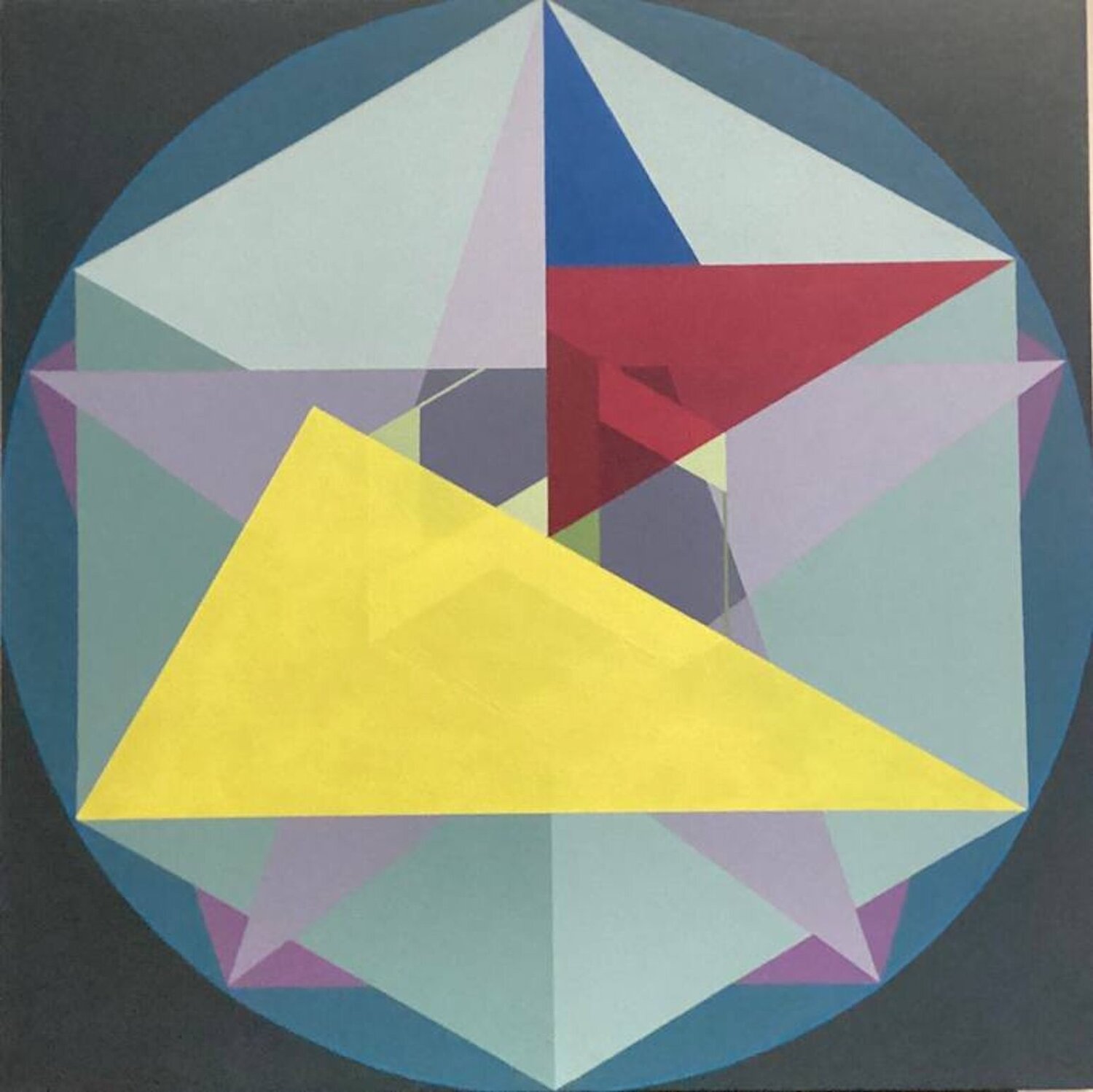
My current work investigates the intersection of sculptural form and optical depth. By constructing layered, multi-dimensional planes of canvas and canvas board, such as nesting concentric hexagon within a circular and square matrix, I create a physical topography on the wall. I activate this structure using a high-contrast gradient of complementary colours, transitioning from a deep, saturated violet to a luminous yellow. This colour progression utilises atmospheric perspective, using value and colour theory to amplify the physical ‘near and far’ relationship of the structural layers.
You studied and worked extensively in London before returning to Italy—how did your time in both places shape your artistic vision and approach to abstraction?
Before moving to London, my art in Italy was primarily figurative—I painted picturesque landscapes and still life, often copying from photographs or reproducing the masterworks of classical and contemporary greats. However, my entire creative paradigm shifted in London. First through adult education, then during my time at the Byam Shaw School of Art, I discovered Constructivism. Around the same time, I came across H.E. Huntley’s seminal book, “The Divine Proportion.” It was a revelation. I suddenly realized I possessed the exact visual and philosophical toolkit I had been searching for. The golden ratio and structural geometry gave me a framework to create art where nature and harmony remain paramount, allowing me to look past surface appearances and instead map the underlying, sacred order of the universe.
Your practice combines rigorous geometric structure with intuitive, vibrant color palettes. Can you share how you find balance between mathematical precision and expressive freedom in your creative process?
For me, mathematical precision and expressive freedom are not opposing forces—they are completely dependent on each other. The rigorous geometric structure, guided by Theosophical principles and the calculations of Theosophy’s golden ratio (The Divine Proportion), acts as the architecture of the artwork. It establishes a sacred, harmonic order on the canvas or relief. I do not see this framework as a cage; instead, it provides absolute liberation. By locking in the structural logic first, my mind is freed from worrying about composition, allowing me to be entirely intuitive and expressive with my color palettes. This is where the influence of pioneers like Wassily Kandinsky comes into play. If geometry maps the invisible, orderly laws of nature, color represents its living, spiritual vibration. When I apply vibrant colours within these calculated spaces, I am channeling pure energy, light, and emotion. The math gives the artwork its bones, but the color gives it its soul. It is a dance between the calculated and the felt, resulting in a visual harmony that mirrors the secret architecture of the natural world.
Sacred geometry and the Fibonacci Ratio are at the heart of your work. What first sparked your fascination with these universal patterns, and why do they continue to inspire you?
My fascination with these universal patterns was actually sparked in childhood, long before I knew the mathematical terms for them. Growing up in Italy, I was captivated by the classical compositions on the Catholic prayer cards handed out in church, particularly the works of Raphael. Even as a child, I could sense a profound, unspoken harmony in those images. Later in life, when I moved to London and discovered H.E. Huntley’s book, The Divine Proportion, it was a massive revelation. It gave a mathematical name to the exact visual balance I had been sub-consciously seeking since I was six years old. Discovering sacred geometry and the Fibonacci ratio felt like unlocking the secret blueprint of creation. As a Theosophist, I believe that nature is not random; it is built upon an underlying spiritual order and universal laws. The Fibonacci spiral governs everything from the growth of a sunflower and the curve of a seashell to the swirling of galaxies. These patterns continue to inspire me because they represent a bridge between the physical and the spiritual. By grounding my constructivist practice in these timeless ratios, I am not just making aesthetic choices—I am tuning into the eternal rhythm of the universe. Every canvas or relief becomes an act of uncovering the sacred harmony that connects us all.
The enigmatic forms of crop circles appear frequently in your compositions. What draws you to these shapes, and how do you reinterpret their mystery for your viewers?
What draws me to crop circles is that they are not just enigmatic phenomena—they are, at their core, masterclasses in sacred geometry and cosmic scale. Long before I began incorporating them into my compositions, my work was already grounded in the mathematical harmony of the Fibonacci ratio and The Divine Proportion. When you analyse the intricate configurations of crop circles, you find those exact same universal templates written directly into the earth. As a Theosophist, I view these formations as visual manifestations of an underlying, unseen intelligence and cosmic order. They are symbols that bridge our earthly reality with the wider cosmos. Their anonymous, overnight appearance carries a profound sense of wonder that resonates deeply with the constructivist idea of the artist as an instrument of universal laws, rather than an egocentric creator. In my work, I don’t merely copy these formations; I reinterpret their mystery by extracting their pure geometric essence. I isolate their grids, lines, and concentric relationships, placing them into a new dialogue with vibrant color palettes and structured spaces. For the viewer, I want the canvas or relief to act as a portal. By translating these fleeting, mysterious landscape formations into permanent abstract structures, I invite the audience to look past the surface enigma and feel the eternal, harmonious vibration that connects all things.
As an artist deeply engaged with cosmic harmony and interconnectedness, what emotions or thoughts do you hope to evoke in people when they encounter your work?
When people encounter my work, I hope to evoke a profound sense of inner stillness, recognition, and elevated awareness. We live in a world that is often fragmented, chaotic, and loud. Through my art, I want to provide a sanctuary of balance. Because my compositions are anchored in sacred geometry, the Fibonacci ratio, and the Divine Proportion, they carry a specific structural frequency—one that mirrors the very laws governing the natural world and the wider cosmos. My hope is that when viewers stand in front of a canvas or a relief, their subconscious immediately recognizes that ancient, universal order. I don’t just want them to look at the work; I want them to feel its vibration. The mathematical precision gives the viewer a sense of safety, stability, and truth, while the vibrant, intuitive color palettes are meant to stir the soul and awaken a higher spiritual consciousness, reflecting my Theosophical worldview. Ultimately, I want to trigger a realization of interconnectedness. I hope my art acts as a mirror that reminds the viewer that the same sacred geometry shaping a crop circle, a galaxy, or my artwork is also beautifully alive within themselves. I want them to walk away with a feeling of deep peace, knowing they are part of a harmonious, beautifully ordered universe.
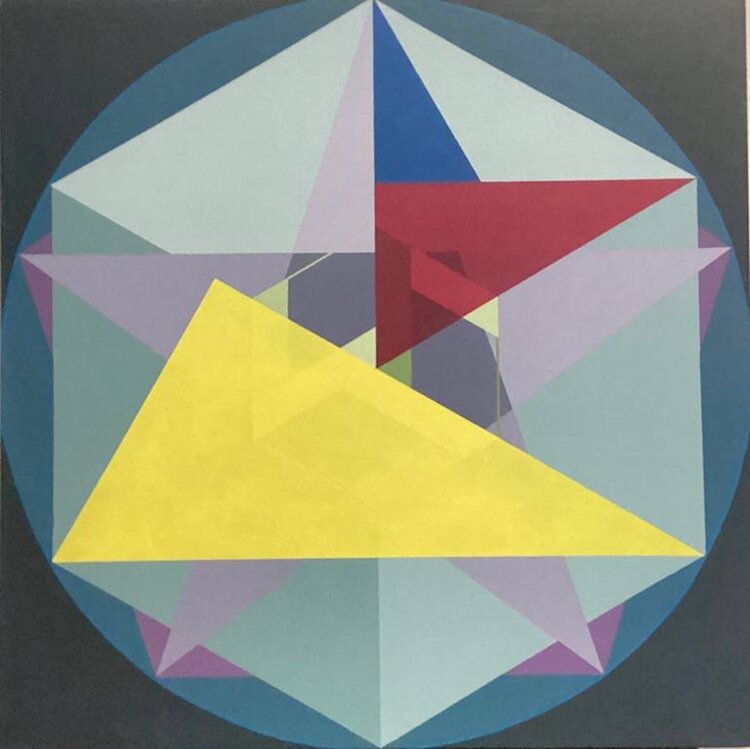 A PENTAGRAM IN PERSPECTIVE (The Transparency of T…
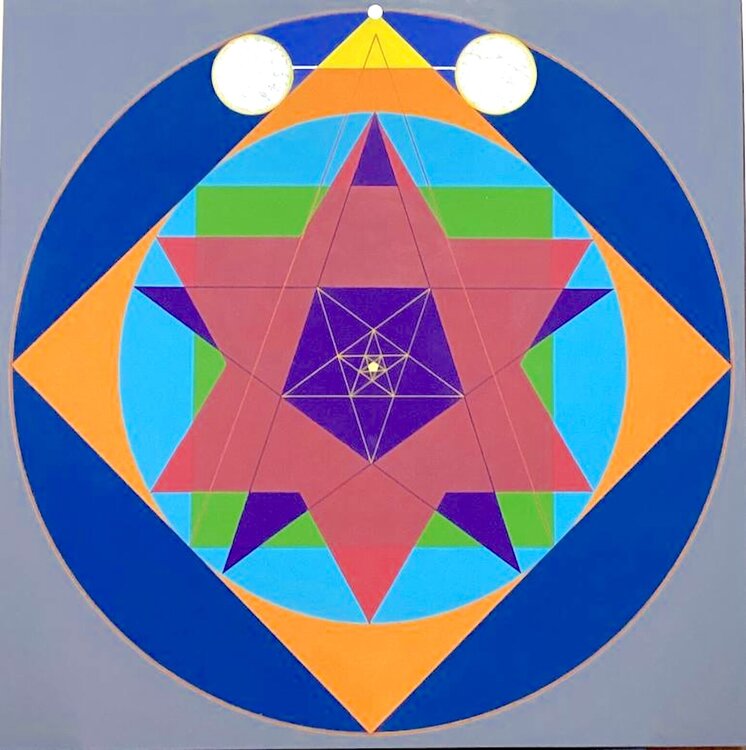 PLEROMA : The Symmetries of the Soul
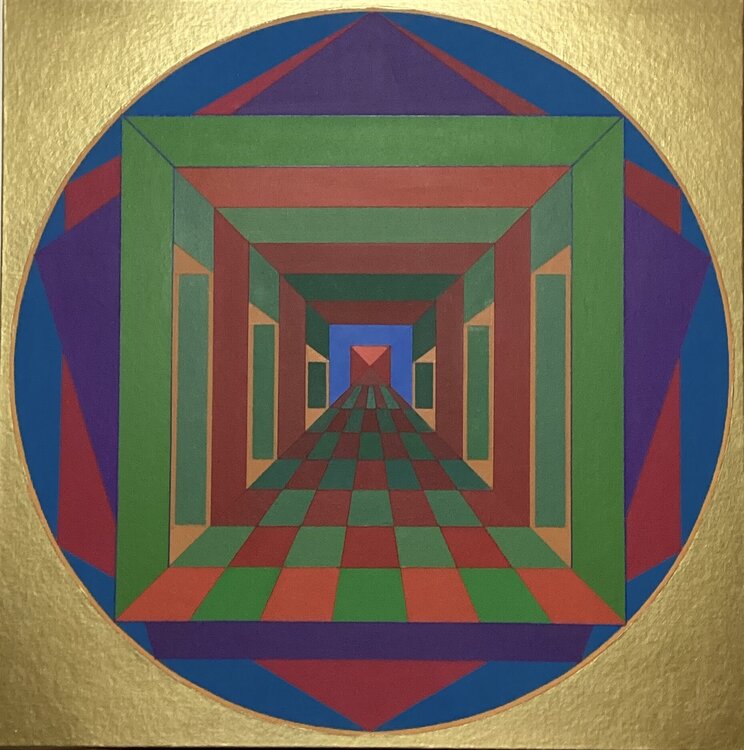 Crop circle with Pentagon & Hexagon