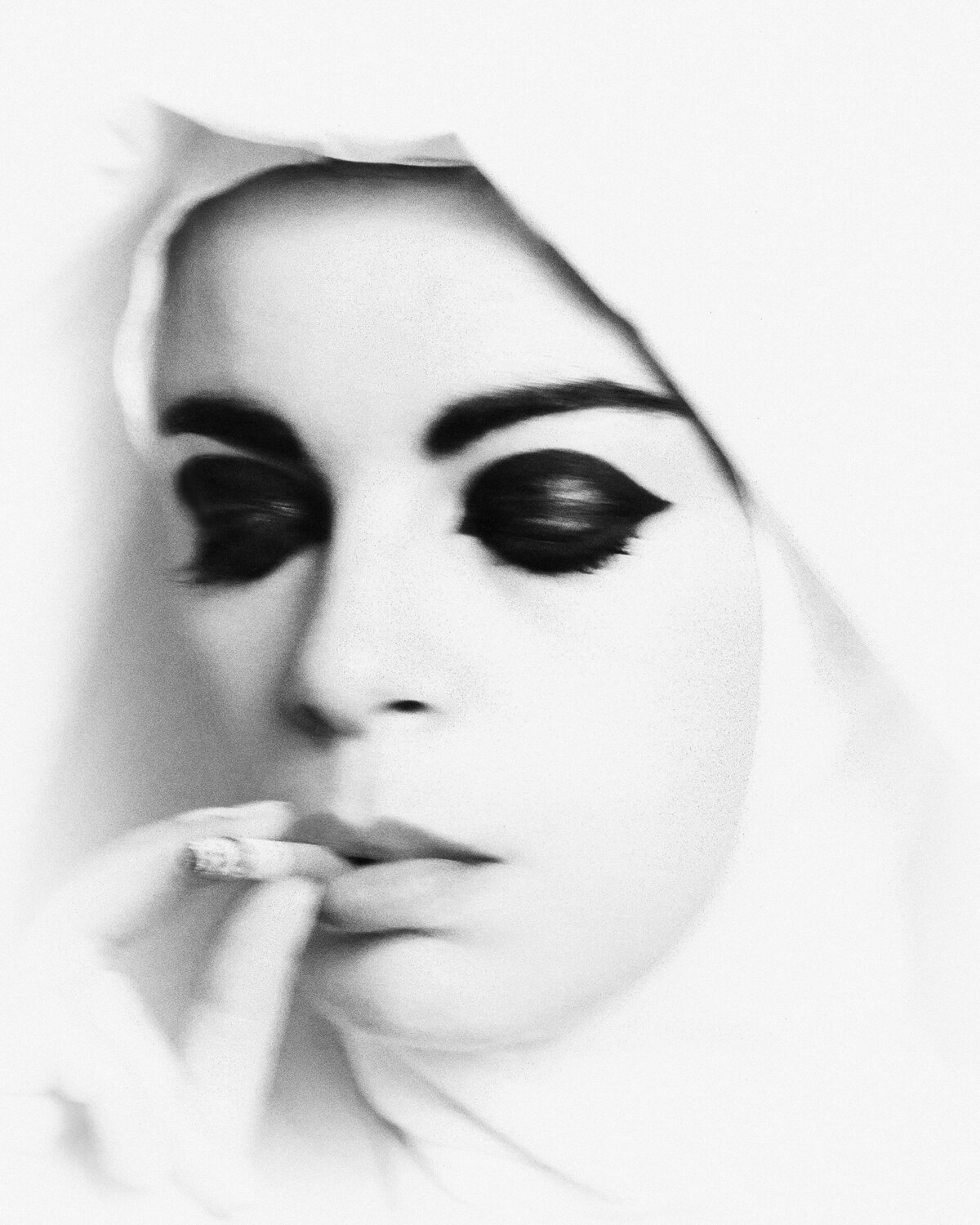
What are you currently exploring in your artistic practice that excites you the most?
If we consider that the boundaries of the artistic universe do not exist, an immeasurable field opens up; beyond photography, what fascinates me most is undoubtedly allowing myself to be surprised by my own mixed-media creations. This may sound strange when put this way, but upon closer inspection, artists evolve throughout their creative journey; they progress through total immersion, giving free rein to their inspiration—and I count myself among them.
Is there a particular artwork on your Singulart profile that best represents your practice today? Tell us why you chose it.
I would say my mixed-media creations; however, photography holds a special place in my mind, and I cannot overlook it as my artistic style evolves. Given the intensity I pour into what I produce, I share a unique bond with all my creations—they become a family of sorts, as each piece is unique. They are dear to me, making it difficult to single out just one. I suppose I should choose my first piece, "Gimme Wings," as it played such a pivotal role in the development of my mixed-media work. It was an intense moment, realizing I had opened a new door and unlocked the ability to step into a different creative dimension. Ultimately, however, I choose "Devoid Diva," as it stands as unequivocal proof of my desire to evolve and my determination to innovate without restraint.
What experiences, places or moments have had the greatest influence on the artist you are today?
It all began in my hometown, Paris, France. From a very young age, I read avidly and admired certain magazines—Vogue, in particular—where the photography dazzled me. My parents owned a restaurant next to a publishing house; the director often came in for lunch. One day, I gathered the courage to ask him a barrage of questions, and his answers helped clarify the path I should take for my future. From then on, I studied the images of the great photographers of the era; their magic was a major source of inspiration. I realized that while the road to rivaling such geniuses would be long, it was not an insurmountable obstacle. My mind was made up: I would become a professional photographer.
Is there a story about your artistic journey that people don't usually know, but that has shaped who you are as an artist today?
Yes! After graduating, I decided it was time to get down to business and put my years of study into practice. I needed to work as a photographer's assistant to bridge the gap between theory and practice. I called Guy Bourdin to offer my services as an assistant; he kindly directed me to the Vogue studios—located at Place du Palais Bourbon at the time. That’s when the unexpected happened: during my meeting with the magazine’s art director, he offered to hire me for the Vogue art department. I was absolutely thrilled and accepted immediately!
Are you currently working on anything you'd like people to know about?
In fact, beyond my personal artistic explorations and other projects, the one closest to my heart is the first book of my photographs. It is a long journey into the creative process—particularly regarding image selection, art direction, and the layout, which I am handling myself. I hope to see it published sometime in 2027, or by early 2028 at the latest.
Your early career as a graphic designer for Vogue France had a significant impact on your artistic direction; how did this experience shape the way you conceptualize and compose your photographic work today?
My time at *Vogue France* was pivotal on every level—from art direction and layout design to meeting so many of the magazine's artists and contributors. It was magical to be thrust into a world I had dreamed of so vividly in my youth. I learned a tremendous amount, evolving at lightning speed—not the kind that turned me into a photographer [smiles], but the kind that enriched me and still makes my eyes sparkle. I developed a strong taste for elegance and a heightened vision regarding the future of imagery—a vision that now informs my own photographic universe.
Living and working in the United States after your formative years in France, in what ways do the different cultural and visual landscapes influence the emotional tone and subjects of your imagery?
In the beginning it wasn't easy; before leaving Paris and upon arriving in New York, I had already started working on a more personalized style of imagery with a very distinct signature. It was something new, and I don't think it worked to my advantage—quite the opposite, in fact. While maintaining my identity, I had to adapt and look inward at my work to assess what wasn't working. It was difficult because I was so convinced that my photographic style conveyed its own message, yet it turned out to be unreadable to industry professionals. Patience is the mother of all opportunities; it was the international magazine press that launched my career in the United States, not to mention the clients across the Atlantic who remained loyal to me. As for the different cultural and visual landscapes, the emotional tone and subject matter of my images never really changed; ultimately, I managed to establish my style calmly and steadily. I couldn't disown the very essence of my work.
You have developed a refined technique known for its intimate yet dramatic compositions, particularly in your portraits of influential women; what draws you to capture the essence of your subjects in such a singular and emotionally resonant way?
Being a very emotional person myself, it is first and foremost about the rapport I build with all my subjects—whoever they may be—as well as the psychological insight I gain by observing their faces without them realizing it. I naturally seek to establish a genuine connection; like a chameleon, I adapt my behavior to their personalities, ensuring they feel as comfortable as possible. Fortunately, this approach yields satisfying results, allowing me to maintain the necessary professionalism to achieve an optimal outcome that truly reflects who they are, while upholding my own high standards. Sessions always end with hugs and, very often, knowing smiles when they see the day’s images on the screen. For me, it is a form of therapy—a source of satisfaction I make no attempt to hide. Happiness isn't just found in the meadow; it is absolutely everywhere, waiting to be discovered!
Working as a photo assistant to the legendary Guy Bourdin and being immersed in the legacy of artists like Man Ray, how have these formative mentorships and inspirations continued to echo in your own creative process?
Assisting a legend like Guy Bourdin is undoubtedly a challenge: you have to prove to yourself that the trust placed in you is justified. It requires constant commitment and vigilance, as unexpected issues can arise during a shoot; those are the moments when maximum focus is needed to ensure everything runs smoothly. The skills acquired in this way become permanently ingrained in us, much like the indelible ink of a tattoo. Without us even realizing it, they foster beneficial instincts that resurface when the time is right—once we have finally achieved our dream of becoming full-fledged photographers. Once assimilated, these profound influences never leave us; they form a legacy that must be neither squandered nor disowned.
With the digital era offering new conceptual and creative possibilities, how do you approach innovation within your practice while maintaining the deep connection and immediacy that define your art?
The freedom to innovate is invaluable when imagining or designing something new without compromising the integrity of original creations. Digital technology evokes the same emotions in me as the work that matters most: that desire to spontaneously bring the invisible facets of my vision to life while adding a personal touch. As a truly multidisciplinary artist, I find that the specific stages of creation—whether analog or digital—present the same challenges; I see no difference between them. Admittedly, there were some technical compromises to accept at first, but once the quality matched that of black-and-white negatives or color Ektachrome, there was no turning back. I can say without hesitation that these new conceptual and creative possibilities have in no way altered the integrity of my art; quite the opposite. The digital age has profoundly revolutionized my creative process and brought great fluidity to my work.
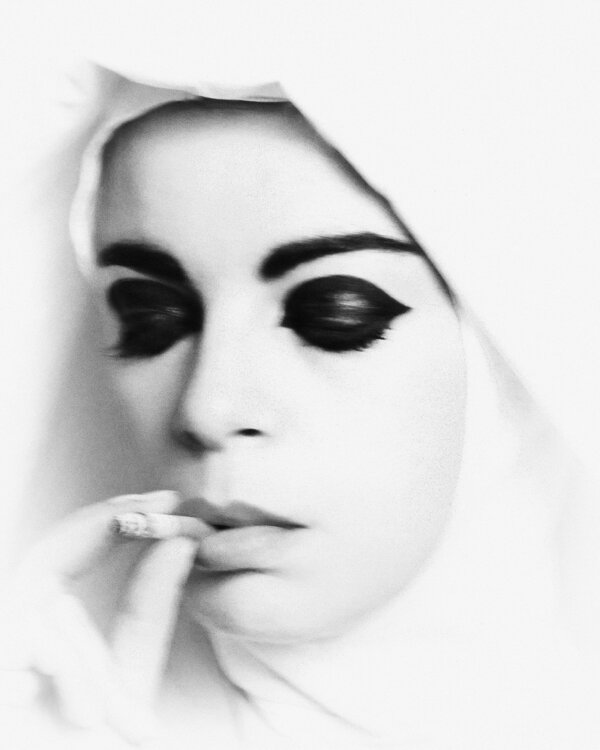 Ink & Ash
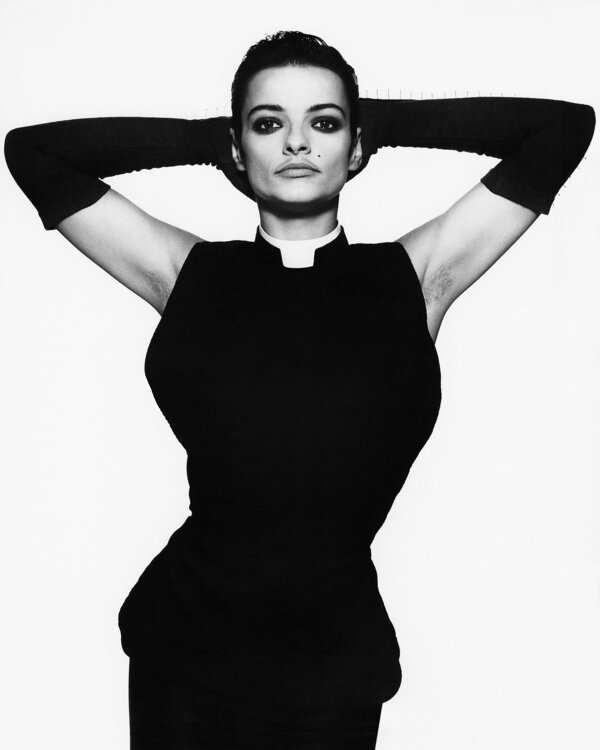 Nina Hagen
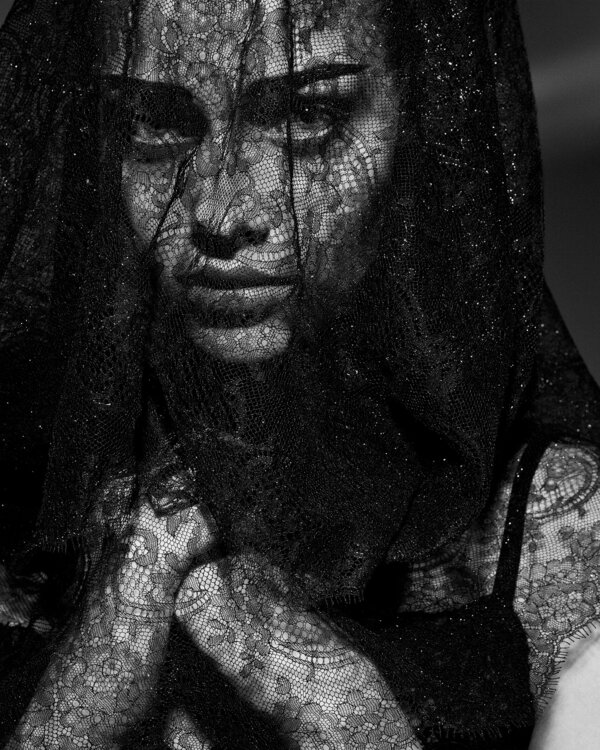 Chiaroscuro Gaze