What are you currently exploring in your artistic practice that excites you the most?
Currently, I am focusing more and more on ecological themes, and my greatest interest lies in exploring how to materialize the shift away from anthropocentrism through painting. I want to visually re-evaluate and truly feel the place of a human within the world. Since childhood, I have naturally felt this equality: I perceive stones as living entities, and I see myself as just another element of the system, no different from a tree or a frog, just a small or large fragment of a shared space. I am incredibly interested in finding ways, both technically and through imagery, to bring more of these interconnected participants into the canvas and into these multitudes, making these hidden, non-human networks visible.
Is there a particular artwork on your Singulart profile that best represents your practice today? Tell us why you chose it.
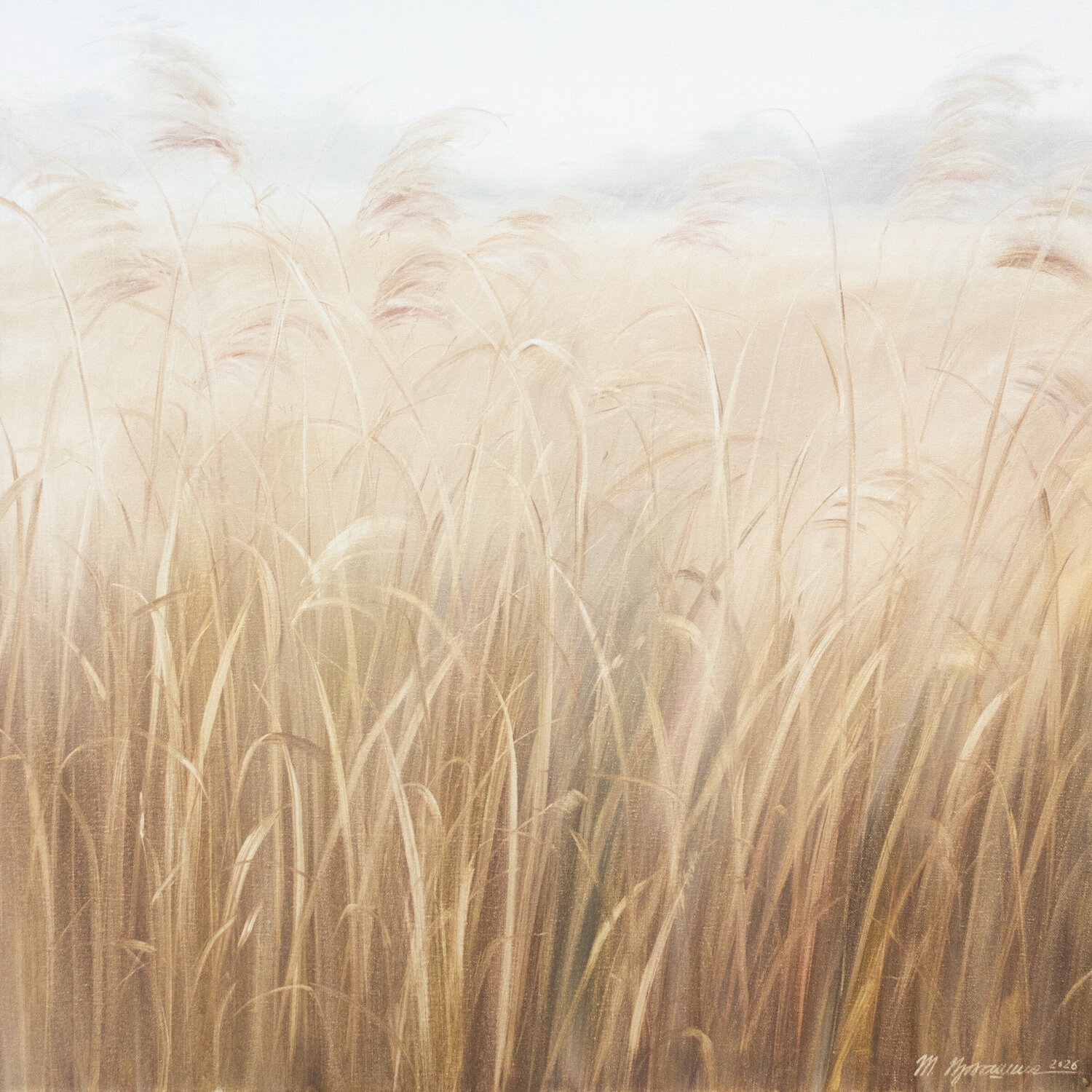
Right now, ‘shimmer of time’ reflects my practice best. In this artwork, my technique of painting in reverse through wiping and blurring the oil paint is clearly manifested. Here, the pigment became a powerful co-author, defining a final result that was completely unexpected at the start. The blurred, organic forms create a fluid space where boundaries disappear. I would also like to highlight my new diptych, which I call ‘two fields.’ In this work, I combine a realistic depiction of grasses with an abstract panel. This juxtaposition creates a new space and new meanings that do not exist when perceiving these parts individually. It allows me to explore how different elements, viewpoints, combinations, and states of matter can coexist within a single network, shifting and showing that no single perspective is the center or the final point.
What experiences, places or moments have had the greatest influence on the artist you are today?
For a long time, I was doing something that wasn’t truly mine, and it turned out to be quite destructive. The turning point came when I completely reconsidered how a person can live and give back. When I committed to my art practice, I realized that I could share with the world and be filled at the same time. Now, this process feels as natural and vital as a geyser or a river that always has an inflow and an outflow. In art, I value novelty in ideas, techniques, and forms, but no trends should ever affect sincerity. I always stay in close contact with myself to remain an honest artist who sincerely does what I feel is important and true.
Is there a story about your artistic journey that people don't usually know, but that has shaped who you are as an artist today?
I rarely talk about this, but a few years ago, I had no idea that I would become an artist. I had no memory of drawing at all, including during my childhood, even though my mother told me once that I used to do it all the time. It turned out to be a deeply buried, hidden layer of my identity, and I am incredibly happy that I managed to uncover it. Now, I realize a vital need and capacity to create and give back. This interconnectedness is essential to me, along with the ability to share my work with the world and be filled at the same time. And I also dislike using capital letters and final periods in my texts 🙂
Are you currently working on anything you'd like people to know about?
Right now, I am focusing on expanding my abstract series ‘traces’ and exploring the concept of ‘multitudes’ formed by these artworks. I am deeply interested in how individual pieces can interact, blur boundaries, and merge into larger, dynamic ecosystems of meaning. At the same time, I am planning a journey to the tropics in the near future. I want to capture and channel the raw, vibrating energy of that powerful environment into my upcoming paintings. It won’t be a literal depiction, but rather an abstract sensation of that massive biodiversity, its layered structure, and its unstoppable vital force. I am excited to see how this encounter with a new, intense climate will reshape my tactile technique and open up new dimensions in my practice.
Your distinctive technique of painting directly with your hands, blurring and erasing without brushes, brings a tactile intimacy to your work—what first inspired you to develop this approach, and how does the physical act of hand-painting shape your connection to the subject matter?
A few years ago, I was erasing an unsuccessful artwork and was completely amazed by how the heavy, thick oil paint changed. It became transparent, and the white canvas began to glow through the wiped lines. Normally, the canvas is hidden beneath layers of paint, and the image is formed by layering. Here, however, it felt like 'painting in reverse'. This process, both symbolic and physical, was able to hold everything that I could never express in words. Since then, I paint by wiping all my works. I can no longer return to brushes because I feel them as crutches now. When I wipe the canvas directly, I literally feel it, erasing and shaping the image with my hands. This physical contact forms a direct, unfiltered connection to the space I am creating, stripping me of control over a predetermined result. But now, I realize this is a true miracle, as the paint, the humidity, the blending pigments, and the drying process itself become my co-authors. They form those invisible, unknowable, yet deeply meaningful connections, and I see an incredible beauty in them.
Dark ecology and human psychology are central themes in your art, and you often explore the hidden connections within natural ecosystems—can you share a particular moment or experience that deepened your fascination with these concepts?
The turning point was a trip to the Curonian Spit. It is a narrow strip of land between a lagoon and the Baltic Sea, completely covered by dunes. For centuries, people who settled there had to constantly migrate because the moving sands relentlessly destroyed everything. The dunes seemed unstoppable until Franz Epha, a visionary dune inspector, proposed planting sand-loving grasses. These fragile plants, through their natural cycle of birth and decay, slowly formed the very first layer of soil, holding back tons of devastating sand. Eventually, bushes and trees grew, birds arrived, and people were finally able to live a full life. It is incredible how something we rarely notice can become so profoundly important. I see so many analogies between the processes in nature and the human psyche, including the core principle of dark ecology: there is an immense network of hidden connections that we fail to fully comprehend and never will. Everything is both an object and a subject, and everything constantly influences everything else.
Having exhibited internationally, including your solo show in Shanghai’s M50 contemporary art district, how do different cultural contexts and environments influence the direction or perception of your work?
First and foremost, I am influenced by the diversity of nature and climate that I encounter in different countries. Shanghai revealed itself as a vibrant, hot world filled with light and color, and the works for that solo show were deeply connected to color in Chinese culture. Currently, I am planning a journey to the tropics, as I deeply love tropical nature, its multilayered structure, breathtaking biodiversity, and the vital energy of that tangled ecosystem. I know this will be reflected in my upcoming paintings. Interacting with international institutions shows me that art speaks a universal language. Anyone who is ready to listen can understand a statement made by a person from a completely different world, revealing the shared experience of people everywhere. I often receive messages from collectors in different countries, saying that my ‘herbs’ remind them of specific places from their lives. My compatriots say the exact same thing. This demonstrates that it is precisely this natural imagery, both realistic and abstract, that can serve as a bridge, a point of connection between people across the earth.
You describe your finished pieces as existing both individually and as part of “multitudes”, forming dynamic, ever-changing spaces—what draws you to this idea of blurring boundaries and interconnectivity, both in your practice and in life more broadly?
First of all, this approach reflects how I feel connections and how I perceive the world in general. I do not think in plots or linear stories. Instead, I perceive everything as a massive, unknowable system, and only by materializing parts of this system, whether in abstract or more realistic forms, can I manifest it as a tangible space. I offer the possibility to take different pieces and combine them into a brand-new space. A collector can do this by selecting different fragments and arranging them in a certain way, effectively becoming a co-author. The viewer is always a co-author because my works live and continue through interpretations and new bonds. It is an endlessly growing network of connections. Just like in a natural ecosystem or within the human psyche, everything changes, shifts, and nothing remains static. Therefore, when I gather a certain ‘multitude,’ it exists only for a fleeting moment. If someone takes one of the parts, that specific multitude ceases to exist, and that is perfectly natural. Much like a new river forming or a dried tree decaying, it simply becomes the bedrock for reality to develop along a new branch.
You mention creating art as a way to slip out of the accelerated rhythm of life and reconnect with something ancient and wise—how do you hope viewers feel or transform when encountering your work, and what role does slowness play in your creative process?
I wouldn’t say that I hope to evoke any specific feelings. My goal is precisely to create a space. The viewer may not react to it at all, and they don’t necessarily have to slow down. It is merely like an open door to a room that you can walk into, you can reflect on something, or you can do absolutely nothing. As for my process, I actually cannot call it slow. Slowness becomes vital not during the creation, but in the process of interacting with the result, with my own finished works, the art of other artists, and the world that surrounds me. Only by slowing down are we truly capable of perceiving the space that opens up before us, which is hard to overstate in today’s accelerated world. I create these spaces through abstract forms or natural imagery, as they are deeply rooted in the human subconscious. They allow one to feel like a part of larger systems, to simply be like a tree that has grown branches and leaves, interacting with the world exactly like finding yourself deep in a forest.
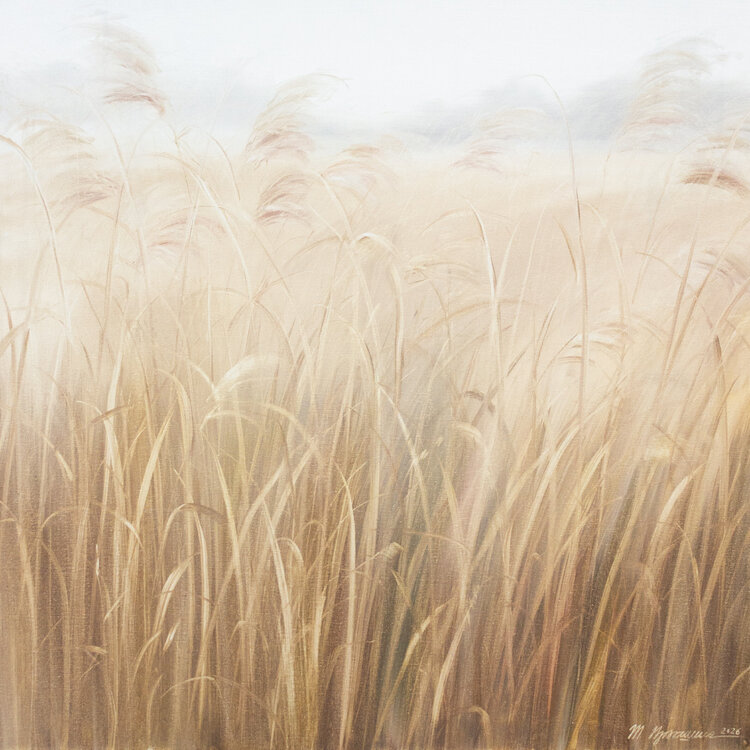 hidden resource
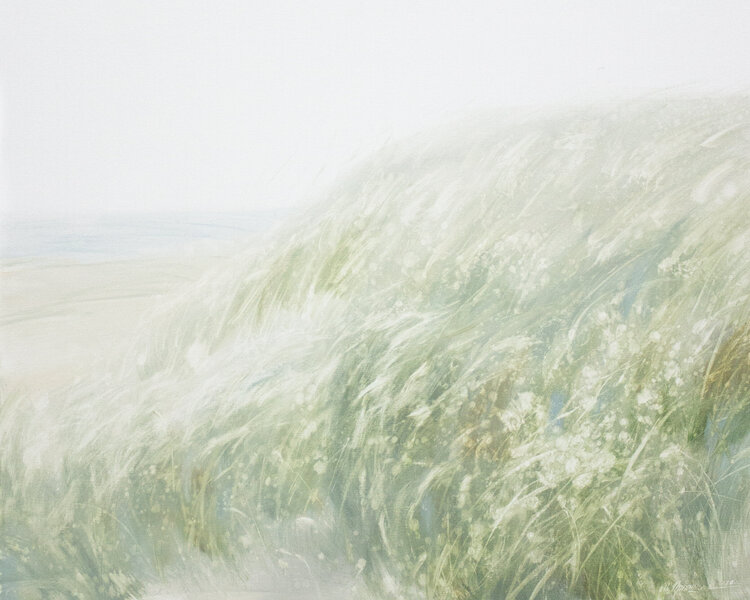 with the wind
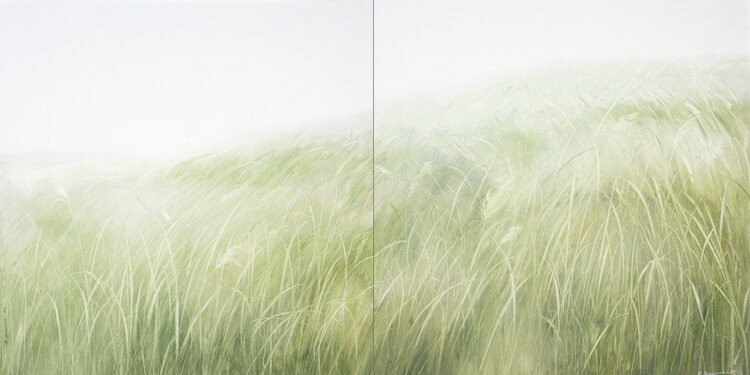 green gold (diptych)