What are you currently exploring in your artistic practice that excites you the most?
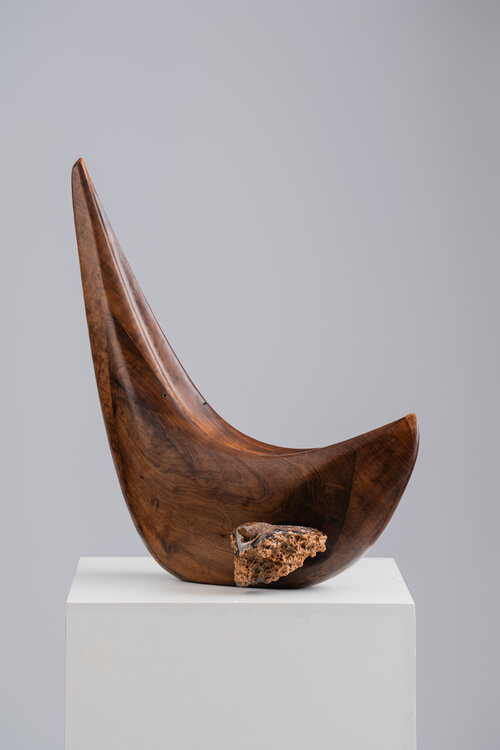
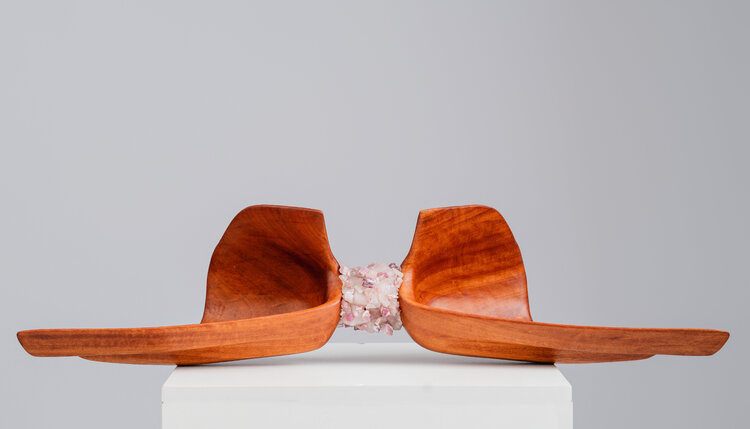
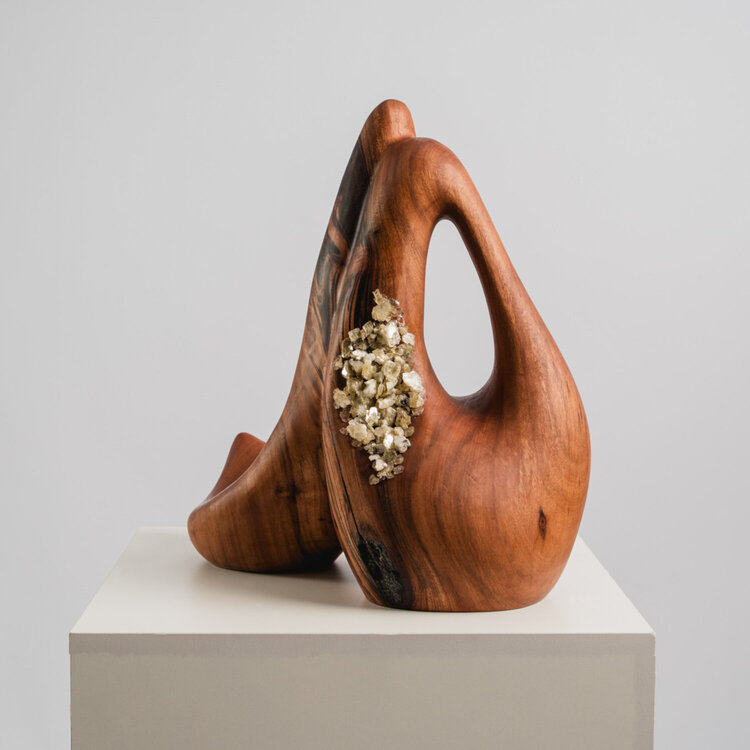
What runs through my work is the observation of life and the connections we can draw between nature and human experiences. I enjoy making these parallels, observing what exists around us and using these relationships to reflect on life and what they can teach us about ourselves. In the series of sculptures made from wood and raw stones that I present on Singulart, I explore questions of authenticity, imperfection and transformation. The marks and scars on the wood make me think about our own experiences, while the raw stones evoke what is most essential within us and what deserves to be preserved. The act of sculpting also leads me to reflect on our ability to choose how we respond to life's circumstances and how we participate in shaping who we become. I am currently developing a new body of research on the resilience of life in inhospitable environments. I look to the depths of the ocean and the bioluminescence of certain fish, which produce their own light in the darkness. This observation leads me to think about our own inner light, what we seek during difficult times and how we find that light within ourselves to keep going, even in the face of the most adverse circumstances. Alongside this, I have been experimenting with new material possibilities, testing combinations of clay and wood residues and exploring the textures and possibilities that emerge from mixing these and other materials.
Is there a particular artwork on your Singulart profile that best represents your practice today? Tell us why you chose it.
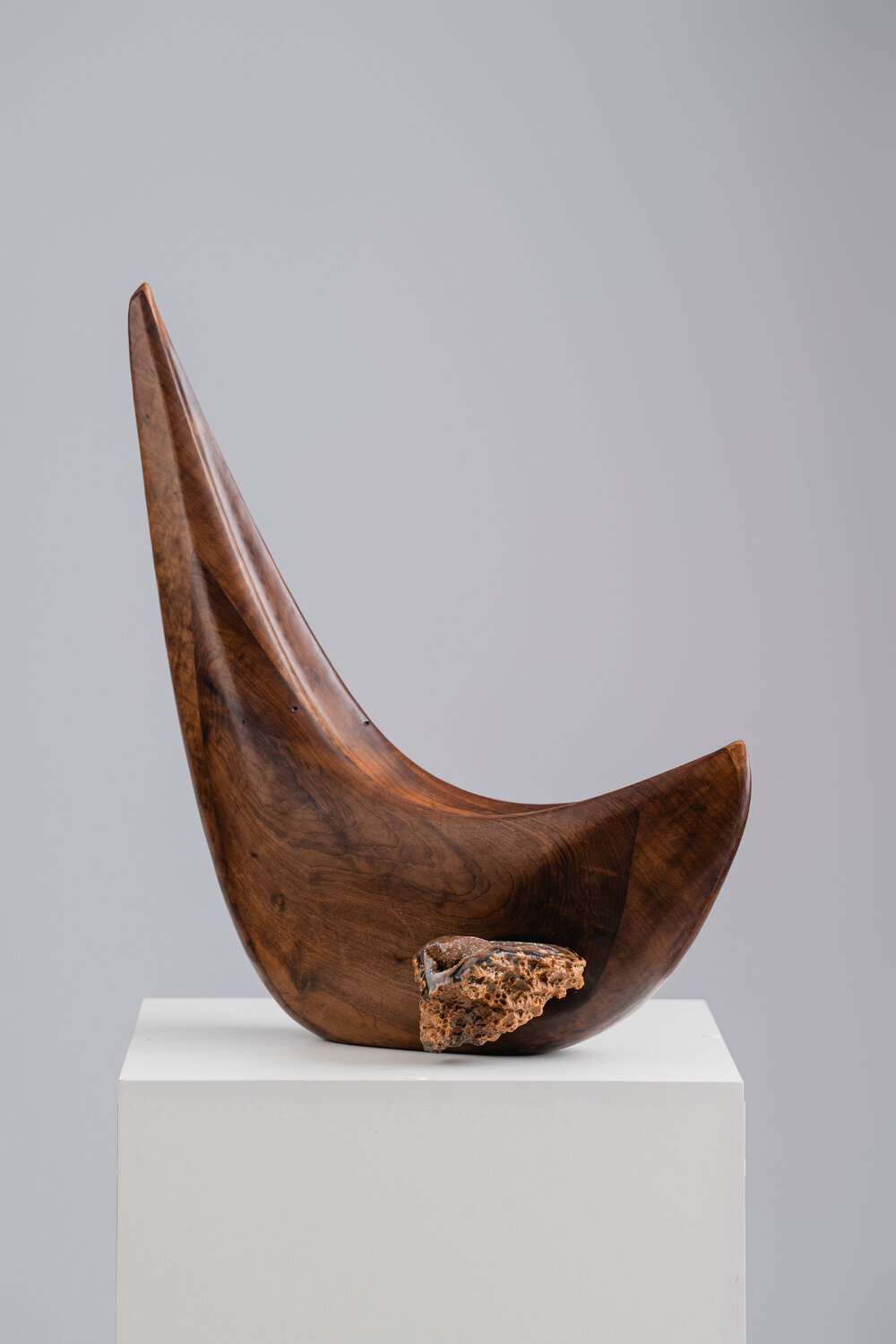
It is a little difficult to choose a single artwork to represent my artistic practice because I see my works as pieces of a puzzle. They complement one another, but each offers a different perspective and its own reflection. Still, I would choose *Danzua*, a very special work to me because of the experience that gave rise to it. When I was beginning my journey in art, I had a remarkable experience during a circular dance accompanied by *Canon in D*, by Johann Pachelbel. The repetition of the movements created an environment conducive to meditation, and at that moment I had an insight into my own creative process: the idea of receiving what comes from the world, bringing it inside myself, mixing it with who I am and giving something back to the world. This movement of exchange and transformation expresses much of what creating means to me. Some time later, I decided to give form to that experience through a sculpture inspired by the movements of that dance. For this reason, *Danzua* also represents an important moment in my life, when I was taking the step toward dedicating myself to art in a more committed way. The work brings together raw stones, wood and sculpted forms, and each element carries a meaning for me. The stones evoke our essence, what is most authentic within us and what does not need to be polished to have value. The sculpted forms speak of our ability to choose how we respond to what happens to us and to participate in shaping who we become. The wood carries its own marks, cracks and scars, traces of its history that make me think about the beauty of imperfection and the marks we also carry throughout our lives. It is a work that brings together many of the questions that interest me: authenticity, transformation and the relationship between what we experience and what we choose to do with those experiences.
What experiences, places or moments have had the greatest influence on the artist you are today?
There are certain influences in my journey that are difficult to explain. One of them is the connection I feel with my grandfather, who worked with wood and passed away when I was still a very young baby. I never really got to know him, but I dreamed about him for many years. I cannot explain this connection, but I feel it may have something to do with my choice to work with wood and to begin my journey in art through sculpture. My education in fashion taught me to observe how political, economic and social events influence people's behaviours and desires. My experience in interior design, in turn, awakened my interest in the relationship between human beings and the spaces they inhabit, and in how what we see, touch and experience around us influences our perceptions and responses. But beyond all of this, I believe what matters most is the way I look at the world: paying attention to details, wanting to explore what I see and feel, and finding ways to give form to these perceptions. I have always had this tendency to reflect philosophically on life, to make associations and to search for meaning in the things around me. I think it is this curiosity that gives rise to part of my work.
Is there a story about your artistic journey that people don't usually know, but that has shaped who you are as an artist today?
During my fashion degree, I had an experience that has stayed with me. In an assignment on window display design, the professor asked us to create something using only black triangles on a white sheet of paper, without explaining the purpose of the exercise in much detail. I created something quite different and full of details that needed to be observed up close to make sense. At the end, the works were placed on the board and viewed from a distance. Mine was the only one that received no votes from my classmates, and I must admit I felt embarrassed. But the professor did something I have never forgotten: in front of the entire class, he said that nobody had voted for my work, but that it was the most creative and ingenious of them all. It simply wasn't a piece meant to be viewed from a distance. He may not even realise how much that gesture affected me. At the time, I was not yet thinking about pursuing an artistic career, but I am certain that experience helped me trust my creativity and continue exploring my own way of seeing.
Are you currently working on anything you'd like people to know about?
I am currently working on a body of research inspired by the depths of the ocean and the resilience of life in inhospitable environments. The bioluminescence of certain organisms makes me think about the light that exists within us, about the strength that allows us to keep going even in the most difficult circumstances. Alongside this investigation, I have been exploring new material possibilities, combinations of materials and textures that might give form to these ideas. I am also developing a series in wood that I see as complementary to the *Nalendece* series. It begins with a reflection on the floods that struck Rio Grande do Sul and on how people experienced, and continue to live with, the consequences of that event. I want to work with wood from trees brought down by the floods, bringing a story that is also ours into the material itself. I have been thinking about how each person was affected by what happened and what remains within us after such an extreme situation. One thought accompanies this research: it is never the water outside the boat that sinks it, but the water that gets inside. In addition, I have other projects in their very early stages, in which I want to explore more inventive paths and experiment with connections to the world of science. These are still very embryonic ideas, and I admit I am a little protective of them at this point. I prefer to let them mature before saying more about what they might become.
You began your professional journey in Fashion and interior design before focusing on art—how have these experiences shaped the way you approach materials, space, and composition in your sculptural practice?
My education in fashion taught me how to channel my creative potential, understand how to stimulate my creativity when needed, and build conceptual frameworks that strengthen an idea. I also learned that the more layers of thought and creation we can consistently bring together in a work, the greater its depth becomes. These layers offer different perspectives and possibilities for connecting with other people's stories and experiences. Fashion also taught me to observe how political, economic and social events influence human behaviours, desires and needs. Trends are, in a way, an interpretation of how people are feeling and how they might come to feel in response to what is happening in the world. This way of looking at human beings and the relationships we establish with the world around us continues to be a rich source for my creative process. Interior design, in turn, made me more attentive to the relationship between people and the environments in which they live. I began to notice how what we see, touch and experience around us can influence our sensations, our mood, our energy and even the way we relate to life. Today, I bring this perspective into sculpture, exploring forms, textures and materials in terms of the experiences they might evoke in those who encounter them. I am interested not only in what a work presents visually, but also in what it might awaken within us, even when we cannot quite explain why.
Living and working in Brazil, how do the local landscapes, culture, or even your personal family history influence the concepts and materials you choose to explore in your art?
This is a very interesting question because I believe that all the experiences I have had so far influence the way I am, think and see the world. And that is where my art comes from. I could write a book about all these influences, but I will try to share a few aspects that I consider particularly important. As a child, I loved browsing through the books in my father's library. One of them, about the formation of minerals, fascinated me in particular. I was drawn to the mystery behind each stone: why did it have a certain colour? Why that particular shape? What made one so different from another? Over time, this memory faded into the background, although I continued to love stones throughout my life. Today, when I look back at my journey as an artist, I realise how this experience, which seemed to have been lost in my memory, has found a place in what I create. Brazil is a place of extraordinary cultural diversity, shaped by the coming together of different peoples and cultures, as well as an immense variety of fauna, flora, climates and landscapes. This richness offers countless references and creative possibilities. But I also believe that the events we experience, and those that affect the places where we live, can inspire new reflections and guide our artistic research. The floods that struck Rio Grande do Sul, for example, deeply affected me and are now the subject of a new series I am developing. Living in Bento Gonçalves, in the Serra Gaúcha region, and being so close to nature makes it one of the main sources of inspiration for my creative process. For me, nature is not simply a landscape that inspires me, but a field of observation and investigation. I am interested in observing its cycles, its marks, its transformations and the strength present in these processes. Through this observation and my connection with materials, I find references that help me reflect on life and on our own experiences as human beings. But there is something even deeper in this relationship with nature, which I consider one of the most important questions in my artistic practice: how we relate to nature and how we recognise our place within the natural world. We live in an increasingly fast-paced world, dominated by technology, haste, competition and the constant need to keep up with everything happening around us. I feel that, if we are not careful, we can become so disconnected from our own nature that we risk losing something essential about what makes us human. I believe that working with natural elements and bringing this relationship into art is also a way of reminding us that we are part of nature. This awareness lies at the heart of what drives me artistically: bringing human beings closer to nature and helping us preserve our connection with what we are, too.
Your sculptures often incorporate natural and reused materials like wood, stones, and clay, and you’ve spoken about letting the materials’ histories and imperfections guide the process—can you share how a specific material has surprised or inspired you during creation?
One of the things that surprises me most during the creative process happens when I am working on a sculpture and approach the final stages. This is when I need to understand how the elements will relate to one another in order to decide how to complete the work. How I will bring a piece of wood and the stones together, which stones to choose, whether to add another element, whether to char the wood or not, among other possibilities. This stage requires me to connect deeply with the piece, almost as if I need to feel it to understand what it is asking for. It may sound a little crazy to put it that way, but it is not simply a matter of analysing the materials and making choices. There is a very intuitive part to this process. Sometimes I enter such a deep state of concentration that solutions seem to emerge from a place I cannot access in the same way in everyday life. I cannot explain exactly what happens in these moments, and I continue to be surprised by this with every new work. This experience seems to continue after the sculpture is finished. When I spend more time with a work, return to look at it days later and observe it again, I realise that I begin to see it differently. My connection with it changes, and it is as if the work itself has transformed, even though no apparent physical change has occurred. It is an intriguing feeling because it seems as though I am looking at something different from what I saw when I finished creating it. I chose to work with natural elements and, unconsciously, I also chose finishing methods for my wooden sculptures that allow the wood to continue working over time, adapting to the environment in which it is placed. For this reason, I generally use natural finishes, such as beeswax, which allows the wood to continue breathing and exchanging moisture with its surroundings. Depending on the humidity and temperature of the place where it is kept, the wood continues to respond, potentially showing subtle changes in colour and even shape over the years. These changes in wood are magical. It remains alive, responding to its environment and adapting to the space it comes to occupy. I made these choices precisely to allow the material to continue its story, even after becoming part of a work of art. But what surprises me most is realising that, beyond these material transformations I have chosen to allow, my own perception also changes over time. After two or three days, there may be no significant physical change in the sculpture, yet I begin to see it differently. It is as if it has genuinely changed, even though it remains physically the same. I do not know to what extent other people experience this in the same way, or whether the fact that I conceived the works with this continuity in mind makes me more attentive to it. Regardless of the explanation, it continues to intrigue me: noticing how spending time with a work can transform the way we see it, even when it remains physically unchanged.
Transformation and the hidden dimensions of human nature are recurring ideas in your work—what draws you to explore the unseen layers beneath visible surfaces, and how do you hope your sculptures impact viewers on an emotional or contemplative level?
I cannot explain exactly what draws me to explore the less visible dimensions of human nature. I think I was born this way. I have always been someone who enjoys reflecting philosophically on life, thinking about its mysteries and searching for meaning in the things around me. Because these are questions that intrigue me and spark my curiosity, they naturally find their way into my art. It is not a rational choice, but a reflection of who I am. When it comes to what I hope to evoke in people, there is a certain contradiction within me. On the one hand, I do not want to create with the intention of affecting someone in a particular way. I feel that I need to give form to what emerges through me, regardless of what the work might cause. On the other hand, I find the possibility of a sculpture awakening a connection between human beings and nature very beautiful. I like to think that a work can spark enough curiosity to make someone stop, look closely and spend time with what is in front of them. This is why richness of detail is important in my work: I want to create pieces that invite people to come closer and offer different elements to observe and discover, allowing each person to build their own relationship with them. Perhaps, in this encounter, reflections will emerge about the beauty of imperfection, authenticity and what makes us unique. Or perhaps the person will simply find a moment of contemplation and well-being. We know how much biophilia and the presence of natural forms can evoke familiarity and contribute to human well-being. For me, bringing this relationship into art is also a way of bringing people closer to nature and fostering this connection, which I believe is so important to us.
With your artistic career now gaining international recognition, including exhibitions in Italy and future solo shows in Brazil, how does expanding your audience influence your vision for future projects or the stories you wish to tell through your art?
I believe this question can be approached from a slightly different perspective, and I would actually be interested to hear from you whether this way of looking at it makes sense. I imagine that the questions running through my research about our connection with nature, and the way this relationship influences us as human beings, may spark particular interest in different cultural contexts, finding other forms of connection and meaning. I do not think that international recognition will necessarily influence my vision for future projects or change the stories I want to tell through my art. I believe that these are precisely the stories I am already telling, or intend to tell, that need to find their audience, not only in Brazil but also in other parts of the world. I also believe that my works carry aspects of Brazil's richness, both through the materials I use and through the references that shape my perspective. I believe art also has the power to bring cultures closer together, allowing people to discover other realities through artworks. For this reason, I imagine that these aspects already make my work interesting to an international audience, although I would also like to know whether this perception makes sense to you.