What are you currently exploring in your artistic practice that excites you the most?
What excites me most is the substance, aesthetics, and plasticity of the human figure. I am searching for the point where the physical presence of a person, the weight of a gesture, the tension of a pose, reveals something deeper. Through colour and layered pigment I try to uncover the unique visual architecture each subject carries, building the surface until it feels as alive and complex as the person it represents.
Is there a particular artwork on your Singulart profile that best represents your practice today? Tell us why you chose it.
Every artwork I create holds a special place in my artistic life, and it is difficult to single out just one. Each piece represents a different problem solved, a different challenge in colour, composition, or the expression of a figure. One work may be about finding the right chromatic balance, another about capturing a fleeting gesture, another about the tension between stillness and movement. Together they form a whole, and choosing one would mean leaving out the others that made it possible. My practice is defined not by a single painting but by the ongoing dialogue between all of them.
What experiences, places or moments have had the greatest influence on the artist you are today?
What has always inspired me is the boundless possibility of art itself, the ability to bring to life what you have conceived, seen, and felt. To transfer it onto canvas in a way that has a unique impact on the viewer, making them a witness to the world as it has passed through your own prism. Much like a bee transforms a flower into honey, the artist transforms lived experience into something entirely new, something that carries the essence of the original but belongs to a different realm altogether.
Is there a story about your artistic journey that people don't usually know, but that has shaped who you are as an artist today?
The lives of other artists have shaped me in ways people might not expect. Their stories, which as so often happens were far from easy, gave me reason to think differently at different stages of my own life. Seeing how they struggled, persevered, and found their voice through hardship taught me that the path of an artist is never a straight line. Each of those lives offered a different lesson at the moment I needed it most, and together they became a kind of invisible mentorship that continues to guide my work and my choices to this day.
Are you currently working on anything you'd like people to know about?
I prefer to keep the process of creation private. For me, a work in progress belongs to the studio, to the silence between the artist and the canvas. I believe that sharing it too early can dilute the energy and intention behind it. I would rather let the finished piece speak for itself when it is ready to meet the viewer.
Having grown up and studied in Yerevan, how does Armenian culture and your local environment influence the mood and themes of your paintings?
Armenian culture runs deep in my work, often in ways that are felt more than seen. The ancient manuscripts dating back to the 8th and 9th centuries have been a profound source of inspiration, their richness of colour, the boldness of their miniatures, the way those early artists combined ornament with spiritual depth. Alongside that, the colours of the Armenian mountains have shaped my palette in a lasting way, the burnt ochres, dusty violets, and shifting light across volcanic stone. Growing up surrounded by both that heritage and that landscape gave me an intuitive understanding of how colour can carry meaning far beyond the surface, a principle I carry into every painting I make today.
Your work is renowned for synthesizing classical traditions with contemporary approaches, often balancing realism and imagination; what draws you to explore this interplay and how does it shape your creative process?
I have never seen classical tradition and contemporary expression as opposites. The old masters built the foundation, the understanding of form, light, and colour harmony, and I see no reason to abandon what works. But I am not interested in repeating the past. Classical knowledge gives me the tools, and contemporary thinking gives me permission to break them when the painting demands it. I may begin a figure with academic discipline and then let the brushwork dissolve into something more intuitive. The tension between control and spontaneity is where the life of the painting lives.
You have developed an innovative pastel technique that achieves the depth of oil painting while maintaining an ethereal transparency – can you describe what inspired you to experiment in this way and how this technique enhances your storytelling?
Pastel offers something rare: the possibility to build a multilayered surface much like oil painting, yet with a quality entirely its own. What drew me to push the medium further was the atmosphere it creates, a kind of misty, mysterious mood that oil cannot quite replicate. Each layer of pigment adds depth while keeping a soft transparency, as if the figures are emerging from fog. This quality enhances the storytelling naturally, because the viewer is not given everything at once. There is always something half-hidden, something left to discover, and that sense of mystery is what I want every painting to carry.
The celebration of human presence and emotion, especially feminine grace, is a central theme in your art; what inspires these lyrical, psychological narratives and how do you select the figures that become your subjects?
The answer is simple: the plasticity and aesthetics of the female figure are among the most beautiful subjects an artist can explore. There is an endless richness in the way a woman moves, holds a pose, or turns her gaze. Each gesture carries its own narrative without needing explanation. I do not select my subjects through a concept or a plan. I am drawn to a presence, a mood, a silhouette that speaks to me, and the painting begins from that moment of recognition. The goal is always to honour that beauty through colour and form, letting the figure tell its own story.
Throughout your global artistic journey, from Helsinki to Amsterdam, how have your international experiences and accolades impacted your vision as an artist and the way you hope viewers engage with your work?
European art has always been close to my soul. The museums of Amsterdam and other cities I have visited were not just exhibitions for me but conversations with artists I deeply admire. Standing before a Rembrandt or a Degas is a kind of dialogue across centuries. These experiences confirmed something I had always felt: that great art speaks a universal language, beyond borders and time. My hope is that viewers engage with my work in the same way, not as something Armenian or European, but as something human that resonates regardless of where they come from.
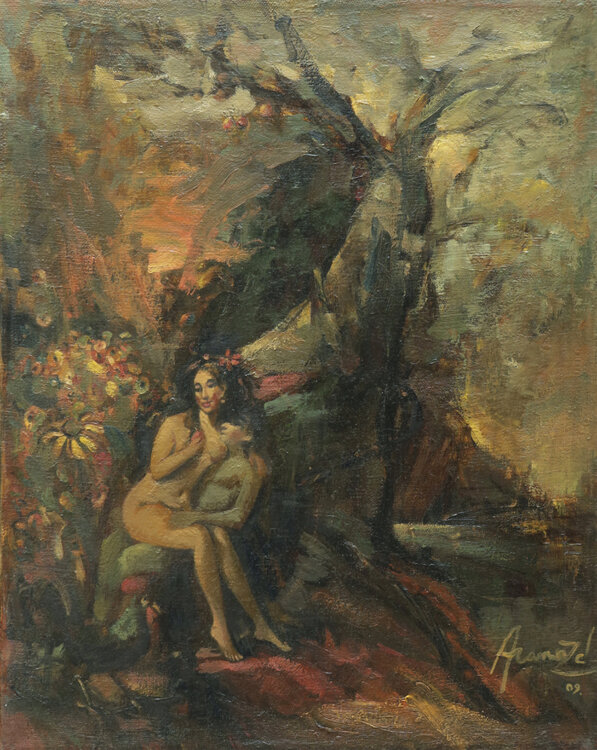 Forbiden fruit
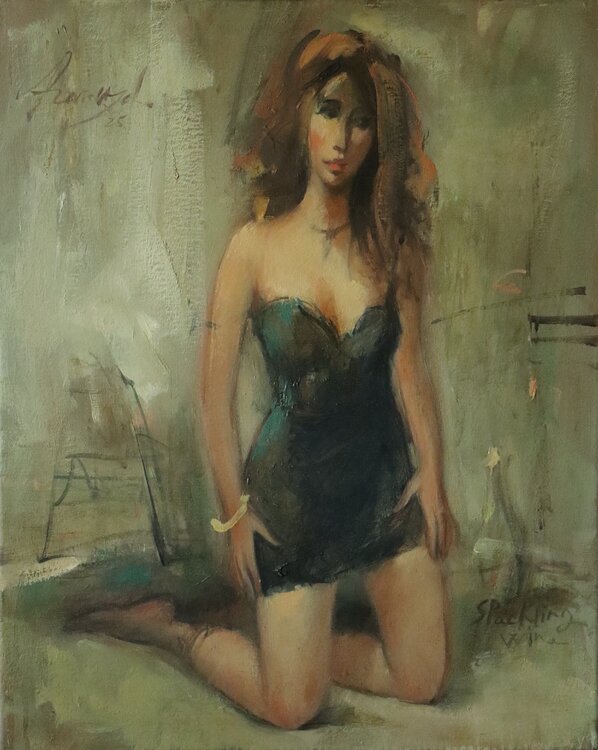 Sparkling Wine
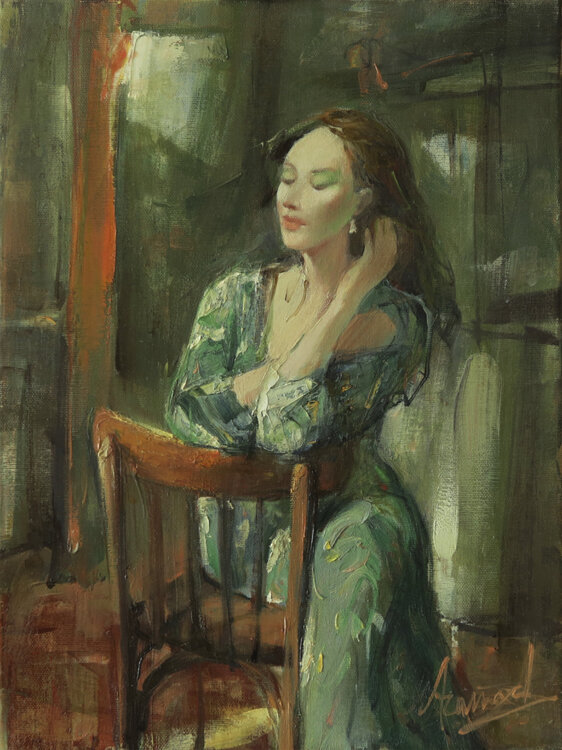 Lady Green