What are you currently exploring in your artistic practice that excites you the most?
I'm exploring the space between a recognizable face and something more instinctive and abstract. I want a figure to carry a sense of character without having to explain exactly who it is. Through vivid color, layered paint, and expressive marks, I'm exploring how identity, emotion, and the subconscious can exist within the same image. What excites me most is when a painting begins to take on a presence of its own—something I couldn't have fully planned before I started.
Is there a particular artwork on your Singulart profile that best represents your practice today? Tell us why you chose it.
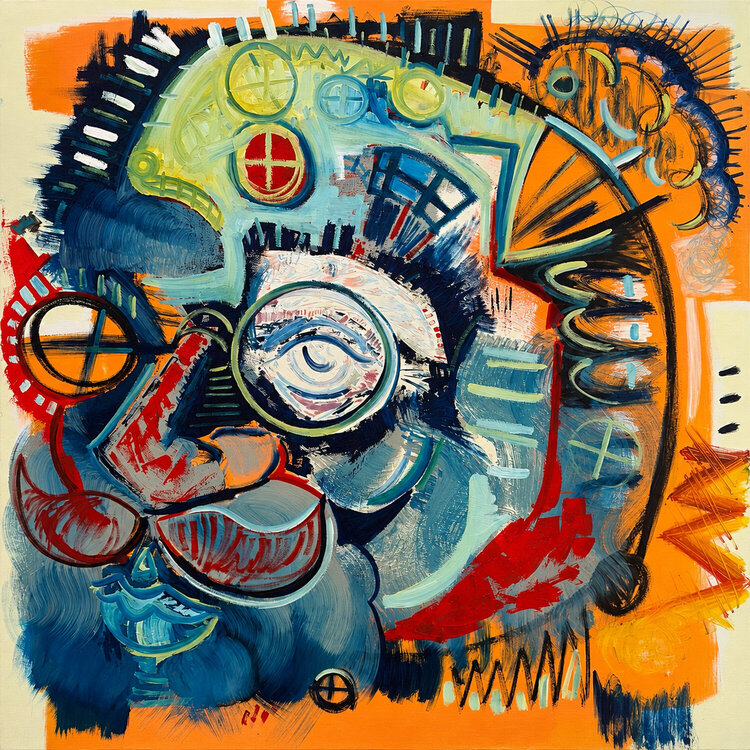
I would choose Mind Blown, a 56-by-56-inch painting from 2019 made with acrylic, oil, and oil pastel. It brings together many of the qualities that continue to interest me: a recognizable face, expressive distortion, vivid color, and a sense of psychological energy. The figure becomes more than a portrait; it suggests an inner world. Although it is an earlier work, it still reflects my interest in creating paintings that feel alive rather than perfectly resolved.
What experiences, places or moments have had the greatest influence on the artist you are today?
My Boston roots, my time in the U.S. Air Force, and my life in Austin are important parts of my story. Moving between those chapters has given me different ways of thinking about identity, purpose, and change. Returning to painting after leaving the military was especially meaningful. Rather than illustrating my experiences literally, I bring them into the work through its mood, movement, and characters. Painting gives me a place to explore questions that don't always have clear answers.
Is there a story about your artistic journey that people don't usually know, but that has shaped who you are as an artist today?
People may not realize that my artistic path hasn't been a straight line. After separating from the Air Force and settling in Austin, I returned to painting. That return reminded me how important it is to have something in my life that isn't entirely practical or predictable. In the studio, I can experiment, make a mess, and follow an idea without knowing where it will lead. Coming back to that freedom helped me recognize that painting wasn't simply an earlier chapter—it was something I wanted to keep building my life around.
Are you currently working on anything you'd like people to know about?
I'm working on new paintings in Austin while preparing a broader collection of large canvases and smaller works on paper to share with collectors. I'm also documenting more of my studio practice through video and photography. I want people to see the physical side of the work: the movement, layering, revisions, and moments when an image begins to emerge. Alongside the finished paintings, I'm interested in sharing a more personal view of what happens in the studio and how the work develops.
You’ve shared that painting occurred naturally for you during your university days, in contrast to studying—can you share more about how that realization shaped your commitment to art as a lifelong pursuit?
At university, painting felt natural in a way that studying often didn't. That didn't mean it was easy; it meant I wanted to stay with it, even when I didn't know what I was doing next. I could become absorbed in making something rather than focusing only on getting an answer right. That difference helped me recognize painting as more than a passing interest. My commitment to art grew from that feeling of connection, and returning to it through different chapters of my life has continued to reinforce it.
Much of your work explores the subconscious and the soul; how do you approach translating such intangible concepts into visual language through your paintings or photography?
I don't try to give the soul a fixed appearance or illustrate the subconscious literally. Instead, I work with suggestion: a fragmented face, an unexpected color relationship, or a mark that changes the mood of an image. Familiar forms give the viewer a point of connection, while abstraction leaves room for what can't easily be explained. I'm interested in the tension between a physical presence and an unseen inner life. The painting doesn't need to answer what the soul is; it can create a space to consider it.
Living and working in the United States, in what ways does your local environment or cultural landscape influence the mood and content of your work?
Austin is where I'm building this chapter of my practice, while my Boston roots remain part of my perspective. I don't usually translate my surroundings into literal scenes. I'm more interested in the people, personalities, and contrasts I encounter, and how those impressions become color, movement, or a character on the canvas. My work is a personal response to the world around me rather than a description of a particular place. The environment comes through in the feeling of the painting, even when its subject is imaginary.
As an action painter who emphasizes “letting go” of strict outcomes, how do you balance preparation—such as rehearsed color palettes—with the spontaneity that defines your creative process?
For me, preparation creates the freedom to let go. Working through color relationships and knowing my materials gives me a starting point, but I don't want that preparation to become a rigid plan. Once I begin, I respond to what is happening on the canvas. A mark or an unexpected combination can change the direction of the piece. I step back, make decisions, and return to the physical act of painting. Spontaneity doesn't mean there is no intention; it means leaving enough room for something unplanned to become important.
Between painting and photography, do you notice distinct differences in how you express your inner thoughts or explore your key themes, or do these mediums naturally inform one another in your practice?
Photography and painting let me approach similar interests from different directions. With photography, I begin with something in front of me and use framing, light, and timing to shape how it is seen. Painting allows me to invent, distort, and build an image more freely through color and gesture. Photography encourages me to notice; painting encourages me to transform. They inform one another through composition, atmosphere, and the search for a sense of presence, without needing to produce the same kind of image.