Marcel Duchamp’s Fountain is one of his most iconic readymades and a masterpiece of twentieth century art. In this article, Singulart explores the concept of the readymade and the history of Fountain in the context of Duchamp’s life. Who was Marcel Duchamp? Marcel Duchamp (1887-1968) was born in Blainville, Normandy in a family where all his siblings also became artists.…
Artworks under the lens
-
-
Horn Players exemplifies many of the qualities now characteristic of Basquiat’s oeuvre, from his interest in contemporary African American culture, to his unique style of painting, scattered with words, figures and an array of mark making techniques. In this article, Singulart takes a closer look at the artist’s life and work and discusses the meaning of his masterpiece Horn Players. …
-
Woman in Front of the Sun represents Miro’s quest for freedom and simplicity in his paintings, created using his Surrealist-inspired subconscious painting style. Consequently Woman in Front of the Sun treads a line between abstraction and figuration and is a wildly ambiguous composition that exemplifies Miro’s mature style. In this article, Singulart discusses the artist’s life and his style in…
-
The dynamic Storm on the Sea of Galilee is the only seascape by renowned baroque artist Rembrandt van Rijn. Depicting Christ leading his disciples through a stormy ocean, the artwork was famously stolen from the Isabella Stewart Gardner Museum in 1990, and remains missing to this day. In this article, Singulart will explore the life of Rembrandt, the composition of…
-
When Wassily Kandinksky created Composition VIII, he considered it the high point of his postwar achievement. Looking at the playful, complex composition, it is easy to see why – the intersecting lines and circles show a mastery of abstract art. In this article, Singulart will discover why Kandinsky is considered the father of abstract art, explore Composition VIII, and delve…
-
Henri Matisse’s The Joy of Life (1905-1906) is a radical Fauvist work that placed him as one of the leaders of early modernism, with its expressive use of color, fluid lines and distorted perspective. In this article, Singulart takes a closer look at the masterpiece, its Fauvist style and its influence on modernism. Who was Henri Matisse? Henri Matisse (1869-1954)…
-
Claude Monet was one of the first impressionists, and the paintings he completed at his house in Giverny are some of his most beloved works. Towards the end of his life, Monet developed cataracts in both his eyes, leading to a departure from his bright, soothing color palette into the more rich, robust colors seen in The Japanese Footbridge. Singulart…
-
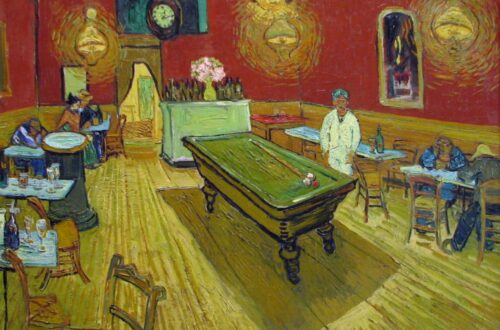
Vincent van Gogh called The Night Café “one of the ugliest paintings I have ever done.” The artwork depicts a desolate café scene at quarter past midnight in violently contrasting colors. In a letter to his brother Theo, Van Gogh described the café as “a café de nuit… staying open all night. Night prowlers can take refuge there when they…
-
Viewing Willem de Kooning’s Woman I is an arresting experience. Drawing inspiration from woman in all her forms, from Paleolithic fertility goddesses to American billboard bombshells, de Kooning presents us with a powerful image that is both intimidating and intriguing. As de Kooning himself said, “Beauty becomes petulant to me. I like the grotesque. It’s more joyous.” In this article,…
-
Raffaello Sanzio, also known as Raphael, is the artist behind one of the most famous paintings of our time. Portrait of a Young Man was taken by the Gestapo in World War II, and its whereabouts remain unknown to this day. The portrait is a fine example of why Raphael became known as the ‘prince of painters,’ showing his mastery…