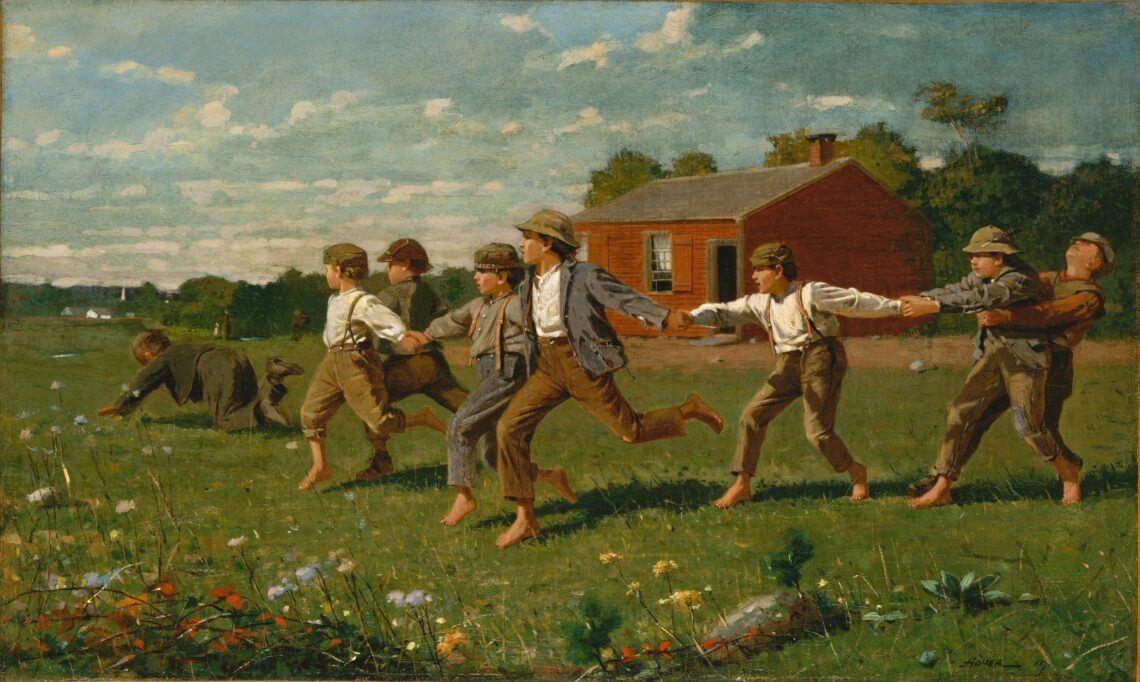
Ever experienced the enchantment of stumbling upon a painting that seems to echo the laughter of carefree days, transporting you to a time when joy was simple and boundless? Winslow Homer achieves precisely that with his masterpiece, Snap the Whip, painted in 1872. Join me on a delightful journey through the life of this artistic wizard, his meanderings in the art world, and a closer inspection of the joyous chaos encapsulated in Snap the Whip.
Who was Winslow Homer?

Let’s start our journey with the maestro behind the canvas—Winslow Homer. Born in Boston, Homer was a creative virtuoso who had a knack for turning the ordinary into an artistic symphony. Beginning his career as an illustrator, he later made a seamless transition into the realm of fine art, where he became known for freezing poignant moments on canvas. His early works were deeply entrenched in the happenings of the Civil War, showcasing his ability to capture emotion through his art.
Homer’s Career
Picture Homer’s career as a vivid painting, each stroke revealing a layer of evolution, dynamism, and surprises. Starting off with illustrations for magazines, he made a significant leap into the world of oil painting in the late 1860s. Homer’s move to New York acted as a catalyst, sparking a love affair with coastal scenes, fishermen, and the raw, unfiltered beauty of nature. These themes became prominent in his watercolors and oil paintings, defining his distinctive artistic voice.
What’s Happening in Snap the Whip?
| Artist | Winslow Homer |
| Date Painted | 1872 |
| Medium | Oil on canvas |
| Genre | Genre painting, Realism |
| Period | 19th-century American art |
| Dimensions | 14 x 22 inches (35.6 x 55.9 cm) |
| Series/Versions | None |
| Where is it housed? | Metropolitan Museum of Art, New York City |
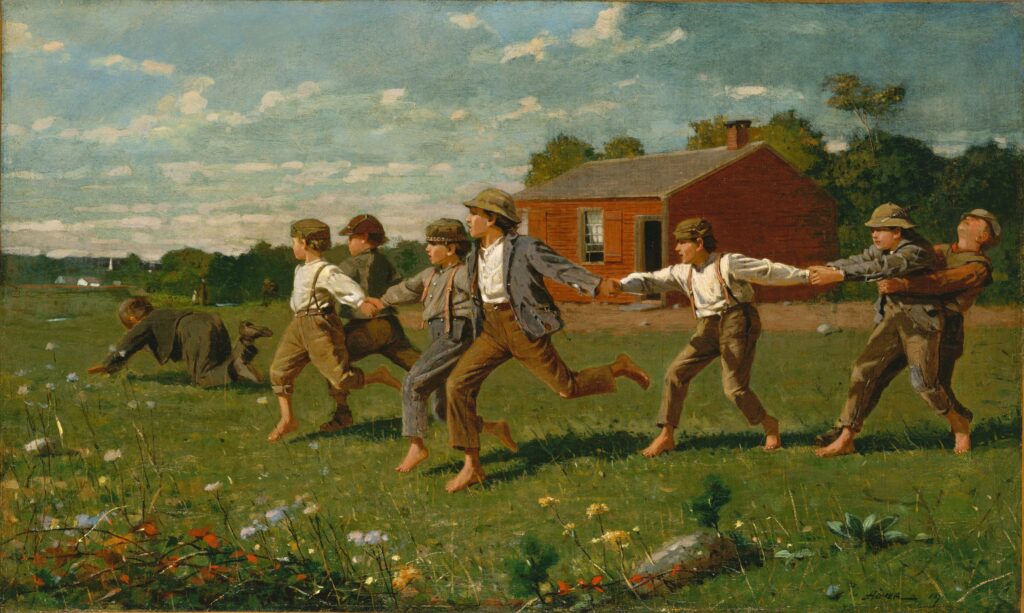
Now, let’s unravel the heart of the matter—what unfolds in the captivating narrative of Snap the Whip? Picture this: a motley crew of young boys engrossed in a game called Snap the Whip. Holding hands in a chain, they sprint together, creating a human whip that propels them forward. The painting encapsulates the infectious laughter, genuine camaraderie, and unadulterated joy of childhood play, transporting viewers to an era when life was simpler and the world was full of possibilities.
Analysis
Now, let’s dissect the enchantment woven into the canvas of Snap the Whip. Homer’s genius lies in his ability to transform the ordinary into the extraordinary. The painting masterfully balances the dynamic movement of the game with the tranquil backdrop of the landscape. Light and shadow play a crucial role, breathing life into the expressions of the boys, creating a harmonious blend of chaos and serenity.
Interesting Facts
Country Life Vibes: Homer’s love for rural life is palpable in “Snap the Whip,” inviting viewers to immerse themselves in the simplicity of everyday activities and the beauty of nature.
Home at the Met: Snap the Whip has found a permanent residence at the Metropolitan Museum of Art in New York City, where it stands as a testament to American artistry. Imagine stumbling upon this gem during your next museum escapade!
Childhood Symbols: Beyond being a depiction of a game, the painting serves as a symbolic representation of unity, friendship, and the fleeting nature of youth. The interconnectedness of the boys mirrors the societal bonds undergoing transformation in post-Civil War America.
Frequently Asked Questions
What technique did Winslow Homer use?
He captured the unique atmosphere and activity of each location using watercolors. He depicted breaking waves, moving animals, and the shifting light’s visual effects with swift brushstrokes. Homer kept parts of the white paper unpainted to imply sunshine.
Where is the largest collection of Winslow Homer paintings?
One of the largest collections of Homer’s artwork in any media, encompassing wood engravings, etchings, watercolors, drawings, and paintings from almost every stage of his career, is kept at the Clark Art Institute.
Conclusion
In the heart of Snap the Whip, Winslow Homer spins a tale of childhood magic and the intrinsic beauty of the American landscape. Homer’s unique ability to infuse ordinary scenes with profound meaning is the secret ingredient that makes his art stand the test of time. As we traverse the laughter and bonds encapsulated in Snap the Whip, we are reminded that art possesses an extraordinary power—to connect us to a shared human experience and to evoke joy from the simplest of moments. The canvas becomes a portal, inviting us to relive the timeless delight of childhood play through the eyes of Winslow Homer.