


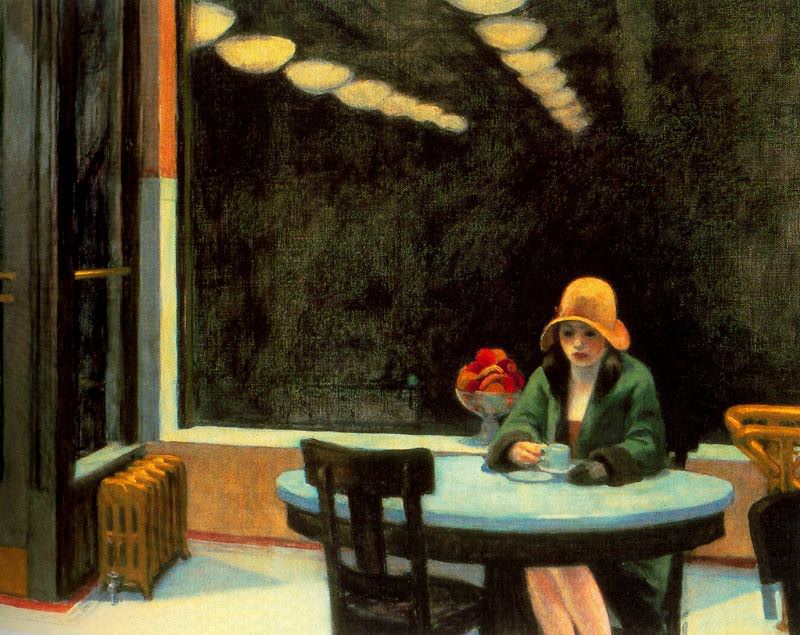
Welcome to Edward Hopper’s “Automat” a captivating universe! Picture this: a time machine, a platform that allows us to travel back to the busy streets and quiet surroundings of urban America in the 1920s.But who was Edward Hopper precisely? And why is that painting so buzzing that everyone is talking about it like freshly brewed coffee? Let’s find out in this article!
Who was Edward Hopper?
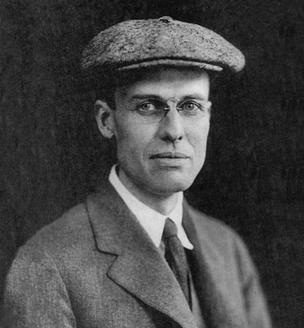
Edward Hopper, an American realist painter, was born in Nyack, New York, on July 22, 1882. He is one of the most acclaimed artists for his subtle and poignant renditions of everyday American scenes that reflect the feeling of loneliness and longing. Hopper manifests his distinctive style, which is characterized by sharp lines, strong contrasts of light and shadow, and the utmost of detail, as a significant contribution to the art world.
FUN FACT: Did you know that Edward Hopper loved watching movies? Yep, he was a big fan of film noir and suspenseful flicks.
His Career
Hopper’s real artistic career started off when he enrolled in the New York School of Art and Design in 1900. At first he did not have his own style, he had tried several styles until in the end he found himself in realism. Hopper’s work was consistently critically and commercially acclaimed during his career, thus earning him a reputation as one of the leading American artists of the century.
What is Happening in Automat?
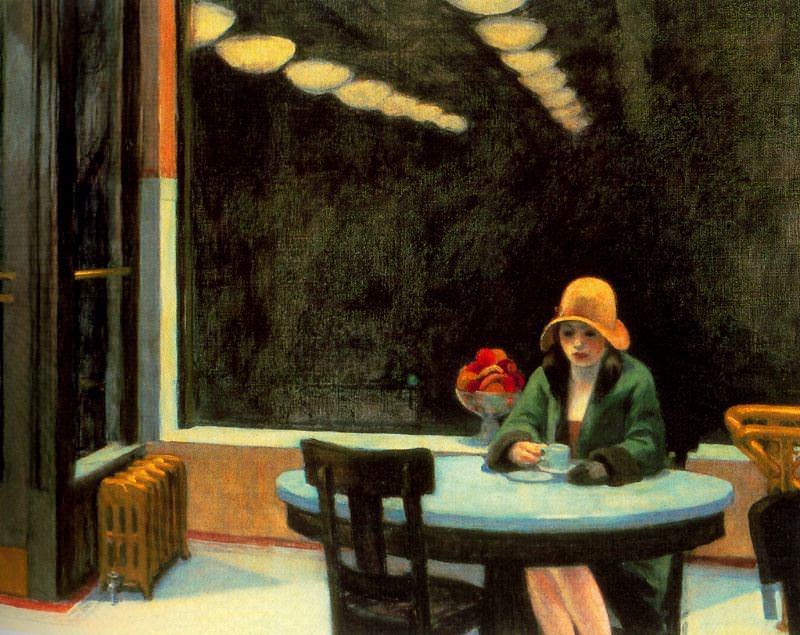
| Artist | Edward Hopper |
| Date Created | 1927 |
| Medium | Oil on canvas |
| Genre | Realism |
| Period | Modernism |
| Dimensions | 28 ½ × 36 inches (72.4 × 91.4 cm) |
| Series/Versions | None |
| Where is it housed? | Des Moines Art Center, Des Moines, Iowa, United States |
Now, let’s dive into the heart of the matter: “Automat.” A single figure, illuminated by the fluorescent lights, enjoying a cup of coffee amidst the busy robotic world is this scene.But wait—what’s she thinking?What’s she feeling? So, to answer the million-dollar question: Hopper chooses to let us discover the mystery of her expression, inviting us to go for a walk in the introspective boulevard of our thoughts.
The automat, with its reflective vending machines and overflowing customers, becomes the setting of this scene. It is a convenience store, where one can buy a fast meal or a cup of coffee without need for interaction with anyone else. However, with all the movement around, the protagonist is alone, lost among her thoughts. Is she taking pleasure from her temporary seclusion from the hustle and bustle of the town, or is her solitude a manifestation of a profound sense of loneliness?
Analysis
Hopper juxtaposes the harsh, impersonal surroundings of the automat with a solitary figure that is highlighted by the crowds of people around her. Under a subtle fluorescent light, she sits along with a mood of weary thinking, her face turned downward, concentration on her mind. But what thoughts are there in her head? What emotions lurk underneath her impassive facade?
Hopper cleverly builds a mood of uncertainty, which leaves the question of the woman’s feelings hanging in the air and undecided. Is she simply savoring a moment of freedom within the pandemonium of the city, or is she hiding a veil of melancholy behind that stoic mask of hers? The automat with its spotless machine rows and lively customers offers a setting for this lonely moment. It is a place of efficiency, where one can satisfy his cravings with a quick snack or coffee without the need for human communication. However, amidst all the bustling activity she finds herself sitting solitary, immersed in her own thoughts.
Interesting Facts about “Automat”
The Setting Speaks Volumes: Ever heard the saying, “location, location, location”? Well, Hopper sure did. By plopping his protagonist smack dab in the middle of an automat—a hotspot for caffeine connoisseurs and lone wolves alike—he sets the stage for a tale of urban isolation like no other.
A Study in Light and Shadow: If you thought Hopper was just a dab hand with a paintbrush, think again. With a flick of his wrist and a stroke of genius, he transforms mere canvas into a symphony of light and shadow. The contrast between the harsh glare of the interior and the murky depths of the outside world? Pure poetry, my friends.
Interpreting the Woman’s Emotions: Ah, the million-dollar question: what’s going on behind those pensive eyes? Some say she’s lost in thought, others reckon she’s pondering life’s big questions. But hey, who needs answers when you’ve got imagination? Hopper’s left the door wide open for interpretation, so feel free to let your mind wander.
Frequently Asked Questions
What was Edward Hopper best known for?
Most people agree that Edward Hopper (1882–1967) was the most important American realist painter of the 20th century. Even while Hopper also created etchings and watercolors, his oil paintings—which frequently evoke a feeling of sorrow or loneliness—are his most well-known works.
How did Edward Hopper learn to do art?
Hopper’s parents urged him to pursue business illustration rather than fine art after he graduated from high school in 1899. In order to fulfill his dream, he enrolled for a year at the Manhattan-based New York School of Illustration before moving to the more somber New York School of Art.
Conclusion
“Automat” is not just a painting; it is a gaze into the human life, a mirror of a universal desire to share among the people in the world which keeps on growing more distant. In the automat with the solitary character, we reflect and let our minds wander while discovering that there are also moments of joy found within the noisy environment of the city.


