As a living legend in the field of photography, Henri Cartier-Bresson serves to demonstrate the lens as a potent tool for portraying the human soul. He is the symbol of the fleeting moment, eternally frozen into a series of stills, a collection of frames that opens a window to the shared experience of the 20th century. In this article, one of the most touching works by Cartier-Bresson, “Gestapo Informer Recognized by a Woman She Had Denounced, Deportation Camp, Dessau, Germany,” which reflects the turmoil of World War II, is discussed. By this extreme image, Cartier-Bresson calls us to take on the part of the spectator who can see the consequences of the betrayal and survival in the darkest times.
Who was Henri Cartier-Bresson?

Henri Cartier-Bresson, the virtuoso behind the camera, was not a photographer but a visionary storyteller who embodied life in the fleeting scenes. Raised in Chanteloup-en-Brie in the southwest of France, Cartier-Bresson’s decision to become a photographer was accidental. He started with painting but discovered the charm of photography after a journey to Africa in the 1930s. This encounter marked the beginning of his life-long relationship with the camera, resulting in him being one of the greatest photographers of the 20th century.
FUN FACT: Did you know Henri Cartier-Bresson’s first passion wasn’t photography? He actually started out as a painter before falling in love with the camera!
His Career
Cartier-Bresson’s career was characterized by his ‘mastery’ of the idea that he coined ‘The Decisive Moment’. He contended that photography was not about staging or retouching, but rather about pinpointing the right moment where everything in the frame is in sync. His art, distinctive for his honesty and improvization, frequently captured the very important meaning in the ordinary.
What is Happening in Gestapo Informer Recognized by a Woman She Had Denounced, Deportation Camp, Dessau, Germany?

| Artist | Henri Cartier-Bresson |
| Date Created | 1945 |
| Medium | Gelatin silver print |
| Genre | Photojournalism |
| Period | 20th Century |
| Dimensions | N/A |
| Series / Versions | N/A |
| Where is it housed? | Private Collection |
In “Gestapo Informer Recognized by a Woman She Had Denounced, Dessau, Germany” Cartier-Bresson depicts a very powerful instant. This is a setting World War II, in a scary place called the deportation camp. The photo captures two people: the guy who shared secrets with the others, and a hero who was injured on that mission.
Imagine yourselves in that camp, fenced in and feeling trapped. Here, you view the tension between the two people. The one telling the secrets looks a little weak, but also a bit strong. The other person seems to recognize them, and you can feel their mix of emotions: sadness, anger, and even forgiveness.
What’s So Special about Gestapo Informer Recognized by a Woman She Had Denounced, Deportation Camp, Dessau, Germany?
This picture is more than just that particular moment. It is the symbol of life’s difficulty in the war. It makes you wonder about right and wrong and how people decide what to do when life is really difficult.
Henri Cartier-Bresson was a real master of this kind of photography. His photos are capable of making you stop and reflect on what is happening. “Gestapo Informer Recognized by a Woman She Had Denounced” is one of those photographs that remain embedded in your memory even years after you’ve seen it.
Interesting Facts About Gestapo Informer Recognized by a Woman She Had Denounced, Deportation Camp, Dessau, Germany
Unveiling Betrayal: The photograph captures the moment of recognition between the woman and her betrayer, offering a haunting glimpse into the human cost of wartime deception.
Power of Expression: Cartier-Bresson’s composition and timing imbue the scene with a palpable sense of tension, as the emotions of both figures are laid bare for the viewer to witness.
Historical Context: Set against the backdrop of Nazi-occupied Germany, the photograph serves as a stark reminder of the atrocities committed during World War II, highlighting the profound impact of betrayal and survival in the face of adversity.
Artwork Spotlight: Paris, 1968
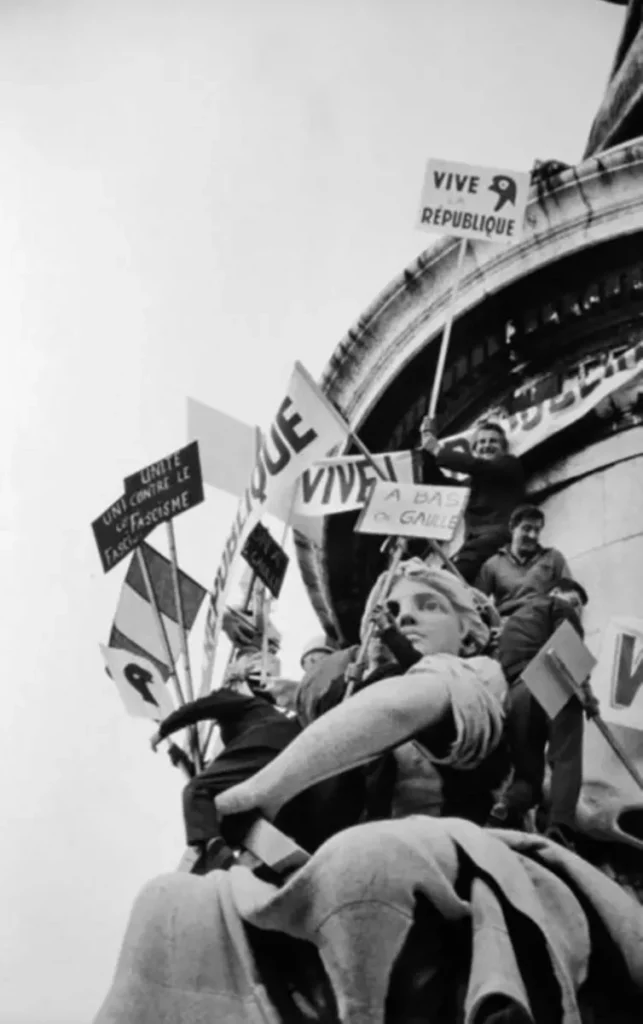
“Paris, 1968,” by Cartier-Bresson is available on Singulart. This artwork freezes a moment when students rebel in May 1968, a manifestation of social disorder and a call for political change in the French capital.
Are you looking for a piece of artwork from Henri Cartier-Bresson?
Singulart has limited edition prints of Henri Cartier-Bresson. If you are looking for a piece of Bresson‘s artwork for sale, simply click on the artwork or the button below to discover more!
Frequently Asked Questions
What techniques did Henri Cartier Bresson use?
In many of his pieces, Henri-Cartier Bresson used the golden triangle or diagonals. This method combines diagonal lines with the rule of thirds. Consider a scenario in which the subject is positioned across the image on a diagonal. Imagine now that it intersects with another line.
Who created the term the decisive moment?
It is fair to say that Henri Cartier-Bresson is regarded as a master of his craft. He was among the pioneers of street photography, skillfully capturing ordinary life with his camera. However, he also created the phrase “Decisive Moment.”
What was Bresson’s first Leica?
His first Leica, a scale-focusing model I (also known as the model A) with a collapsible, non-interchangeable 50mm f/3.5 Elmar lens, had an interchangeable lens. He was also a strong advocate of keeping with a single focal length, in his case the traditional 50mm.
Conclusion
The photograph by Henri Cartier-Bresson, Gestapo Informer Recognized by a Woman She Had Denounced, Deportation Camp, Dessau, Germany, is not only a photo. It’s a peephole into a sad moment in time. It mirrors the dilemma that people had to face due to the consequences of the choices they made.