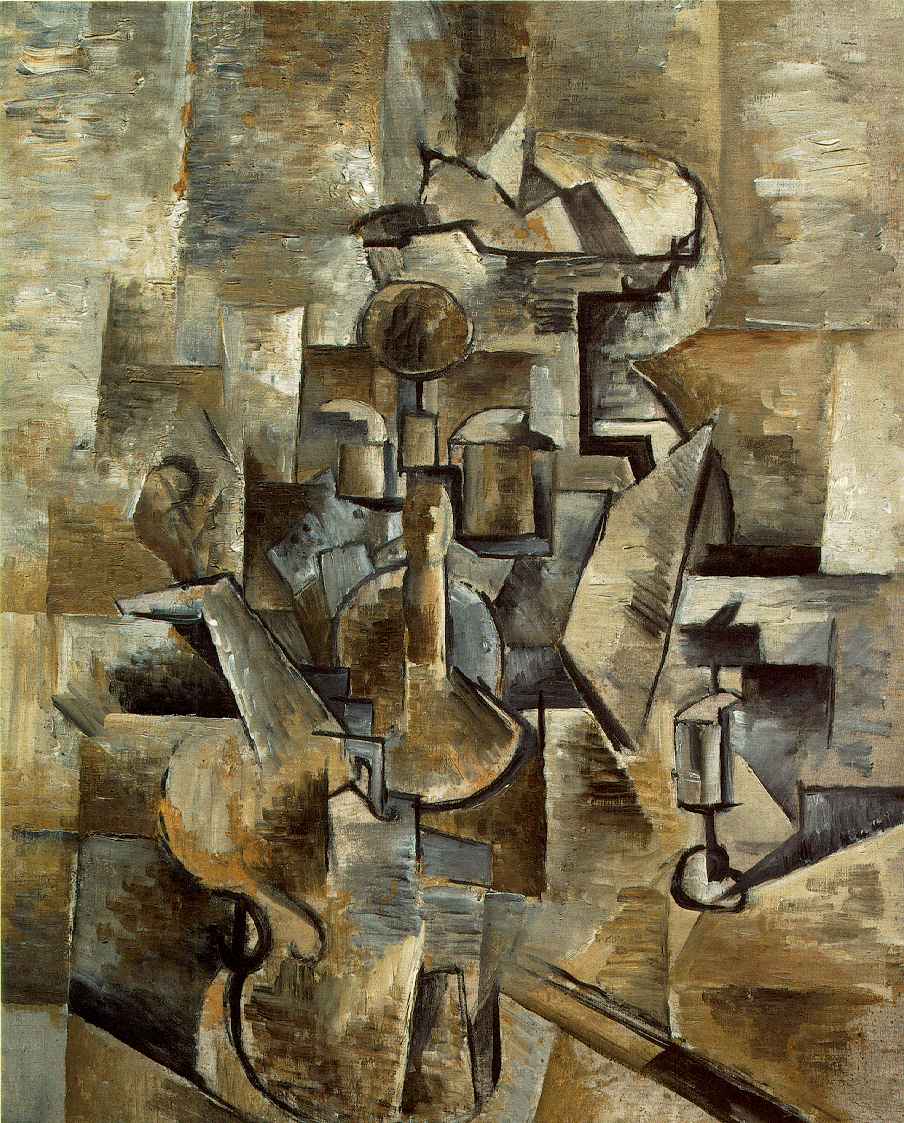
Georges Braque wasn’t just a painter, he was an innovator. He was known for taking risks and for helping to shake the art world with his development of Cubism, a style that broke down objects into multiple viewpoints to give the viewer a layered effect on the canvas, along with Picasso. With Violin and Candlestick, one can see exactly why Braque is the kind of central figure one might not find in modern art. This is not just about a violin and a candlestick. It’s reimagining what we see and how we see it.
The painting by Braque invites us to play with the shape and angles as if it were a secret. He deconstructs a violin and a candlestick using muted browns, greens, soft shadows, and fragmented planes, and layered forms. In the beginning, you don’t see them but when you observe them, you can identify them at first sight. This piece is mesmerizing in its hidden details drawing you in and showing you what everyday things can look like from a different angle.
Who Was Georges Braque?
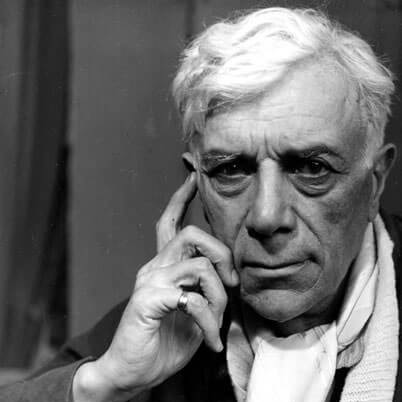
Georges Braque was born in 1882 in France in Argenteuil. He was always around color and design because his father was a house painter. When he grew up, his love for art developed and he chose to study painting. Braque experimented with different styles early in his career. His first foray was into bold colors and light via Impressionism and Fauvism.
When Braque encountered the work of Paul Cézanne, an artist famous for stripping natural forms of their angularity, something had changed. Braque was inspired to try a new way of painting, painting that would lead to Cubism with Picasso. With Cubism, an entirely new way of considering how we see objects and spaces was opened up.
FUN FACT: Besides being a trailblazer in the art world, he was also passionate about boxing! Braque found boxing to be a thrilling way to stay fit and focused.
His Career
Evolution is the right word for Braque’s career. Initially, his colors were bright but bold and inspired by Fauvism, and he later became fascinated with geometry and form. He worked closely with Picasso to develop Cubism, a style that breaks down objects into simple shapes and then reassembles the objects on the canvas from multiple perspectives.
From about 1908 to 1914, Braque and Picasso kept pushing one another toward great art. At this time, apart from Analytical Cubism, Braque’s paintings grew more abstract. Instead of coloring, he focused on the structure of what he was painting. Braque continued to develop as an artist after World War I. He resumed working in color and began to lose the fluidity while still being concerned with form.
What Is Happening in Violin and Candlestick?
| Artist | Georges Braque |
| Date Created | 1910 |
| Medium | Oil on canvas |
| Genre | Still Life |
| Period | Analytical Cubism |
| Dimensions | 24 x 19 3/4 in (61 x 50.2 cm) |
| Series / Versions | Part of a series of Cubist still-lifes |
| Where is it housed? | San Francisco Museum of Modern Art, USA |
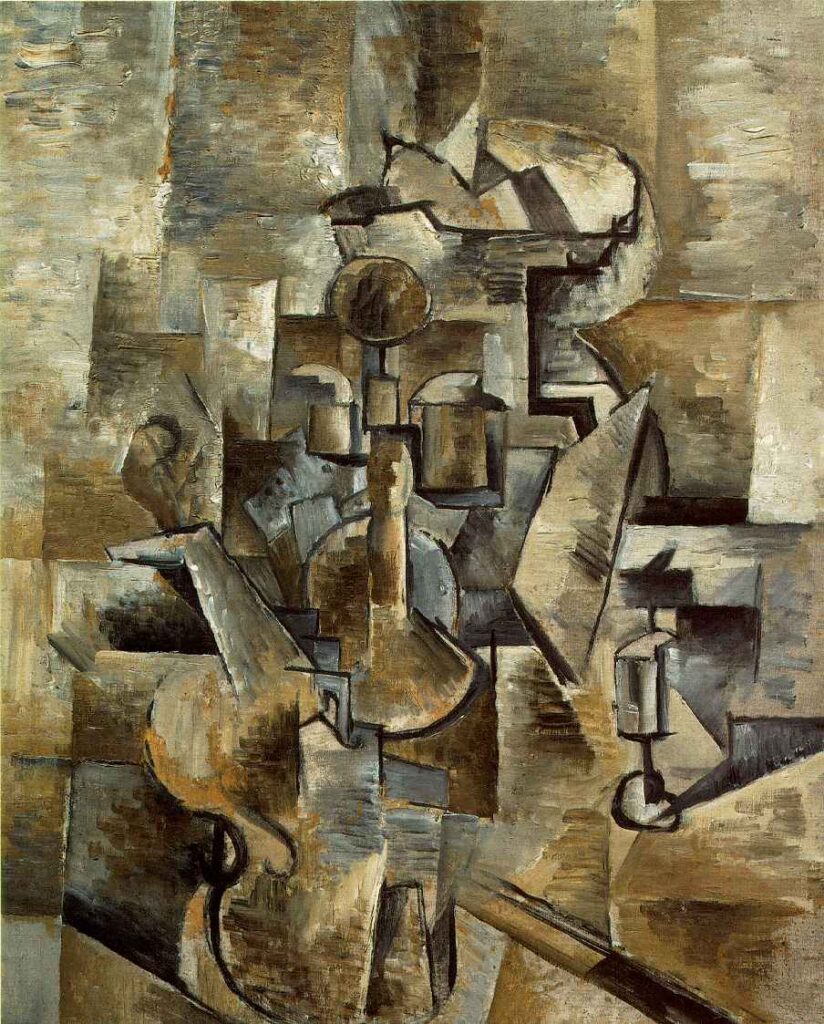
But what’s going on with Violin and Candlestick? Picture looking at a violin and a candlestick, but not as we normally do. Braque has dismantled these objects, reducing them to shards and splinters. He uses Cubist techniques to make us see these familiar objects at once from multiple perspectives.
Braque uses earthy tones and soft shadows in this painting. The colors: shades of brown, green, and a bit of an earthy gray, create a depth that feels almost three-dimensional. It’s a puzzle, when you look closer, you see more. Braque taunts you into seeing the ‘whole’ violin and candlestick in your head.
But this isn’t about a still life, it’s about perception. Braque urges us to think not only about what we see but how we see it. The seat of every plane, every angle, every detail of shadow; inviting you to look closer, to find what’s unexpected, and meaningful.
What’s So Special About Violin and Candlestick?
So how is it that Violin and Candlestick stand out? Firstly, it is a good way of looking at Analytical Cubist art. Braque and Picasso developed this style, which they wanted to ‘analyze,’ breaking things down into planes that overlap. What Braque does here is less about painting a violin and candlestick; he’s portraying their ‘essence’: by reducing them to geometric shapes and yet letting us know what they are.
Think about it: In traditional art, objects are painted to look as they appear in the real world. Braque was daring—he didn’t want to in essence copy reality. Rather than creating a new kind of reality on the canvas, multiple perspectives were to coexist. The result? A painting that works not simply because it’s hanging on the wall, but because it asks our attention, our reflexive stare.
Interesting Facts About Violin and Candlestick
Collaboration with Picasso: This piece is from a time when Braque and Picasso worked closely together, inspiring and challenging each other to push Cubism further. Picasso’s influence can be seen in the fragmented shapes and layered composition.
Musical Theme: Braque loved incorporating musical instruments into his Cubist works. For him, instruments like the violin weren’t just objects; they symbolized harmony, rhythm, and creativity.
Play of Light and Shadow: By carefully balancing light and shadow, Braque creates a sense of depth, giving the painting a sculptural feel. It’s almost as if the objects are floating in space, waiting for us to piece them back together.
Painted in Paris: Created in 1910, Violin and Candlestick was painted in Paris, the heart of the early 20th-century art world. The painting captures the energy of Parisian art culture and the city’s role as a birthplace of modern art.
Legacy of Cubism: Violin and Candlestick is a hallmark of Analytical Cubism, a style that continues to influence artists to this day. Braque’s approach to reimagining everyday objects has inspired generations of painters, sculptors, and even designers.
Artwork Spotlight: Antiboree

Antiboree by Georges Braque is available on Singulart. This artwork challenges us to think differently, to see differently. With every brushstroke, he invites us into his world—a world where form and space are playful, complex, and endlessly intriguing.
Are you looking for a piece of artwork from Georges Braque?
Singulart has limited edition prints of Georges Braque. If you are looking for a piece of Braque‘s artwork for sale, simply click on the artwork or the button below to discover more!
FAQs
1. How did Georges Braque contribute to Cubism?
Georges Braque was a leading figure in the groundbreaking Cubist art movement. Throughout his life, Braque’s art was primarily still lifes and ways to use color, line, and texture to see objects from different angles.
2. What was Georges Braque’s art style?
The Cubist style is the basis for George Braque’s well-known paintings. The reason it is termed Cubism is that the objects shown in the artworks appear to be constructed from cubes and other geometric shapes. Despite working on a variety of subjects, Braque is best known for his masterful still-life paintings.
Conclusion
Violin and Candlestick, by Georges Braque, is a masterpiece in its own right, that changes the way we see art and the world. Before we can learn about the painting we are drawn closer, we can step up and see the fractured tones and lines and the forms of a violin and a candlestick like never before. It is a piece that unites art and reason to create a new kind of beauty, which is not about realistic representation but perception and imagination.
Bonne journée!