Presenting her painting style Weronika Dyląg is showing her new series called “Journey” and the thoughts behind the concept. So without further word, let’s immerse ourselves in her beautiful, chaotic series and look at art with her perspective.
What is your newest series?
My newest series, which will be on display starting October 10th, 2024, is an exploration of form and color inspired by the works of Chuang Che. I have always been fascinated by mid-20th-century American art, and I hold great admiration for artists like Helen Frankenthaler and Lee Krasner. It was a privilege to see their works at the Met during my time in New York City. Both were prominent abstract expressionists, and their art set me on a path that eventually led to the works of Chuang Che.
His pieces were a revelation to me. They captivated my imagination and inspired me to push my practice further, exploring new color palettes and forms. The upcoming exhibition, titled “Balanced Chaos” will showcase this series. It will include large-scale works such as “Chaotic Harmony” and “Dissolution” as well as, for the first time, a selection of works on paper.
What was the inspiration or concept behind this new series?
As I mentioned, the inspiration behind this series comes from the works of Chuang Che. His use of color and his approach to working with it resonate deeply with me. However, I enjoy working with fluid acrylic paint and air techniques so much that I didn’t want to abandon that aspect of my process. I’ve been developing my own compositions using my unique technique, while drawing inspiration from his palette or loosely referencing his work. In a way, it’s a transcription of his art, filtered through my own perspective.
This series is less optimistic compared to my previous cycles. Its aim isn’t to uplift or inspire. Rather, it seeks to explore the subtle emotional tremors within us that are triggered by a combination of color and title. Some paintings will evoke a sense of wonder, others may provoke unease, and both reactions are completely valid. Working on this cycle was incredibly enjoyable, partly because it involved viewing an abundance of beautiful artworks, but there’s more to it than that. I know I’m not alone in feeling this, as many artists experience it too—those moments when the ego dissolves, and the artist becomes one with the artwork. The artwork becomes the artist, and you are merely a tool.
What’s the message behind your new series?
I focused on chaos. As a species, we have a tendency to search for or impose meaning, even where there may be none. We seek explanations and feel a certain discomfort when we can’t find them. We crave order. We need meaning. However, chaos in life is inevitable. We don’t have control over everything, and not everything fits neatly into predictable frameworks. Learning to live with chaos, to accept it, is essential.
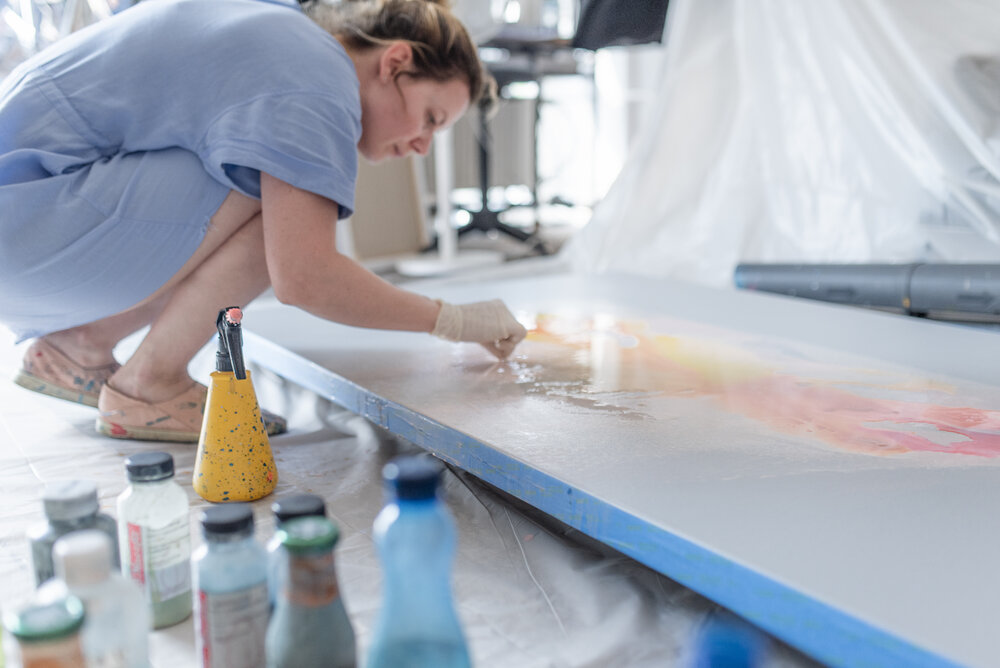
This is also reflected in my work with paint and canvas. Working with fluid, semi-fluid, or thinned paint, water, and powerful gusts of air carries an element of unpredictability. While I’ve learned to control these elements over time to achieve my desired effects, there’s still a delicate balance between acceptable chaos and unintended outcomes. Chaos seeps in like an uninvited guest, often creating results that are hard to foresee. I call this the art of acceptance.
This “balanced chaos” feels like a key to an interesting life. A little chaos adds a dynamic pace, a sense of spontaneity, and unpredictability that isn’t always negative. Chaos can take the form of a child entering a family, or adopting a pet—moments that shift our lives in unexpected ways. However, it’s crucial that the chaos we generate—due to our own cognitive limitations or inner inconsistencies—remains balanced. An excess of chaos in our personal lives can have destructive consequences. Chaos in public spaces can also bring negative outcomes. For example, armed conflict represents a form of chaos that leads only to devastation. In my view, this is the extreme end of the chaos spectrum.
In this series, I examine chaos from different angles. For instance, the work “Attractor” draws inspiration from systems theory, while “Entropy” references the scientific concept most commonly associated with disorder, randomness, or uncertainty. Other works, such as “Dissolution,” explore organic processes of decay, and “Storm” offers a visual representation of a meteorological phenomenon.
What’s your personal highlight of the series?
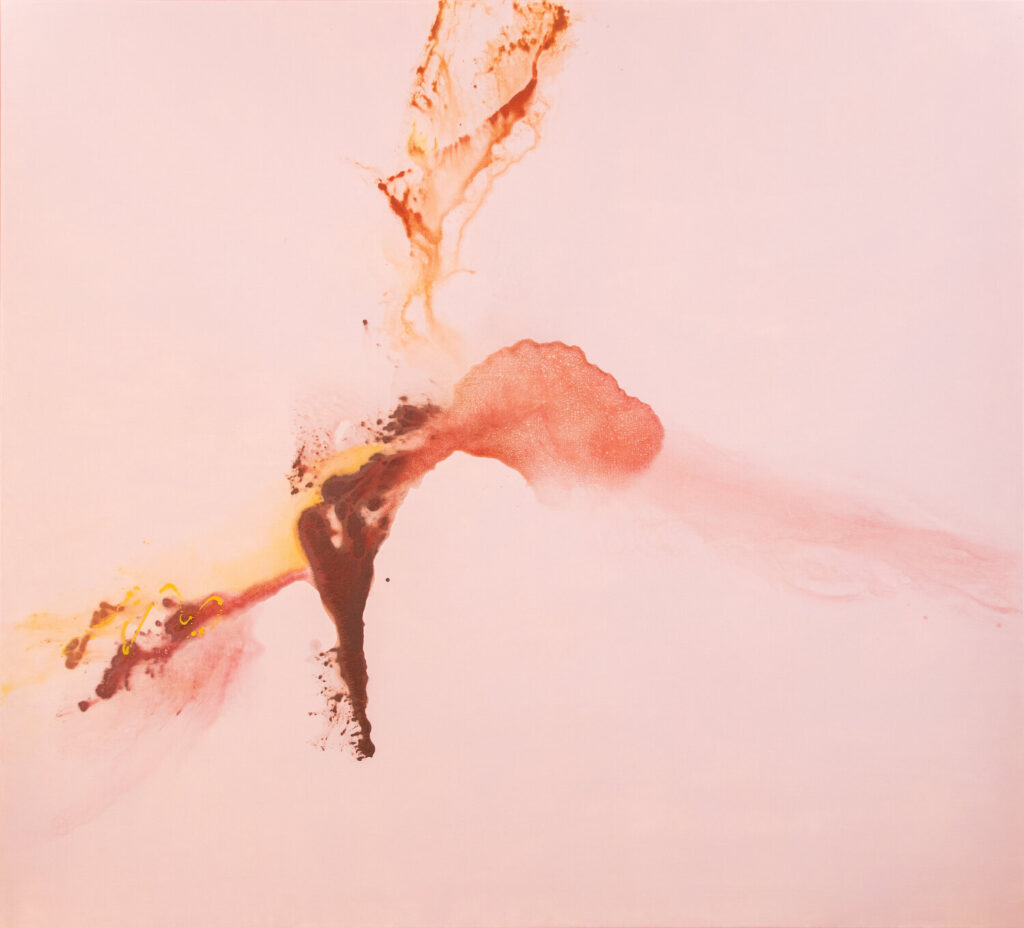
The personal highlight of the series is undoubtedly “Dissolution.” It’s a large painting set against a soft pink background, featuring a minimalist, abstract composition with a very delicate and ephemeral form. Its size allows the viewer to immerse themselves in it, to truly “be in it.” Another significant piece is the previously mentioned “Storm.” This work may not appeal to everyone. There’s an underlying sense of unease, even in the background itself, which lies on the edge of green and beige. However, it is a strong composition, and I would even say quite bold. At the same time, I think it’s relatively straightforward to interpret due to its literal nature.
If you encountered any challenges during the creation of this series, how did you manage tackle and overcome them?
The process of preparing for the exhibition was fairly continuous. However, there were moments when I felt like my mind was a bit fatigued, overworked, and lacking a fresh perspective. What helped me during those times was spending even just 30 minutes looking through albums of Chuang Che’s work. This simple act allowed me to reset, unblock, and give space for new ideas to emerge.
How would you recommend a visitor to experience your creation?
I definitely wouldn’t recommend viewing the works in a rush or quickly passing by. These pieces aren’t about depicting the beauty of a place or presenting a figure. Rather, they are meant to encourage self-reflection and provoke questions within oneself. So, if I were to suggest anything, it would be to experience the works in a calm and focused manner—focusing not only on the artwork itself but also on your own reactions, asking, “What is this art doing to me?” I would also recommend looking at each piece as a whole composition, but equally important is observing it up close. The effects created by the mixing of paint on the canvas and the frozen drips of paint can captivate viewers for hours, offering intriguing visual stimuli.
What kind of engagement or interaction do you hope to have with your audience?
I hope to create a space for the audience to engage with the artwork on a personal, introspective level. I’m not looking for a specific reaction or a particular interpretation, but rather for viewers to connect with the works in their own way. My goal is for people to take their time and allow the colors, forms, and compositions to evoke thoughts or emotions that might surprise them. I want the audience to feel free to ask questions—both about the art and within themselves—because it’s in that process of questioning that the real engagement happens. Ultimately, it’s less about interacting with me as the artist and more about fostering a dialogue between the viewer and the artwork. If someone leaves the exhibition thinking or feeling something they didn’t expect, then I consider that a meaningful interaction.
What’s next for you? Are you already working on a new series or project?
Although I haven’t closed the “Journey” series, which this exhibition focuses on, I am already working on a new cycle. This time, it’s in oils. I am exploring the theme of “Invisible Women” inspired by a book of the same title. The works will present patterns from fabrics, reflecting the reality that, in the past, and even today in less developed countries, unmarried or poor women often worked as weavers or seamstresses. The paintings will depict the shadows of women cast upon these fabric patterns—but not only that…
Singulart Insight
The Singulart Editors recognize Weronika Dyląg’s mastery in air-spread fluid paint art. Her new series, Journey, invites introspection into life’s chaotic beauty. She draws heavy inspiration from Chuang Che and mid-20th-century American abstraction. Using fluid acrylics and air techniques, she balances control and unpredictability. Her work emphasizes accepting chaos as an essential, dynamic force in life. Signature pieces like Dissolution and Storm prompt deep reflection and emotional engagement. Viewers experience intricate paint effects that evoke unexpected feelings. Dyląg encourages mindful, immersive viewing to inspire introspection and dialogue. We eagerly await her next project, Invisible Women, which explores untold stories.