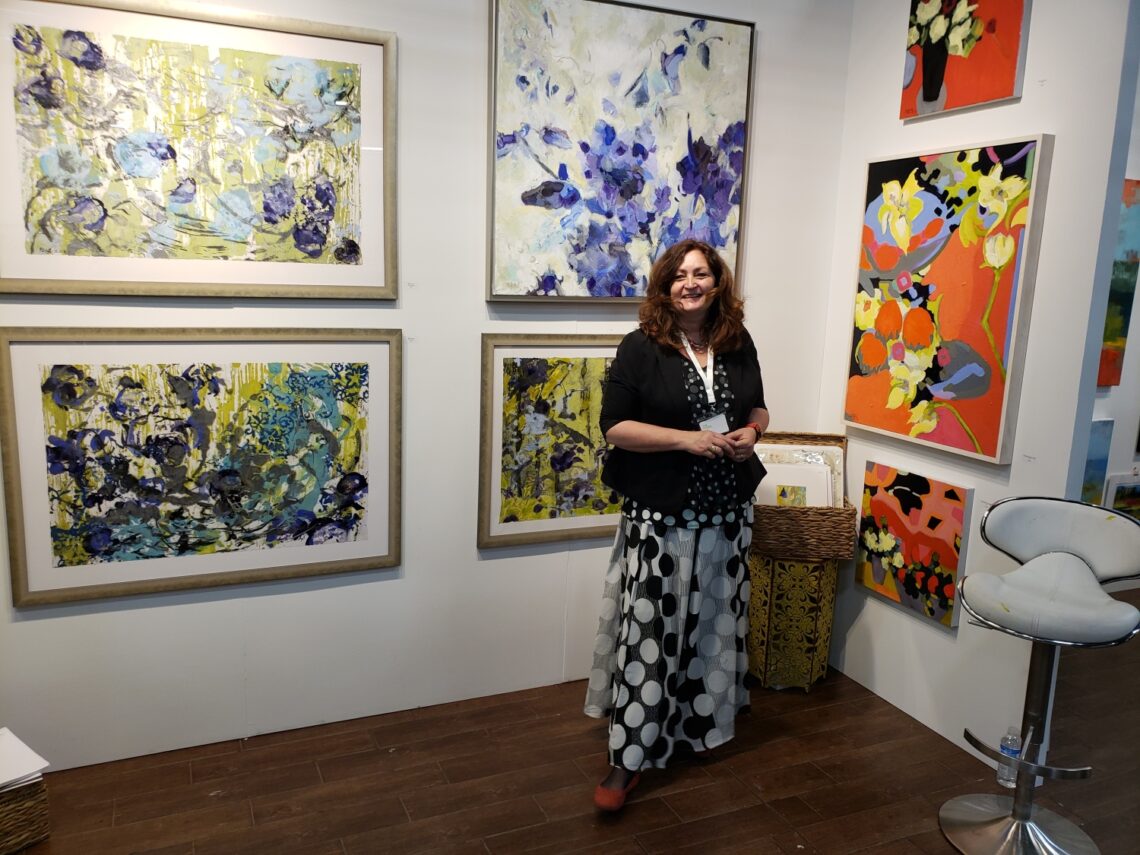
Birgit Huttemann-Holz, an award-winning, US-based contemporary romanticist/artist gives Singulart the inside track on her niche new project, and explains why you might need a set of wheels to appreciate her energetic works around nature and abstractions.
What is your newest series?
Seeds, Grasses, and Flowers encaustic monotypes on Japanese paper
What was or is the inspiration or concept behind this new series?
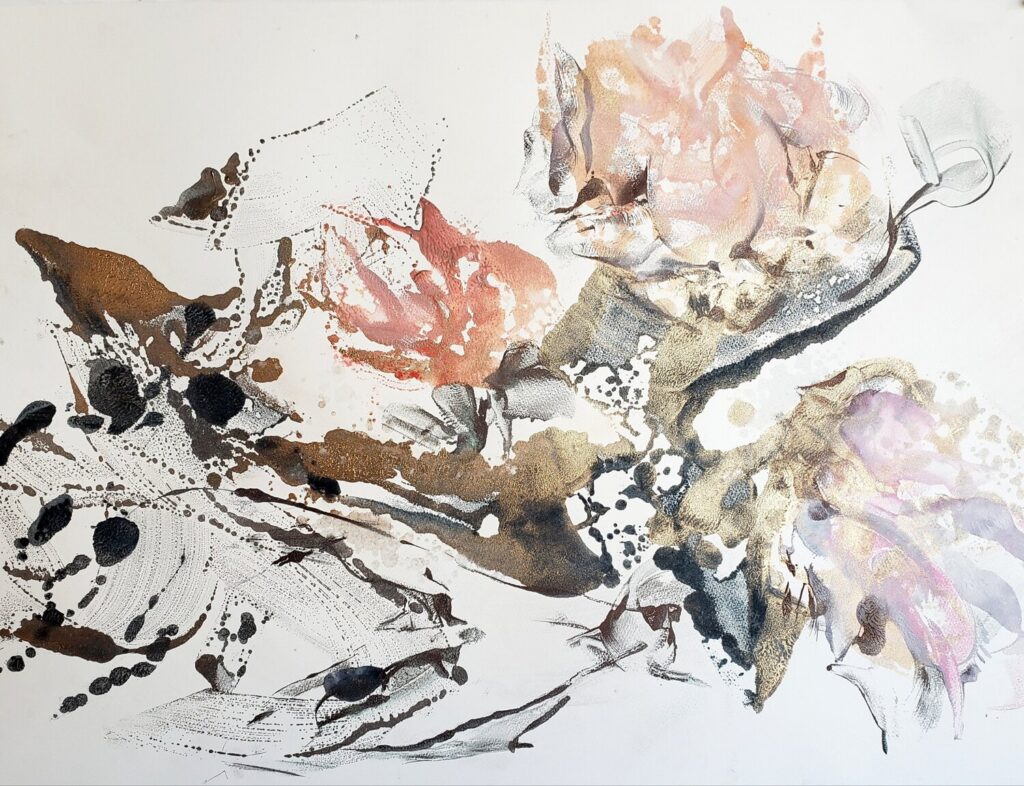
In my newest series “Seeds, Grasses and Flowers” I am honoring the seemingly unspectacular: seeds, reeds, grasses, flowers, aka the microcosm of landscapes. The encaustic monotype process (printing with beeswax and pigments) lends its unique beauty and appearance to heighten the experience of reading an abstraction as part of the whole. Therefore, creating landscapes within landscapes.
I was invited to NG Art Creative Residency in Maussanne des Alpilles, Provence, France in September 2023. There, I was surrounded by wonderful gardens and the gorgeous landscape of the Alpilles. The beautiful month of September highlights the peak of a season and the following decay and withering of grasses, flowers which in the process will release their seeds for the next generation to come.
What’s the message behind your new series?
I am touched by glorious landscapes, the close-ups, and the long views. It is here, when I stumble upon an exterior landscape that mirrors my interior wilderness that my creative process starts. Painting for me is a colorful musing of an interior world projected outwards. The landscapes and florals bleed hues of pink, magenta, purple, orange, and gold, alluring and alarming. I coax the image to the surface with color as my leading subconscious gateway. At heart being a contemporary romanticist, I depict the grandeur of nature and the place of humanity within it. My emotional truth, my paintings touch on the Human Condition, life, and its fragility.
What’s your personal highlight of the series?
The encaustic monotype process is a very humbling experience.
I am painting on a hot aluminum plate with liquid beeswax and pigments. The image is transferred to handmade Japanese paper by placing the paper face down on the plate and hand-rubbing it with a Japanese burin. The loose fiber absorbs the wax and the image bleeds partially through the backside. After the paper is pulled from the plate, I wipe the plate clean, paint the next image, and print again. One monotype is made of multiple, sometimes up to 100, unique printing processes printed on both sides of the paper. Every time I lay the paper down the design re-melts. It creates a lot of artifacts, loss, and new unexpected marks. To be able to adapt each time and coax an image and design out of this chaos is my greatest joy and accomplishment.
The paper gets translucent and saturated with pigmented wax. The colors are uniquely brilliant and luminous and metal pigments sit as an embellishment on top of the paper.
It is a pas de deux, a dance of vulnerability and beauty.
Since the works on paper are more affordable, I am also particularly fond of presenting my work to young collectors. I enjoy their insights and enthusiasm and I hope that my work brings them the same joy that I had creating it.
Moreover, is there a particular piece in the series that you’re most fond of? Why?
It changes, daily, monthly, or when I create a new piece.
As to why, they all have their own intensity and charm. I do love to print with metallic pigments. The reflection of the gold or silver pigment gives the monotype often a new look. Suddenly, depending on the light, you see another abstract mark or image, that enables and surprises you to read the monotype in a different way.
If you encountered any challenges during the creation of this series, how did you manage to tackle and overcome them?
In general with patience and tenacity.
In Provence, I did not have my usual equipment. I improvised with a plate heater and an aluminum plate to create my heated surface. The temperature was often not hot enough on the outer periphery. Therefore, I had to wait longer, push the aluminum plate to a different spot on the heater, etc.. My materials were sent back to the USA by accident, so I had to purchase new ones. I worked with pigments that performed quite differently than my pigments of choice. But in the end my passion and joy and my training to adapt, adjust, and improvise all paid off in creating a beautiful, ethereal series.
How would you recommend a visitor to experience your creation?
Bring your glasses or a magnifier!
Ok, I am kidding!- but there is partial truth to it. The uniqueness of the encaustic monotype will let you marvel at the marks, the soft hues and bleeding of colors, and the raised silver or gold pigments on the graphite bed. When you step back, you will see an entirely different image of a flower, grass, or seeds. You see landscapes within landscapes.
What kind of engagement or interaction do you hope to have with your audience?
A sense of wonder, marvel, to appreciate the beauty of our world.
What’s next for you? Are you already working on a new series or project?
I am always working and developing something new. I cannot repeat what I am doing. Neither in painting in acrylics and oil pastels nor in encaustic monotype. I switch between the 2 mediums, frequently. Right now I am back into painting large formats of landscapes again, short and long views. My evolving and developing becomes itself by doing my art. The revelation of what exactly I am doing will come along the way. I do not think too much about it, it is more like a discovery of a treasure that I had all along.
Singulart Insight
The Singulart Editors are very delighted to see the newest series by Birgit Huttemann-Holz – Seeds, Grasses, and Flowers on Japanese paper. Inspired by Provence’s September landscapes, she honors nature’s microcosms. Using beeswax and pigments, she creates layered and unpredictable images, blending spontaneity with meticulous craftsmanship. Each piece undergoes numerous printing processes, resulting in vibrant, translucent colors with shimmering metallic effects. She loves the element of surprise, as light reveals hidden details. She hopes her work inspires awe and a deeper appreciation of nature’s beauty, and she continues to explore new artistic directions.