There is a painting by Aki Kuroda called L’Autre Côté, that immediately draws your attention. It’s bright, colorful, and energetic. However, it’s not just what you see on the surface. Kuroda has taken us on a trip where cultures melt, and boundaries vanish. It’s a piece that makes you dig more, look further, see past the colors and forms, and find the layers of meaning underneath.
Let’s dive into Kuroda’s world and explore what makes L’Autre Côté so special.
Who was Aki Kuroda?
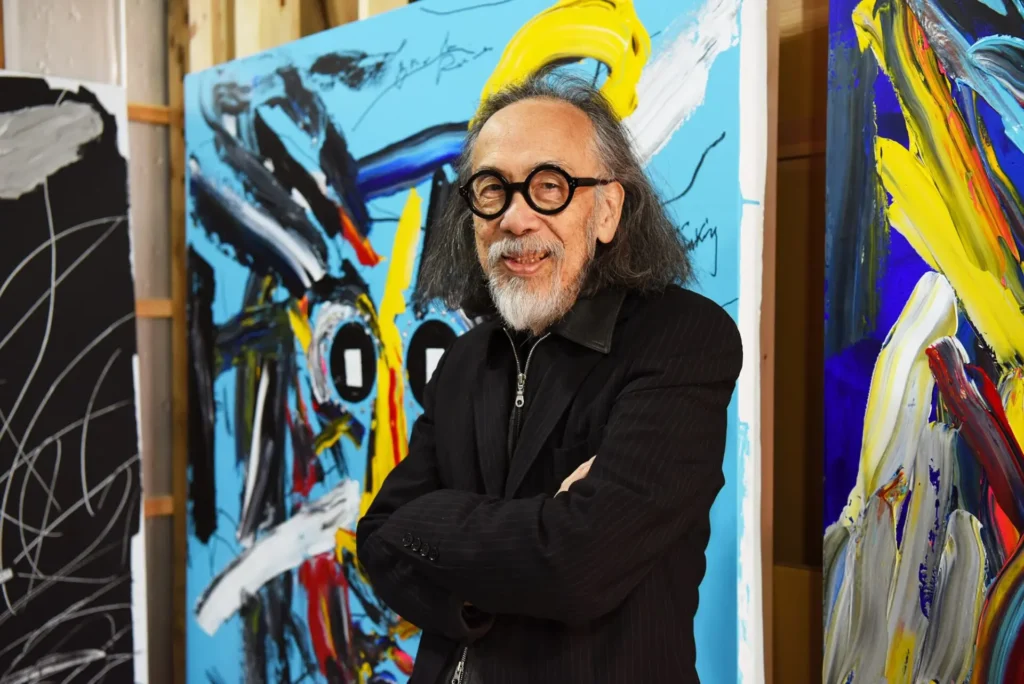
Aki Kuroda is a Japanese artist who fuses Eastern and Western influences within his art. Kuroda was born in Japan, and around 1980 he moved to Paris where his art started to mix traditional Japanese elements with a more contemporary European style. His colors are vibrant, his shapes are abstractions, and the meanings are deep. Kuroda’s art isn’t just pretty perched on your wall, there’s a story behind it and a purpose, and it’s meant to make you think about life, culture, and the in-between.
He’s a unique artist who captures the beauty of blending different worlds, and that’s exactly what L’Autre Côté does.
FUN FACT: Aki Kuroda refers to his studio as his atelier, keeping it true to his French roots. It’s not just a workspace—it’s a creative hub.
His Career
It really was in Paris where his creative explosion really began, and where he found an artistic freedom that greatly influenced his work. First, he just started doing things that were no less abstract, and there was a lot of writing, books, large paintings, and also large installations. His art was a cross between his Japanese upbringing and his love of French culture.
Kuroda has worked in painting, sculpture, and large-scale installations, throughout his career. However, his ability to change and experiment with different styles made his work remain fresh and relevant. What is notable about his approach is his collaborations with architects and designers that have led his artistic vision onto the public stages and thus out into the larger, more public spaces, bringing art to broader audiences.
What is Happening in L’Autre Côté?

| Artist | Aki Kuroda |
| Date Created | 2000 |
| Medium | Acrylic on canvas |
| Genre | Abstract, Surrealism |
| Period | Contemporary |
| Dimensions | 140 x 200 cm |
| Series / Versions | One-off piece |
| Where is it housed? | Private Collection |
L’Autre Côté translates to “The Other Side” and can indicate what the painting represents. It’s all about breaking down and proving to people that you can go into a new world, cross a boundary, step into a new world, and see the world from a new perspective. When one looks at the painting they’re being summoned into a dreamlike and mysterious space. You step into it; the swirls of color, the bold shapes, the abstract forms all make it feel as if you’re not looking at a painting, but stepping into it.
The use of colors like deep reds, yellows, and blues keeps an energy of movement in play. It looks like the forms being pulled on the canvas into their little world. The painting itself looks alive, continually cycling as it changes with what you look at it.
What’s So Special About L’Autre Côté?
L’Autre Côté is unique in the way that it combines so many ideas into one piece. It looks like a beautiful, colorful painting on the surface. It’s when you start to dig deeper that you realize there’s more going on. It’s not about the color being used solely to be visually striking, it’s a story of crossing over into new lands, into the unknown, into what lies past the normal everyday world.
The piece is alive, almost as if you’re a part of the journey due to the swirling patterns and bold brush strokes. It’s a painting that depends on you to move past the boundaries you’ve crossed in your own life. L’Autre Côté is all about embracing the unknown and exploring new possibilities, whether in your culture, your relationships, or even your thoughts.
Interesting Facts About L’Autre Côté
Mixing Cultures: L’Autre Côté by Kuroda merges East with West creating a one of a kind piece of art.
A Personal Touch: This painting was made by Kuroda in Paris when he was drawn to the cultural change and when the issue of self became more clear to him.
Layers of Meaning: What you see on the surface isn’t all there is to the painting. The shapes and textures imply there’s always something more to explore.
How Does L’Autre Côté Make Us Feel?
L’Autre Côté has energy and excitement. The bold colors, and swirling shapes, all seem to be pulling you in like they’re saying grab your seat, you’re staying for the ride. It’s not another painting you see, it’s a painting that angers your senses. You might even feel like you’re leaving this world behind and entering a new one — where anything is possible.
It’s also somehow mysterious. The closer you look, the more you feel you see something in the layers of color and texture. It’s a piece that is always finding new things, always becoming a source of discovery.
Artwork Spotlight: Festival d’Avignon 2000

Festival d’Avignon 2000 by Aki Kuroda is available on Singulart. This artwork is a good example of how he mixes abstract forms with elements of performance and culture.
Are you looking for a piece of artwork from Aki Kuroda?
Singulart has limited edition prints of Aki Kuroda. If you are looking for a piece of Kuroda’s artwork for sale, simply click on the artwork or the button below to discover more!
FAQs
1. What inspires Aki Kuroda’s art?
Aki Kuroda is inspired by a tangle of Eastern tradition and Western modernism. His work seamlessly blends his Japanese upbringing and his experiences in Paris.
2. What makes Aki Kuroda’s work unique?
What’s special about Kuroda’s art is he can use vibrant colors, abstract forms, and deep ideas. His art is both modern and traditional, Japanese influenced with a modern twist.
Conclusion
L’Autre Côté an Aki Kuroda masterpiece, continues to draw art lovers and collectors alike. What makes this piece so important is how well Kuroda blends his cultural roots with his journey.
If you ever have the chance to see L’Autre Côté in person, take a moment to step into the painting’s world. Who knows what you might discover on the “other side”?