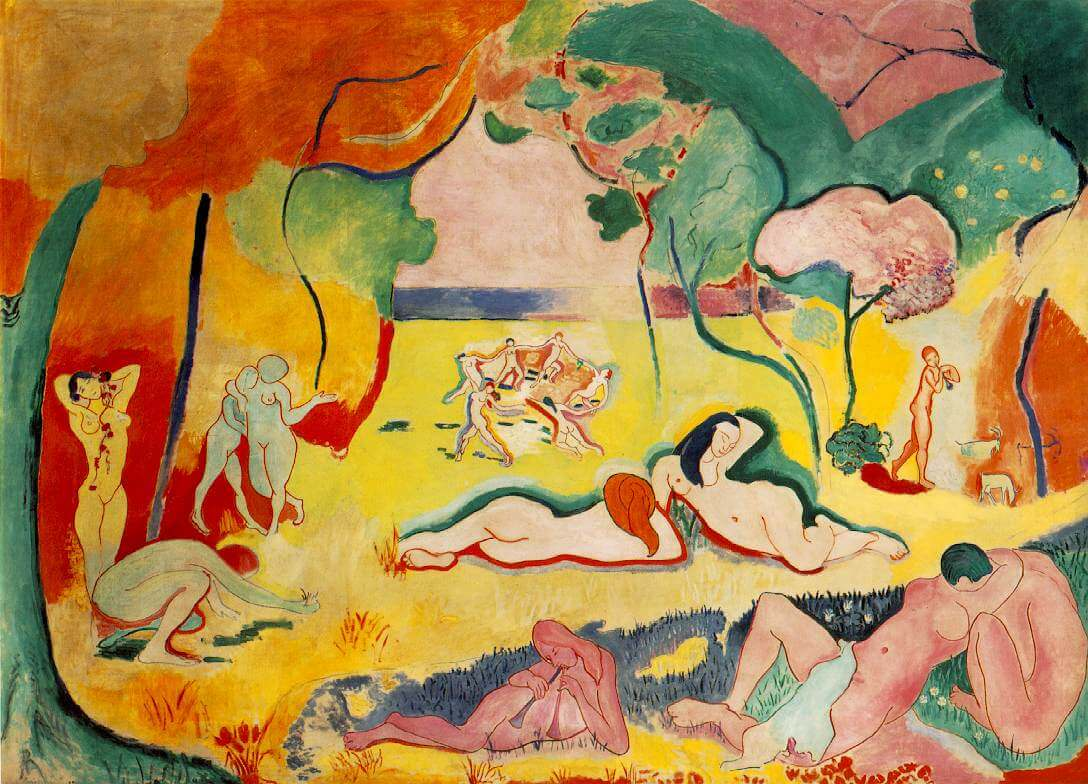
| Artist Full Name | Henri Matisse |
| Artwork name | Joy of Life (La Joie de Vivre) |
| Date of creation | 1905-1906 |
An overview of “Joy of Life (La Joie de Vivre)”, Picasso, (1905-1906)
A seminal masterpiece from Matisse’s Fauvist period, the ‘Joy of Life’ stands out as a bold celebration of life, color, and sensuality.
Created during the prime of Fauvism, a movement characterized by expressive and non-naturalistic use of color, this piece is among Matisse’s most famous.
Purpose of this analysis:To delve deeper into the formal elements, composition, and historical significance of this revolutionary artwork.
Description of “Joy of Life (La Joie de Vivre)”
Visual elements
The painting features a serene landscape populated with numerous figures in various states of repose and activity.
Notable features
The canvas is dominated by a dancing circle of nude figures in the foreground and a seascape in the background.
Mood atmosphere
Euphoric, spirited, and jubilant, evoking a harmonious connection with nature.
Formal Elements
- Line: Fluid, sweeping lines define the figures and the landscape.
- Shape: Both organic shapes (of human bodies and nature) and geometrical forms (in the backdrop).
- Color: Vivid, non-representational hues dominate with blues, reds, and greens taking prominence.
- Texture: Smooth, with minimal texture, emphasizing color over detail.
- Space: Foreground figures dominate the space, with expansive natural surroundings giving depth.
- Harmony: Harmonious with a balance between stillness (resting figures) and movement (dancing figures).
Composition
- Arrangement: Figures are scattered throughout, with a focal circle of dancing figures at the center.
- Focal points: The dancing figures and the central reclining female.
- Symmetry and asymmetry: Generally asymmetric, with various elements adding balance.
- Gaze Guidance: The viewer’s gaze is guided through the painting by the flow of figures and landscape elements.
Color and Light
- Color scheme: Bright and varied, primarily primary colors with non-naturalistic application.
- Color emotion symbolism: The vivid colors symbolize raw emotions, joy, and an unbridled celebration of life.
- Light description: Even, diffused light across the canvas.
- Light effect on the dood: The soft lighting adds to the dreamy, euphoric mood of the painting.
Brushwork and Style
- Technique: Broad, flat brush strokes with minimal detail.
- Brushwork description: Expressive, quick, and unrestrained.
- Realism / Abstractism: Veering towards abstraction, but with recognizable elements.
- Style interpretation: A quintessential example of Fauvist style – wild, vibrant, and free.
Subject Matter and Symbolism
- Subject matter: The joy of life, nature, and the human form.
- Symbolism narrative: Celebration of life, human connection with nature, and the hedonistic pleasures of existence.
- Cultural and historical context: Reflects early 20th-century modernism and a break from traditional representational art.
Emotion and Impact
- Viewer emotions: Elation, curiosity, and a sense of liberation.
- Formal elements impact: The painting’s audacious use of color and form exudes a vibrancy that deeply impacts the viewer.
Art Historical Context
- Historial Context Period: Fauvist movement in the early 20th century.
- Artist Career Trajectory: Marks a pivotal moment in Matisse’s career, solidifying his reputation as a leader of avant-garde art.
- Influences on and from movements: Influenced by Post-Impressionism and Neo-Impressionism, while profoundly influencing later movements like Abstract Expressionism.
A complete analyse of Joy of Life (La Joie de Vivre) by Henri Matisse : Conclusion
‘Joy of Life’ is a testament to Matisse’s genius and the revolutionary spirit of Fauvism, marrying form, color, and emotion in a jubilant celebration of existence.
The painting remains a touchstone in art history, representing a freeing moment from convention.
It continues to inspire with its celebration of life, emphasizing raw emotion over realism, resonating with today’s viewers seeking authenticity and joy.
Sources:
- Elderfield, John. Henri Matisse: A Retrospective. New York: Museum of Modern Art, 1992.