Jackson Pollock’s art was associated with the Abstract Art movement and was highly regarded throughout the art world. Jackson Pollock’s paintings, known as drip paintings, were noted for taking non-representational art to the next level, ushering in a new era for Abstract art. Original Pollock paintings are sold at auction for millions of dollars, with the most expensive Pollock painting, Number 5 (1948), being auctioned for a whopping $140 million in 2006 by David Geffen. Below, you can find out more about the most renowned Jackson Pollock paintings.
The Most Renowned Jackson Pollock Paintings
Jackson Pollock has often been cited as among the most notable American artists of the Post-War era. He is also regarded as a pioneer in Abstract art, specifically Abstract Expressionism, largely due to his distinct drip paintings. For Pollock, the techniques he employed in creating art only served to make a statement, and the method used to apply the paint was not as important as what was ultimately being said. Before we find out more about Jackson Pollock’s paintings, let’s first introduce the artist himself.
FUN FACT: Jackson Pollock sometimes incorporated everyday materials into his paintings, such as sand, broken glass, and even nails.
A Brief Introduction to Jackson Pollock
| Artist’s Full Name | Paul Jackson Pollock |
| Nationality | American |
| Date of Birth | 28 January 1912 |
| Date of Death | 11 August 1956 |
| Place of Birth | Cody, Wyoming, United States |
Born in Cody, Wyoming, on the 28th of January, 1912, the artist was known to his family and friends as Paul Jackson Pollock. During the latter half of the 1920s, Pollock studied at the Manual Arts High School, and it was there that he met Philip Guston, a friend who would also eventually become a pivotal figure in the Abstract art movement. The artist then relocated to New York in the autumn of 1930, where he enrolled in the Art Students League and was mentored by Thomas Hart Benton, a highly renowned Regionalist artist.
The murals that Pollock produced around 1937 were highly influenced by Benton’s style, in addition to the style of José Clemente Orozco, a renowned muralist from Mexico. He then went on to create works in a more Surrealist style, many of which reflected the influence of Joan Miró. Peggy Guggenheim was one of the first prominent individuals in the art world to take notice of Jackson Pollock’s art, hosting his debut solo exhibition in 1943. The original Pollock paintings produced in the latter half of the 1940s would come to define his style and legacy.
Renowned Examples of Jackson Pollock’s Art
Pollock began to experiment with Abstract art after attending one of Pablo Picasso’s exhibitions in 1939. He subsequently developed his unique method of creating drip paintings in 1947, splashing paint onto huge canvases that had been laid out on the floor. This novel method required velocity and energy to produce, and the inherent properties of the medium, along with the colors and lines produced, were appreciated without having to represent any specific form. This technique is said to have helped reinvent art, helping to push it into previously unexplored artistic territories. Let us dive deeper into Jackson Pollock’s art below.
The She-Wolf (1943)
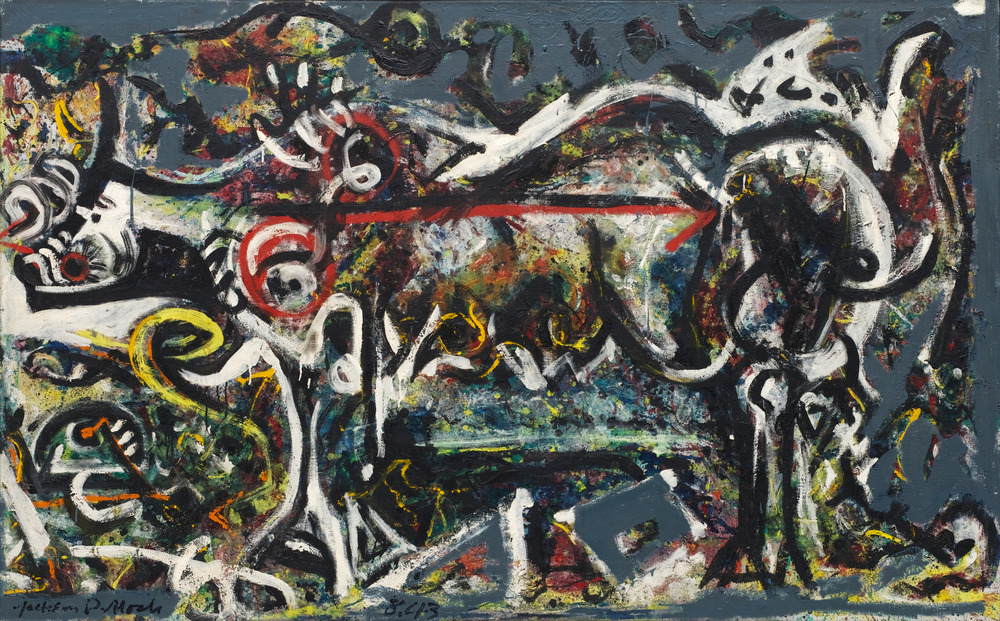
| Date Completed | 1943 |
| Medium | Oil on canvas |
| Dimensions (cm) | 106 x 170 |
| Location | Museum of Modern Art, New York City, United States |
As with many other artists in the 1940s, Jackson Pollock explored mythological subjects in his art. While Pollock refused to make any statements as to what the work was about, many believe that it alludes to the mythological animal that suckled Remus and Romulus, the twins who founded Rome. Pollock stated that the animal existed because he created it, and any attempt to explain it would destroy it. It was among the Jackson Pollock paintings that were first exhibited in how debut show in 1943. The very next year, the painting was acquired by the Museum of Modern Art, making it the first of the artist’s paintings to become part of a museum’s collection.
While he may be most well-known for his drip paintings, this particular piece was produced when he was still experimenting with Surrealism. While his later works of Abstract art were non-representational, these earlier works were regarded as a mixture of unconscious iconography and mythology. Jackson Pollock’s art was also influenced by Jungian analysis. Rendered in thick white and black lines, the body of the she-wolf faces to the left of the canvas. Abstract patches, lines, and shapes that look like letters are spread throughout the surface of the painting. The mythological iconography mixed with the somber color palette conjures the atmosphere of the era marred by war. The work was said to portray something that is both unknowable and meaningful.
Mural (1943)
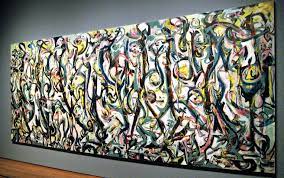
| Date Completed | 1943 |
| Medium | Oil on linen |
| Dimensions (cm) | 243 x 604 |
| Location | Stanley Museum of Art, Iowa, United States |
This artwork was produced three years before Pollock started experimenting with his drip paintings. It was produced for Peggy Guggenheim and was the first of his works to be commissioned. It was originally meant to be hung in Guggenheim’s townhouse, but subsequently became a renowned artwork that signified a shift from representational to action painting. For around a month, the artist just stared at the blank canvas in front of him, until he finally produced the entire work in a single day. However, many believe that the story of him creating the work in one day was purely a fabrication made up by his own wife and Guggenheim. The swirls and colors of the work are meant to represent every animal of the American West in a massive stampede.
When Guggenheim left New York to relocate to Venice, she gave the artwork to the University of Iowa. Her original plan was to give it to Yake University, but apparently, the students did not want it. The artwork ended up in Iowa City, displayed in the art studio, and then subsequently in the library until it was eventually displayed in the art museum of the university. While the actual value of the work is unknown, it has been estimated to be worth more than 100 million dollars today. Many regard this to be the artist’s breakthrough work. After the Iowa River flooded in 2008, entering the museum itself, the work was moved to Davenport. It was then moved to the Getty Museum in 2012, where it underwent a two-year restoration process. Since then, it has been exhibited across the United States and Europe.
Full Fathom Five (1947)
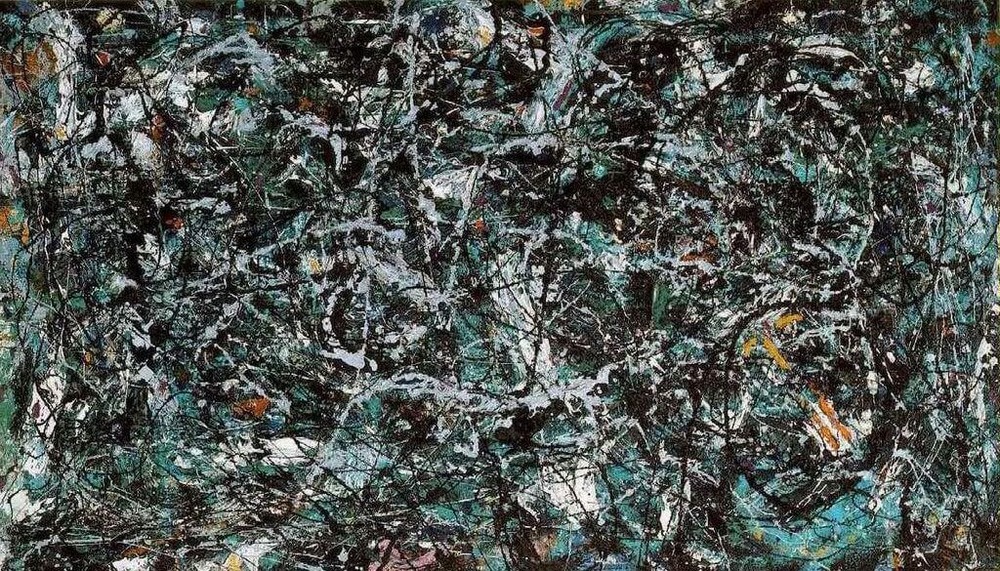
| Date Completed | 1947 |
| Medium | Oil on canvas with buttons, keys, coins, nails, tacks, matches, and cigarettes |
| Dimensions (cm) | 129 x 76 |
| Location | Museum of Modern Art, New York City, United States |
As the earliest and most renowned of his drip paintings, this masterpiece marked Pollock’s artistic emergence. Splattering paint onto canvas, he incorporated unconventional elements like money and cigarette butts, distinguishing his style. This unique approach, separating color from line, revolutionized traditional painting, influencing generations of artists.
While infused with surrealism, the artwork conveys a frenzied performance through color. Renowned for its intense hues, it evokes both grief and tranquility, reminiscent of The Tempest. Pollock’s skillful use of color deflects attention from the catastrophic shipwreck described in Shakespeare’s play.
Number 17A (1948)

| Date Completed | 1948 |
| Medium | Oil on canvas |
| Dimensions (cm) | 112 x 86 |
| Location | Private collection |
An oil painting on fiberboard canvas that brilliantly exemplifies the artist’s revolutionary drip painting method. Pollock’s use of a variety of colors allows observers to track every motion and the perfect control he possesses. Pollock’s drip paintings were at first treated with much scrutiny by the public, were mainly disliked, and were not regarded as very valuable by the art market at the time. Those within the world of art initially had highly conflicting reactions to his works, with many polarising opinions. In 1948, Pollock debuted a handful of his first drip paintings in New York City at the Betty Parsons Gallery. In 1949, he was featured in Life Magazine. In 2016, it was bought for around $200 million, making it the most expensive Pollock painting sold at the time, as well as the fourth most expensive painting to be sold. It had been on display at the Art Institute of Chicago before being sold. It was bought by Kenneth C. Griffin, a renowned art collector who is believed to own several of the most expensive paintings ever sold.
Autumn Rhythm (Number 30) (1950)

| Date Completed | 1950 |
| Medium | Enamel paint on canvas |
| Dimensions (cm) | 266 x 525 |
| Location | The Metropolitan Museum of Art, New York City, United States |
In October 1950, Pollock showcased his pinnacle with a new drip painting technique. Using thinned-out paint, he splattered, dripped, and poured it onto an unprimed canvas laid flat on the ground, abandoning the traditional easel. Employing unconventional tools like trowels and sticks, he crafted rich, rhythmic compositions devoid of focal points.
Spanning 525 cm, the artwork immerses both artist and viewer in its environment. Pollock’s tactile style, marked by intricate visual rhythms and graceful color lines, reflects his spontaneity. Despite appearing unplanned, each splash or stroke was meticulously placed, conveying significant content, as Pollock believed art should.
Number 1 (Lavender Mist) (1950)
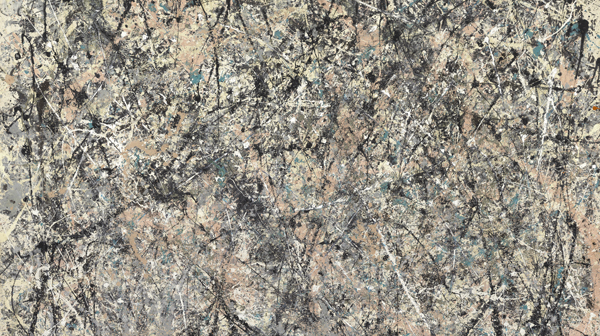
| Date Completed | 1950 |
| Medium | Oil on canvas |
| Dimensions (cm) | 221 x 299 |
| Location | National Gallery of Art – East Building, Washington, United States |
Seeking refuge from New York City’s chaos due to alcoholism, Pollock moved to eastern Long Island. There, in a tiny barn adjacent to his home, he established a studio and laid out canvases on the floor. Layering black, green, white, and hints of brown, he created a three-dimensional, earthy masterpiece. Visible shoeprints and handprints showcased his physical involvement.
Using patterns from paint marbling and separation, Pollock generated infinite tones. The canvas teemed with spattered lines and scribbles, embodying his pure paint-handling virtuosity. Delicately blending colors like salmon and aluminum, he achieved nuanced tones without lavender. His preference for thin enamel paints facilitated the creation of intricate visual networks. Handprints on the canvas underscored Pollock’s emotional and active engagement, emphasizing its flatness and non-illusionistic nature.
One: Number 31 (1950)
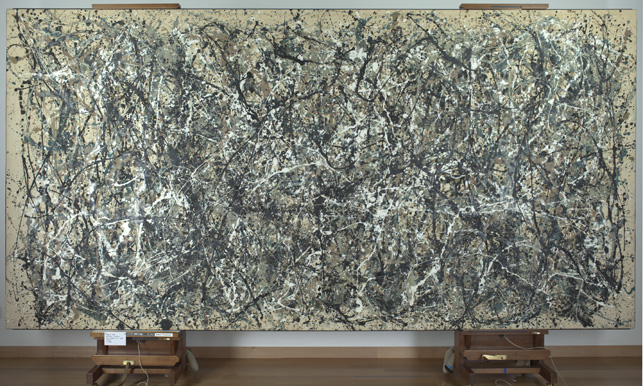
| Date Completed | 1950 |
| Medium | Oil and enamel paint on canvas |
| Dimensions (cm) | 269 x 530 |
| Location | The Museum of Modern Art, New York City, United States |
Like many of Jackson Pollock’s paintings, he titled this one using numbers rather than words since numbers are neutral and objective. The contrast of muted colors and paint splattering is an essential example of Abstract Expressionism. The various combinations of straight lines and curves interact in such a manner that a light and color scheme so complicated that it was unable to be explained in Euclidean geometry was produced. The artist’s unrivaled talent was accentuated by the piece’s interwoven bands of color, which added an atmosphere of force and depth to the canvas as a whole yet retained a feeling of elegance and attention to detail. Pollock’s approach captured the unpredictable gravitational impact caused by paint being thrown onto a canvas, demonstrating his disdain for the Surrealist idea of chance transcending human consciousness in making art.
He believed that there were no accidents in any of his drip paintings, just as there is likewise no beginning and no end. In 2013, the artwork was removed from its location at the Museum of Modern Art and set horizontally on the ground so that preservationists could examine it and arrange for its restoration. It had been wiped with sponges and cleaned with a chemically modified water solution to get rid of a yellow filth coating and other residual debris, as it had only been dusted since entering the museum’s collection in the late 1960s. Conservators noticed that an area of cracking, caused by natural deterioration of the original paint, was painted over with what was later determined to be “overpaint”. In order to allow for little interference with the aesthetics of the original artwork, the conservators ultimately opted to get rid of the white overpaint on the cracks and just replace them with watercolor paint.
Blue Poles (Number 11) (1952)

| Date Completed | 1952 |
| Medium | Oil on canvas |
| Dimensions (cm) | 210 x 486 |
| Location | National Gallery of Australia, Parkes, Australia |
This artwork varied from his other drip paintings in that it featured vertical blue lines that were the main focus of the painting. The artist used sand and glass for this piece to distinguish each of his works from one another. The National Gallery of Australia bought the piece in 1973. In stark contrast to the artist’s iconic works from 1947 to 1950, the electrifying hues in this artwork do not resemble nature’s palette in any manner. It was an ambitious transitional piece in which not just the colors, but also his handling of composition, marked a deliberate and significant departure from his earlier pieces. The artist used big slashes to reinstate the old notions of ground and figure into this artwork, while not making any adjustments regarding conventional concepts of perspective.
Contemporary disputes regarding the work at the time of its purchase by the National Museum of Australia went well beyond issues of aesthetic value and Pollock’s career. Given the piece’s exorbitant price – at the time an all-time high for an artwork by a 20th-century painter – it came to represent, almost by accident, a number of themes that were particularly important to the Australians. These included the importance of politics and art, the legitimacy and worldwide effect of Abstract Expressionism, and the acquisition of the image as a symbol of contemporary nationhood for the Labour Government. First-hand experience of Pollock’s captivating artwork, now a widely acclaimed masterpiece, serves to underscore the magnitude of the artist’s effect on the 20th-century art world.
Convergence (1952)
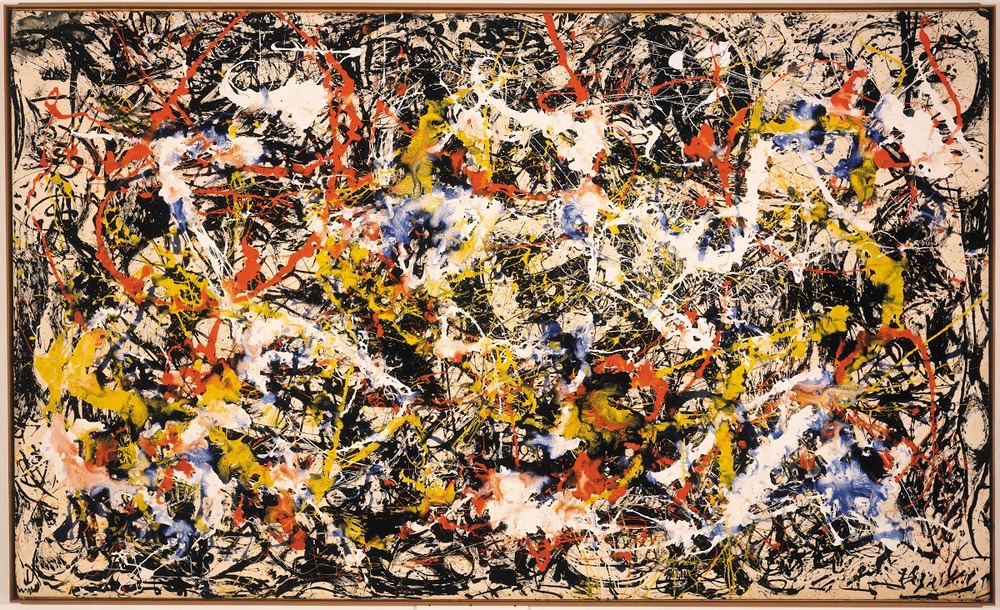
| Date Completed | 1952 |
| Medium | Oil and enamel on canvas |
| Dimensions (cm) | 393 x 237 |
| Location | Albright-Knox Art Gallery, New York City, United States |
This piece was made in the years following World War II, amid the emergence of Abstract Expressionism. It is regarded as one of the artist’s best masterpieces and must be viewed in person to fully comprehend its majesty. It consists of distinct colors that have been skillfully placed on top of each other to create forms and lines that trigger emotions and intrigue the eye. He started working on the piece purely in black and white but later added color to improve it. Pollock once stated that each era develops its own style for aesthetic expression; drip paintings were his major contribution to the history of art during his lifetime. With its unique combination of skill and passion exhibited via colors layered on canvas, this piece of artwork continues to attract art enthusiasts from all around the world. The painting was believed to illustrate the Cold War by depicting his feelings during an uncertain period.
Pollock was boldly questioning convention, both political and artistic, struggling for free expression at a moment when many in the United States believed this essential right was under attack. Many ardent advocates of this political statement were also fans of Pollock’s art, and they pushed others to help them by supporting or financing future original Pollock paintings. The yellow, red, white, and blue paint, in particular, generate dramatic moments of emphasis to guide the eye in this artwork. Many other Jackson Pollock paintings employ primary hues for this purpose as well. It even inspired a jigsaw puzzle, which was dubbed the most difficult puzzle in the world in 1964, and Hundreds of thousands of American citizens bought the puzzle after that. There is even a 1,000-piece version of the puzzle available today!
Greyed Rainbow (1953)
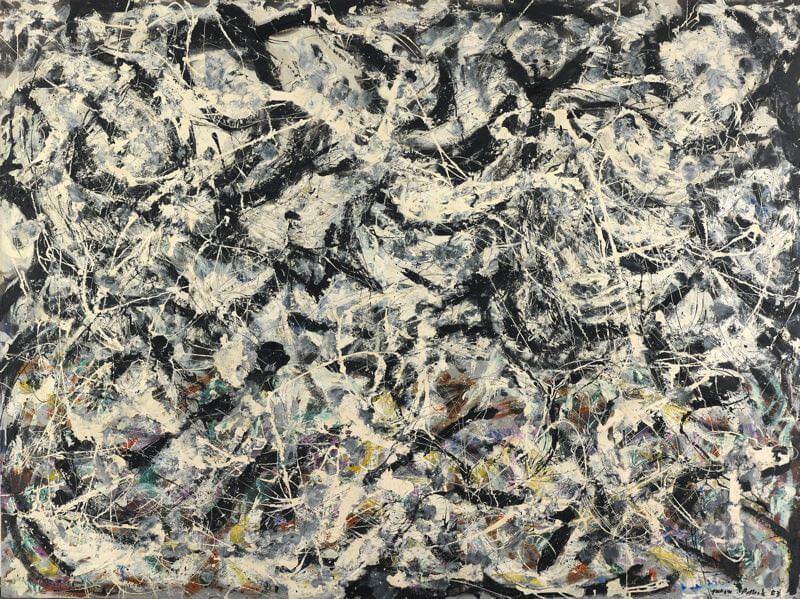
| Date Completed | 1953 |
| Medium | Oil on linen |
| Dimensions (cm) | 182 x 244 |
| Location | Museum of Modern Art, New York City, United States |
This piece, one of Pollock’s final outstanding purely abstract works before his untimely passing, is primarily white, black, gray, and silver; yet, he thinly buried yellow, orange, blue, green, and violet in the lower third of the canvas. The title most likely relates to these grayed-out areas of concealed color. Pollock’s thin strokes produced the appearance that the whites, grays, and blacks were designed to hide these colors. The bright marks at the bottom section of the image are initially lost in the backdrop, but as they capture the eye, it becomes clear that they form the artwork’s foundation.
The artist began drinking again after two years of abstinence at this point and started sinking into an emotional state of monotonous misery and despair. His marriage was falling apart, yet regardless of the fact that his canvases were selling well, he never produced anything new, fearing repetition and self-imitation. At first sight, the picture appears to accurately portray Pollock’s mental condition in the latter years of his life. It is only on closer inspection that one begins to see the colors that lay beneath.
That completes our list of famous Jackson Pollock paintings. While the artist was originally interested in producing Surrealistic artworks, he subsequently began experimenting with Abstract art, which led to his famous drip paintings. This unique style may seem haphazard at first, but those who admire his works are able to see the intentional motions of his technique. Today, original Pollock paintings are highly valued, despite receiving very mixed reviews from critics initially.
Artwork Spotlight: Dripping 4

Jackson Pollock’s art piece, “Dripping 4” demonstrates him at his best, the dripping or splashing of artwork that is typical of the artist. It is therefore substantiated that this piece represents the true meaning of abstract expressionism especially when identifying the ability of Pollock to portray movement.
Frequently Asked Questions
What Is Jackson Pollock’s Art Known For?
Pollock is best known for his distinctive drip paintings. He’d place canvases on the floor and then drip or pour paint onto them, forming complicated webs of lines. This method enabled him to create art that was spontaneous and expressive. He is regarded as a pivotal player in the Abstract Expressionist movement that arose in America during the mid-20th century. Unlike traditional representation, his approach to drip painting emphasized intuitive and emotive creative expression. Pollock’s unconventional method of art-making had a significant effect on modern art. His works pushed the boundaries of artistic subject matter and techniques, laying the path for innovative thinking and experimentation in subsequent art movements.
What Is the Most Expensive Pollock Painting Ever Sold?
Original Pollock paintings fetch millions of dollars at auction, with the most expensive of all Jackson Pollock’s artworks, Number 5 (1948), fetching a stunning $140 million in 2006 by David Geffen. Jackson Pollock’s paintings are regarded as American cultural icons, personifying the tortured artist and the avant-garde ethos. His career and life, as well as his untimely death in a car accident, all added to the mystique that surrounded him.