


In the kaleidoscopic world of contemporary art, few names shine as brightly as Faith Ringgold, and Faith Ringgold paintings are the vivid tapestries that tell the story of a pioneering artist. Born in Harlem in 1930, Ringgold’s artistic journey blossomed through her education at City College of New York and the College of New Rochelle, where she laid the groundwork for her distinct voice.
She was raised in a family deeply entrenched in the rich cultural mosaic of Harlem, with a mother who was a fashion designer and a father with a penchant for storytelling, Ringgold’s upbringing fostered a unique fusion of creativity and narrative within her. As she navigated her career, Ringgold’s paintings became powerful reflections of the societal currents of her time, from her involvement in the Black Arts Movement to her pivotal role in feminist art circles. Join us as we delve into the captivating stories behind Faith Ringgold’s iconic paintings, each stroke a brushstroke in the masterpiece of her life and legacy.
1. Tar Beach (Part I from the Woman on a Bridge series)
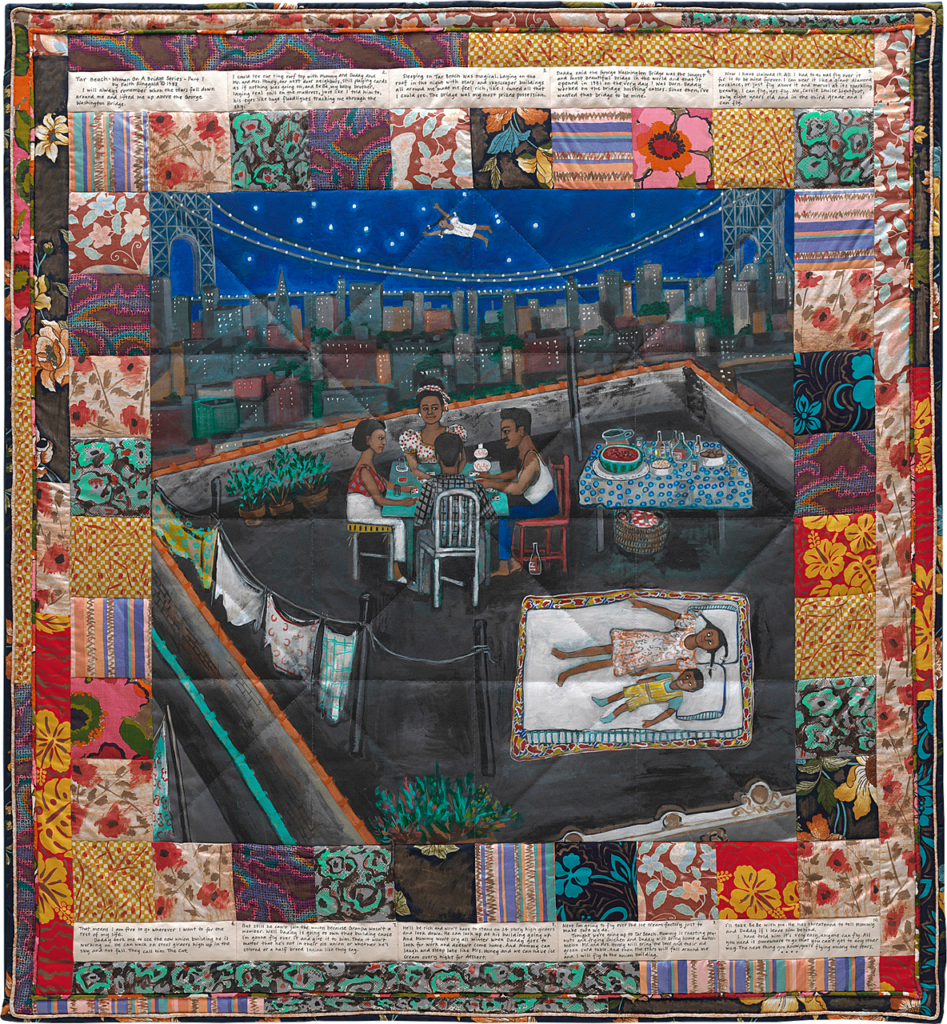
| Date of Completion | 1988 |
| Dimensions | 76 x 68 inches |
| Location | Solomon R. Guggenheim Museum, New York |
Let’s embark on our journey with “Tar Beach,” a quilt that transcends the boundaries of traditional art. Completed in 1988, this piece is the initial installment of the “Woman on a Bridge” series. Imagine a young girl named Cassie Louise Lightfoot soaring above the Harlem skyline, her dreams lifting her beyond the confines of the city. This Ringgold’s quilt isn’t just a visual feast; it’s a testament to the power of dreams and the ability of art to transport us to fantastical realms.
2. Street Story Quilt
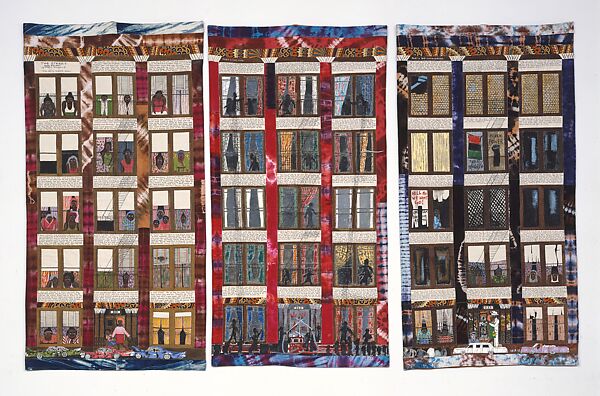
| Date of Completion | 1985 |
| Dimensions | 75 x 81 inches |
| Location | The Studio Museum in Harlem, New York |
Our next stop is the lively streets of “Street Story Quilt,” a creation from 1985 housed at The Studio Museum in Harlem. This quilt is not your grandmother’s patchwork; it’s a dynamic scrapbook of urban life. Every stitch tells a tale of the city’s hustle and bustle, creating a quilt that’s not just observed but explored, revealing hidden stories in every nook and cranny.
3. Slave Rape Story Quilt
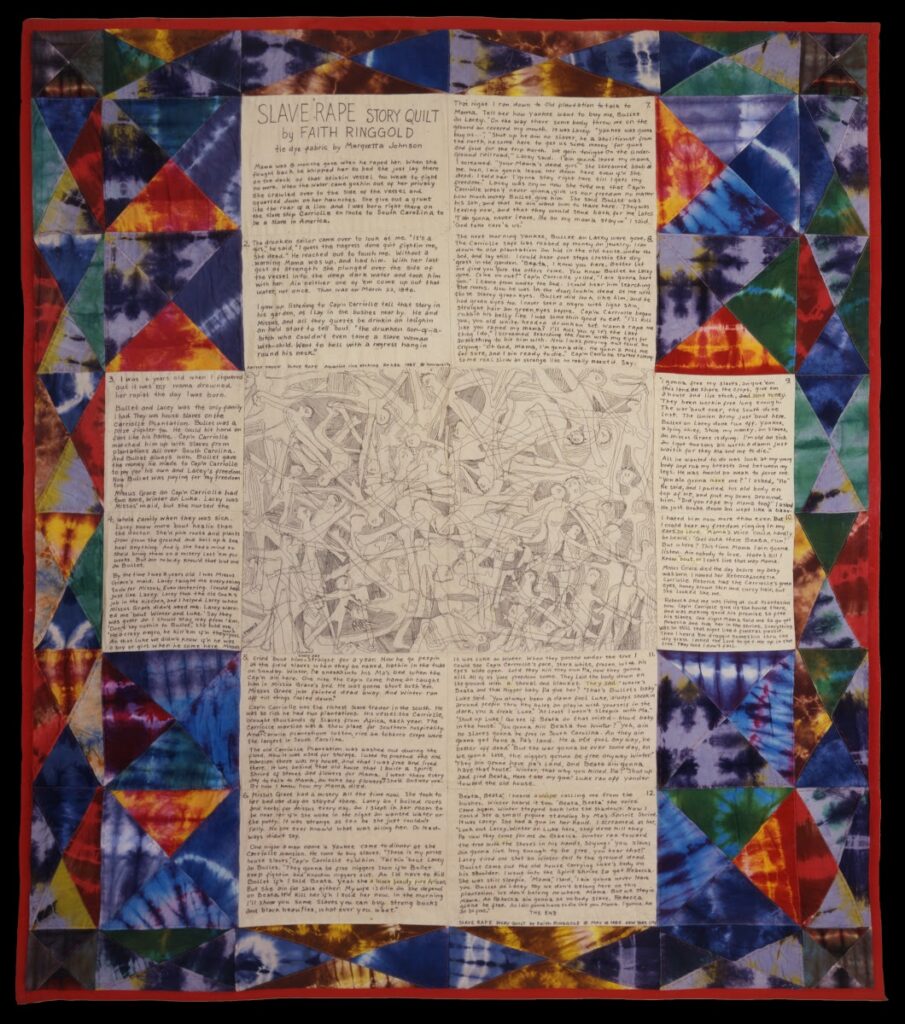
| Date of Completion | 1985 |
| Dimensions | 79 x 79 inches |
| Location | Collection of the Artist |
Moving into the profound, “Slave Rape Story Quilt” from 1985 is a powerful narrative woven with threads of strength and resilience. This quilt fearlessly confronts the harsh realities of history, serving as both a visual and emotional testament to the indomitable spirit of those who faced adversity head-on. The stitches are not just patterns; they are echoes of the past demanding to be heard.
4. Flag Story Quilt
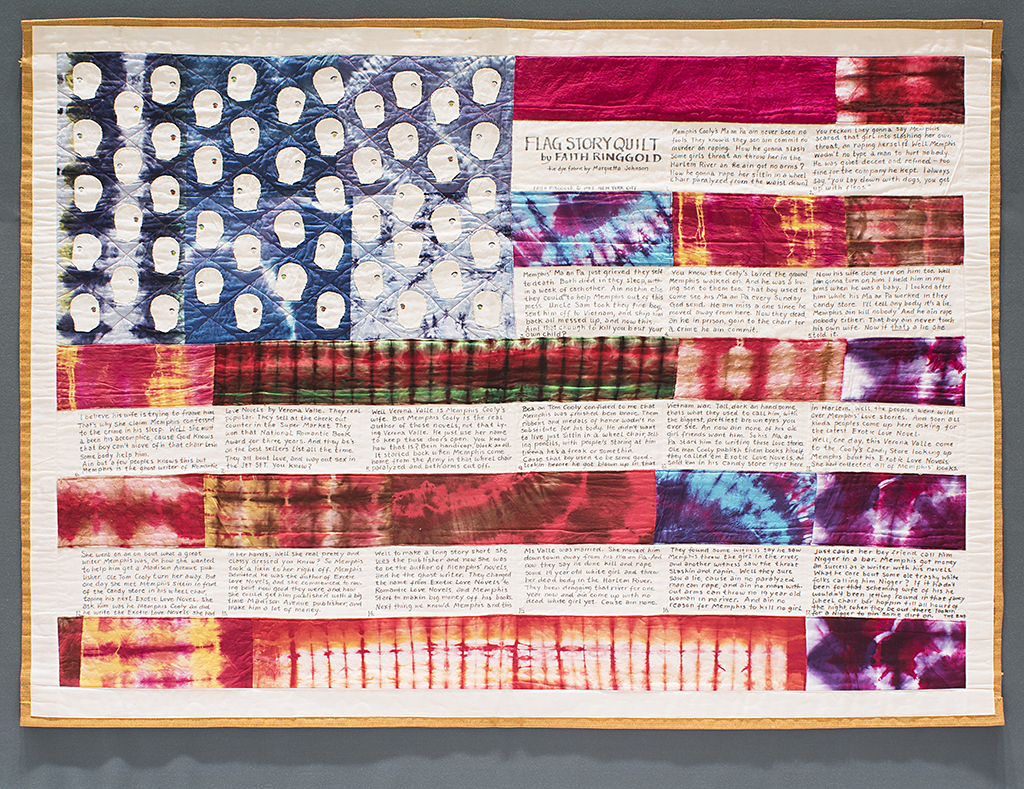
| Date of Completion | 1985 |
| Dimensions | 87 x 79 inches |
| Location | National Civil Rights Museum, Memphis |
Prepare to be amazed by the rebellious spirit of “Flag Story Quilt.” Completed in 1985 and residing in the National Civil Rights Museum in Memphis, this quilt is Old Glory’s vivacious cousin. Faith Ringgold uses the American flag as a canvas for protest, creating a riotous reminder that patriotism comes in every color imaginable. It’s a quilt that waves not just the flag but a colorful call for change.
5. Oprah We Love You…
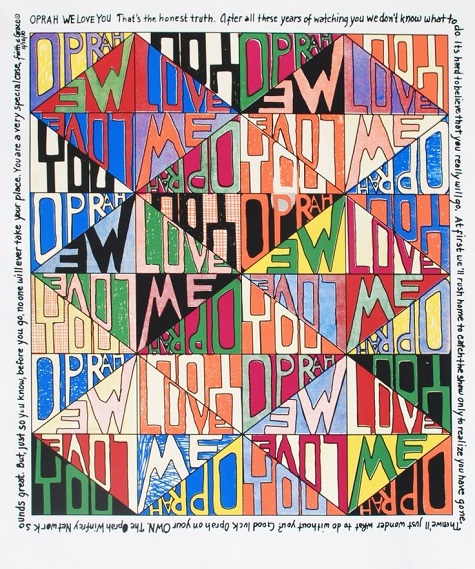
| Date of Completion | 2011 |
| Dimensions | 49 x 39 inches |
| Location | Collection of Oprah Winfrey |
Our journey takes a star-studded turn with “Oprah We Love You…,” a radiant burst of admiration completed in 2011 and now residing in the collection of none other than Oprah Winfrey. This jubilant explosion of color pays homage to the queen of talk shows, turning the quilt into more than a portrait—it’s a celebration of Oprah’s influence on screens and hearts.
6. Freedom of Speech
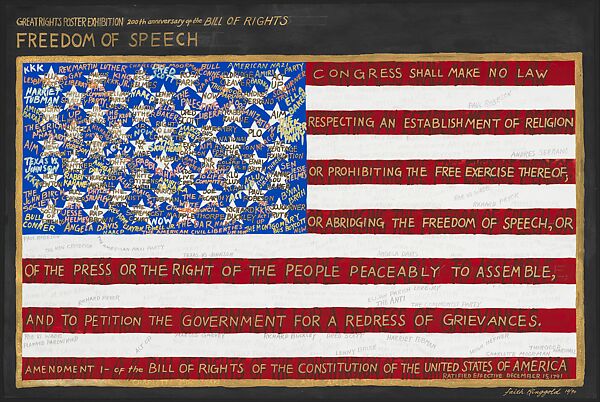
| Date of Completion | 1990 |
| Dimensions | 64 x 49 inches |
| Location | National Museum of Women in the Arts, Washington, D.C. |
Now, let’s venture into the heart of democracy with “Freedom of Speech.” Completed in 1990 and housed at the National Museum of Women in the Arts in Washington, D.C., this quilt is a visual shout-out to the essence of free expression. With bold colors and dynamic flair, Ringgold captures the spirit of speaking one’s mind. It’s the quilt version of a mic drop, inviting you to let your voice be heard in the most vibrant way possible.
7. Sonny’s Quilt
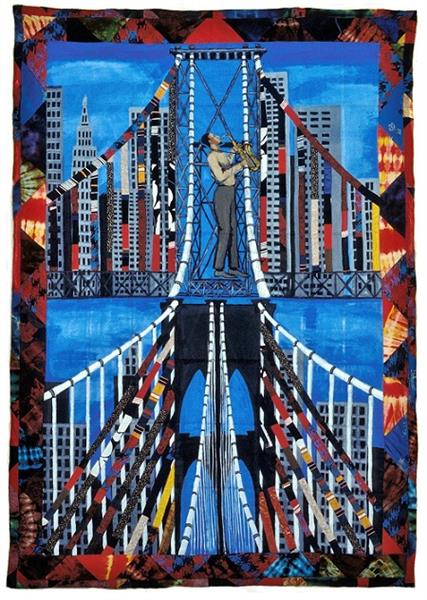
| Date of Completion | 1986 |
| Dimensions | 79 x 79 inches |
| Location | Collection of the Artist |
Time for a cozy interlude with “Sonny’s Quilt.” Completed in 1986 and residing in the personal collection of the artist, this Ringgold’s masterpiece is like a warm family hug on fabric. Celebrating the ties that bind generations, it invites you to wrap yourself in the comfort of familial love. It’s the quilt equivalent of a heartwarming family story, stitched with care and affection.
8. All Power to the People
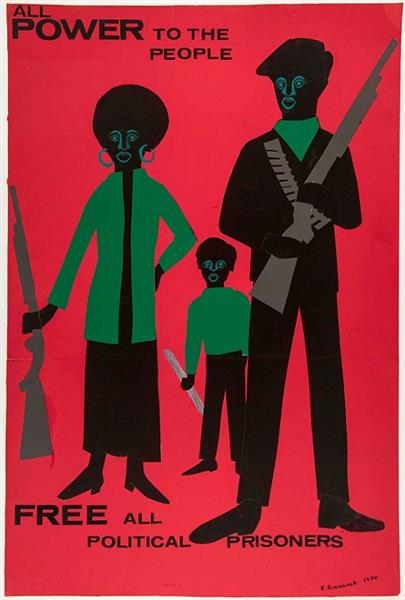
| Date of Completion | 1970 |
| Dimensions | 76 x 73 inches |
| Location | Collection of the Artist |
Get ready to be energized by “All Power to the People.” Completed in 1970 and nestled in the personal collection of the artist, this quilt is a visual call to arms. With riotous colors, this Ringgold’s painting depicts empowerment and solidarity, turning the quilt into a vibrant banner of strength. It’s the quilt you need when you want to feel unstoppable and make a statement.
9. We Came to America
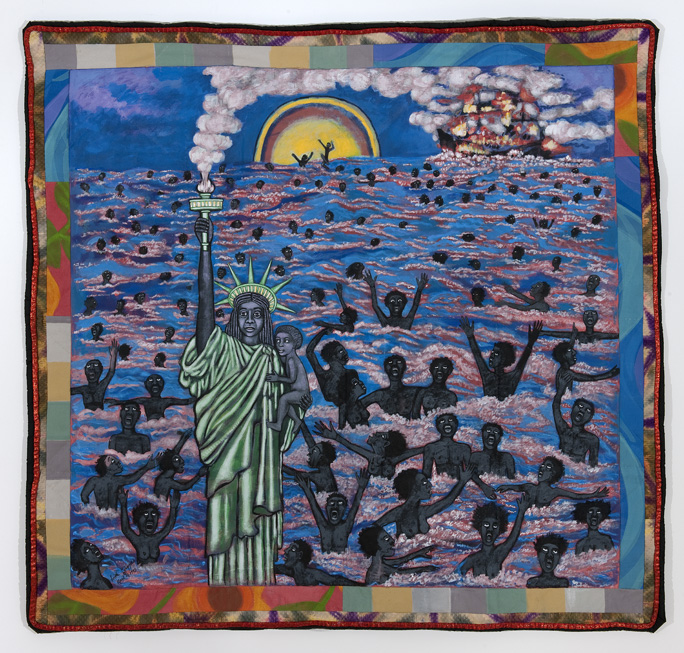
| Date of Completion | 1997 |
| Dimensions | 80 x 80 inches |
| Location | Museum of Fine Arts, Houston |
Dive into the celebration of diversity with “We Came to America.” Completed in 1997 and now housed at the Museum of Fine Arts in Houston, this quilt is Ringgold’s love letter to the melting pot that is America. It throws a lively party of colors, inviting everyone to join in and embrace the beautiful differences that make us uniquely us.
10. The United States of Attica
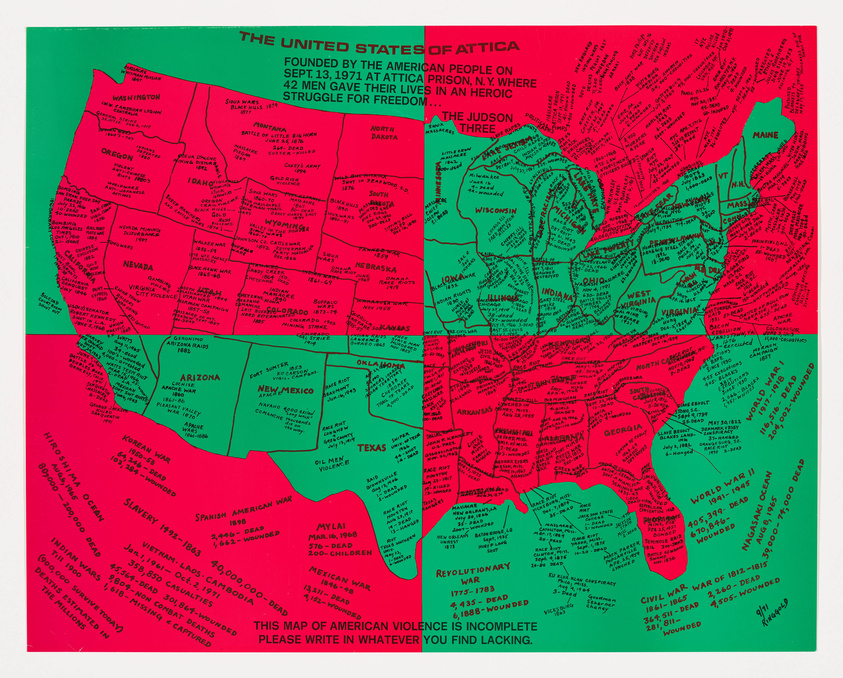
| Date of Completion | 1972 |
| Dimensions | 96 x 96 inches |
| Location | Collection of the Artist |
As we approach the final stop on our journey, we encounter the powerful “The United States of Attica,” completed in 1972 and residing in the personal collection of the artist. This quilt is a stark reminder of injustice, drawing inspiration from the Attica prison uprising. It demands attention, sparking conversations and inspiring action, proving that art can be a catalyst for change.
Frequently Asked Questions
What is Faith Ringgold’s most famous piece?
Ringgold’s most well-known quilt, Tar Beach, is the first in her Woman on a Bridge series, which tells the story of young Cassie Louise Lightfoot, an African American girl who grows up in Harlem.
What was an interesting fact about Faith Ringgold?
When Ringgold’s display of sculpture from the 1930s at the Whitney Museum of American Art failed to include any African American artists, Ringgold assisted in planning protests in 1968. Aiming for equal participation of female artists in the Whitney Biennial, she later co-founded the Ad Hoc Women’s Art Committee.
Conclusion
In conclusion, Faith Ringgold’s quilts are not merely stitched fabrics; they are portals to diverse worlds, stories waiting to be discovered in every stitch. From soaring dreams above Harlem to protests stitched into the American flag, each quilt is a unique chapter in the kaleidoscopic odyssey of Faith Ringgold’s artistic journey. These masterpieces aren’t just art; they’re experiences that challenge, inspire, and celebrate the boundless creativity of an artist who dared to redefine the very fabric of storytelling. Who knew quilts could be so much more than cozy blankets? Faith Ringgold did, and she’s inviting us all to join the party!


