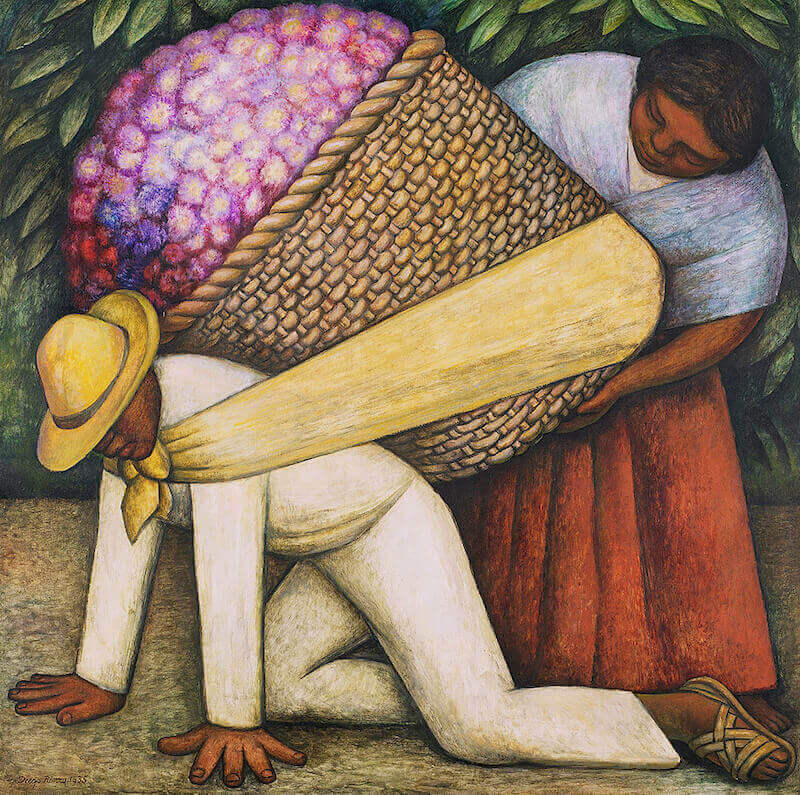
Diego Rivera, a name that resonates in the vibrant hues of Mexican art, didn’t just paint pictures; he painted stories. Among his myriad masterpieces, “The Flower Carrier” stands out as a testament to his unique ability to weave narratives through the strokes of his brush. In this expansive exploration, we’ll delve deeper into the life of Diego Rivera, traverse the landscape of his career, and unravel the multifaceted layers of significance embedded within “The Flower Carrier.”
Who was Diego Rivera

Diego Rivera, born in 1886 in Guanajuato, Mexico, was no ordinary artist. His canvases were not mere reflections of visual beauty; they were canvases that echoed the pulse of a nation. Rivera’s early artistic education took root at the Academy of San Carlos in Mexico City, where he honed his skills as a painter. However, it was his journey to Europe that exposed him to a variety of artistic movements, from Cubism to Post-Impressionism, laying the foundation for his unique style.
Returning to Mexico, Rivera found himself deeply influenced by the Mexican Revolution (1910-1920), a period of intense social upheaval and political change. It was during this transformative era that Rivera’s art found its purpose, becoming a powerful tool for social commentary and cultural celebration.
FUN FACT: Diego Rivera was a man of many talents, and one unexpected skill was his love for cooking! He was not only a passionate artist but also a culinary enthusiast who enjoyed experimenting with flavors and creating delicious dishes.
Rivera’s Career
Rivera’s career was not just about creating beautiful paintings; it was a journey of artistic and political expression. His murals, large-scale artworks painted on public buildings, became the canvas through which he communicated Mexico’s rich cultural history, the struggles of the working class, and the impacts of industrialization. Rivera believed that art should be accessible to everyone, and what better way to achieve this than by painting on walls for everyone to see?
His return to Mexico marked the beginning of the Mexican muralism movement, a significant art movement that aimed to use murals as a medium for storytelling, education, and social critique. Rivera’s murals, often depicting scenes from Mexican history and celebrating the common people, became a powerful means of connecting with the masses.
What is Happening in The Flower Carrier
| Artist | Diego Rivera |
| Date Created | 1935 |
| Medium | Oil on canvas |
| Genre | Social Realism |
| Period | Mexican Muralism |
| Dimensions | 48 in × 47 in (122 cm × 119 cm) |
| Series / Versions | N/A |
| Where is it housed? | San Francisco Museum of Modern Art |
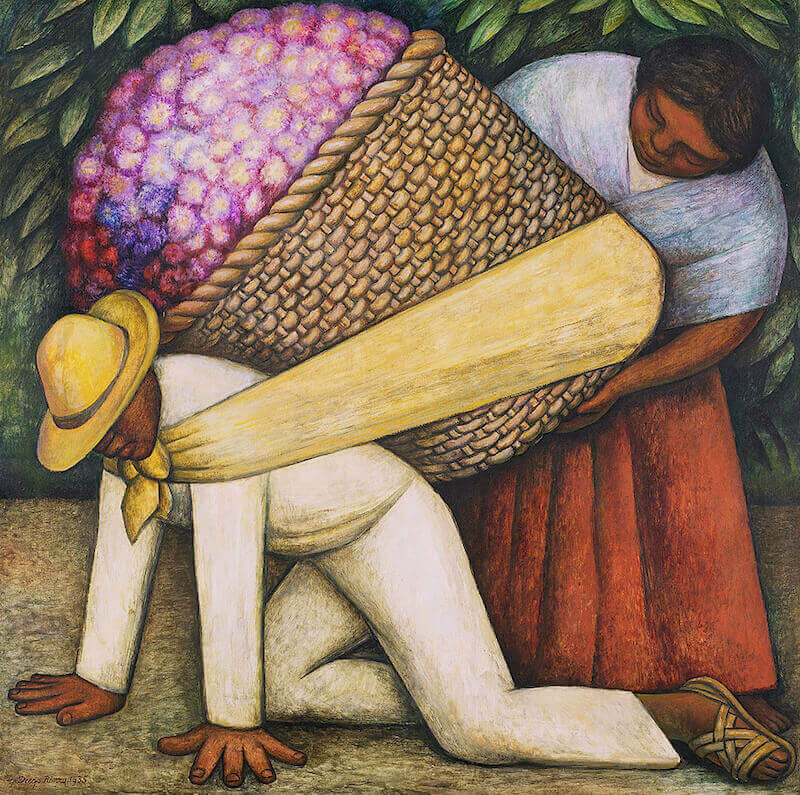
Now, let’s step into the world of “The Flower Carrier,” a painting that encapsulates the essence of Rivera’s artistic vision. Created in 1935, the artwork portrays a man carrying an enormous load of flowers. At first glance, it might seem like a simple depiction of a floral arrangement, but a closer look reveals a profound narrative.
The central figure, burdened by the weight of the flowers, is bent under the load, embodying the physical and metaphorical struggles of the working class. The vibrant colors of the flowers, a signature element of Rivera’s style, contrast with the earthy tones of the laborer’s clothing. This stark contrast serves as a visual metaphor, symbolizing the dual nature of the laborer’s existence—rooted in the cultural richness of Mexico yet weighed down by the heavy burden of labor.
Interesting Facts
Inspiration from Pre-Columbian Art: Diego Rivera’s artistic palette was enriched by the influences of Pre-Columbian art. The flattened perspective and symbolic use of color seen in “The Flower Carrier” are nods to the ancient artistic traditions of Mexico.
Commissioned for the International Labor Building: “The Flower Carrier” was originally commissioned for the International Labor Building in San Francisco. This context underscores Rivera’s commitment to portraying the struggles of the working class on an international platform, transcending geographical boundaries with his art.
Depiction of Mexico’s Cultural Identity: Beyond its socio-economic commentary, “The Flower Carrier” also serves as a celebration of Mexico’s cultural identity. Rivera intentionally incorporates indigenous symbols and Mexican folk art into the painting, reinforcing the importance of preserving and cherishing Mexico’s rich heritage in the face of industrialization.
Symbolism of Flowers: The choice of flowers in the painting holds a dual significance. While flowers traditionally symbolize beauty and joy, in this context, they also represent the cultural richness of Mexico. The laborer carries not just a physical load but also the weight of his cultural heritage.
Influence of Social Realism: “The Flower Carrier” is a quintessential example of Social Realism, an artistic movement that sought to depict the everyday lives of ordinary people. Rivera’s commitment to portraying the struggles of the working class aligns seamlessly with the principles of Social Realism.
Artwork Spotlight: Vendedora

The painting ‘‘Vendedora’’ painted by Diego Rivera is available on Singulart. It is an excellent piece of work that depicts the challenges that Mexican women have to go through in their daily lives. This piece goes hand in hand with Rivera’s penchant to depict social issues through his unrivaled style.
Are you looking for a piece of artwork from Diego Rivera?
Singulart has limited edition prints of Diego Rivera. If you are looking for a piece of Rivera‘s artwork for sale, simply click on the artwork or the button below to discover more!
Frequently Asked Questions
What is the meaning behind the flower carrier Diego Rivera?
“The Flower Carrier” depicts Mexico as a land marked by oppression, where individuals endure relentless struggles for minimal wages, while others revel in abundance. Through his paintings, Diego Rivera sought to shed light on the glaring disparities within society, aiming to foster greater awareness of these pressing issues.
What inspired Diego Rivera to paint ‘The Flower Carrier’?
Diego Rivera was inspired to paint ‘The Flower Carrier’ by the struggles and hardships faced by the Mexican working class. The painting symbolizes the laborious nature of their work and the dignity they find in it.
What is the flower seller painting Diego Rivera?
Painted in 1941, “The Flower Seller” portrays a young woman kneeling beside a sizable bundle of calla lilies. Her attire, though modest, exudes vibrant colors and meticulous neatness, reminiscent of the typical attire of young Mexican women in the early 20th century. The presence of double braids in her hair suggests her unmarried status, signifying her youthful innocence.
Conclusion
In the vast tapestry of art history, “The Flower Carrier” emerges as a masterpiece that transcends the boundaries of time and space. Diego Rivera, with his unyielding dedication to social justice and cultural celebration, crafted a narrative that speaks to the hearts of those who gaze upon it. The painting goes beyond being a mere composition of colors on canvas; it is a living testament to the resilience, beauty, and struggles of the human spirit.