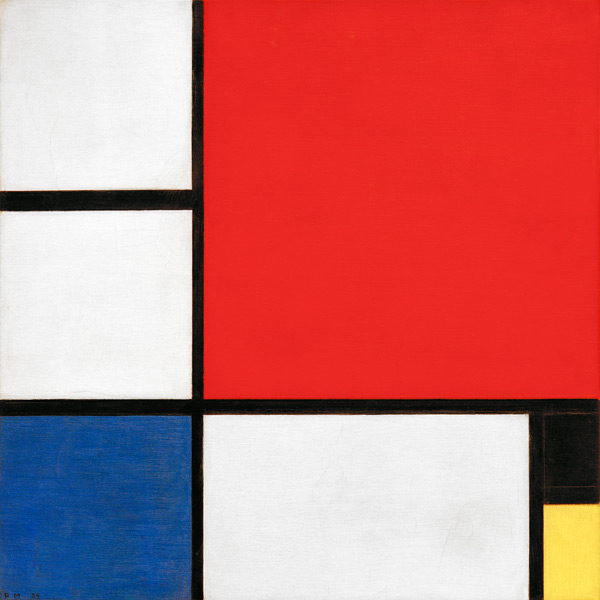
Step into the fascinating world of Piet Mondrian, a Dutch artist whose revolutionary style, Neoplasticism, reshaped the art scene. At the heart of his artistic legacy lies the masterpiece “Composition II in Red, Blue, and Yellow,” a canvas that encapsulates Mondrian’s pioneering vision for a universal and harmonious art form.
Who was Piet Mondrian
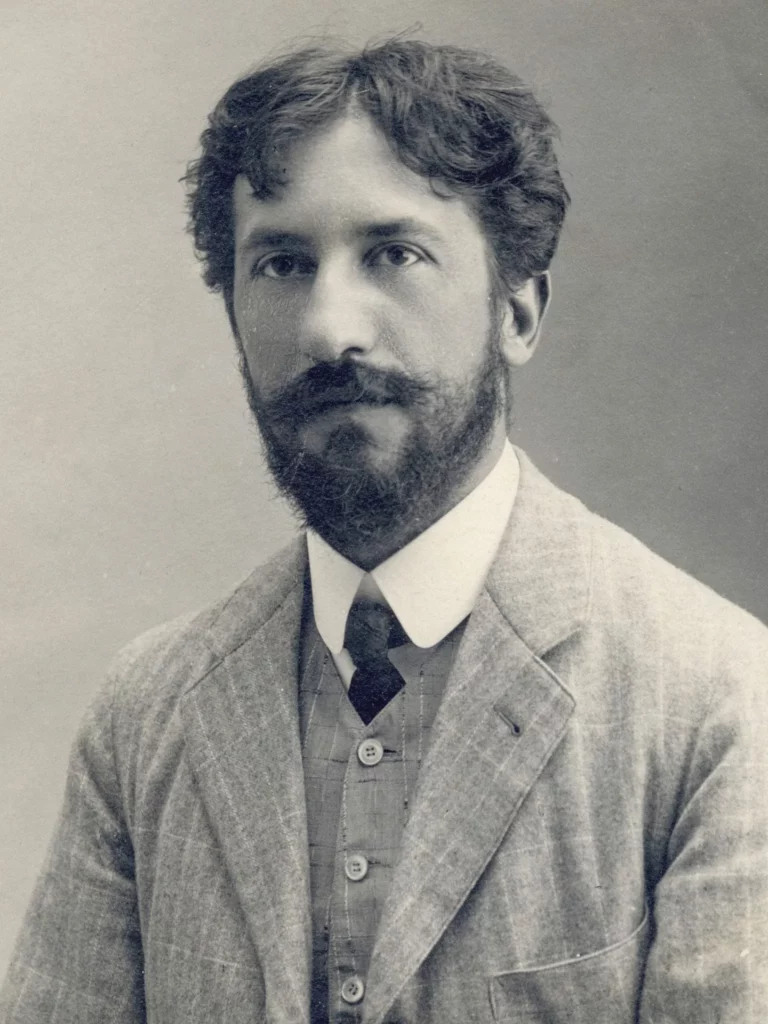
Piet Mondrian, born in the Netherlands in 1872, began his artistic journey with traditional naturalistic painting. However, he found his true calling in abstract art and became a key figure in the De Stijl movement, a Dutch art movement that sought to simplify artistic expression to its fundamental elements.
FUN FACT: Piet Mondrian was a dedicated practitioner of theosophy, a spiritual movement that seeks to explore the mysteries of existence and the nature of reality.
His Career
Mondrian’s career reflects a remarkable evolution from traditional roots to avant-garde abstraction. Influenced initially by the Cubist movement in Paris, Mondrian later distanced himself to develop a unique style characterized by geometric shapes and primary colours. His journey signifies not just a personal exploration but a profound contribution to the trajectory of modern art.
Composition II in Red, Blue, and Yellow
| Artist | Piet Mondrian |
| Date Created | 1930 |
| Medium | Oil on canvas |
| Genre | Abstract art |
| Period | De Stijl movement |
| Dimensions | 46.4 cm × 46.4 cm (18.3 in × 18.3 in) |
| Series/Versions | Part of a series |
| Where is it housed? | Collection of The Museum of Modern Art (MoMA), New York |
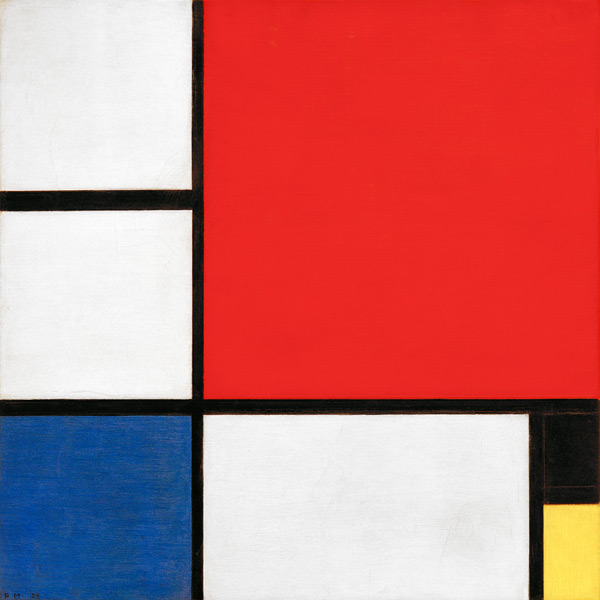
Painted in 1930, “Composition II in Red, Blue, and Yellow” is a pinnacle of Mondrian’s mature style. The canvas, a mesmerizing interplay of a black grid intersecting with bold blocks of primary colors—red, blue, and yellow—exemplifies Mondrian’s pursuit of universal harmony. This seemingly simple composition is a nuanced masterpiece, each element meticulously arranged to convey a sense of equilibrium and dynamism.
Analysis
“Composition II in Red, Blue, and Yellow” is a visual symphony, with Mondrian conducting a harmonious dance between form and color. The intersecting lines create a dynamic structure, providing a framework for the vibrant primary colors to coexist. The careful orchestration of these elements results in a composition that is not just visually striking but spiritually resonant.
The grid, often considered a rigid construct, becomes a playground for Mondrian’s exploration of balance and tension. The blocks of color, unapologetically bold in their simplicity, evoke a sense of purity and clarity. This intentional arrangement of elements reflects Mondrian’s belief in the potential of art to communicate universal truths that transcend cultural and geographical boundaries.
Interesting Facts
Spiritual Inspiration: Mondrian’s artistic journey was deeply intertwined with his interest in spirituality. Influenced by the Theosophical movement, he believed that through simplification and abstraction, art could convey profound, universal truths.
Evolution of Style: Mondrian’s transformation as an artist is evident in the evolution of his style. Beginning with landscapes and trees, he gradually distanced himself from representational art, moving towards geometric abstraction. This transition mirrors his philosophical shift towards a more utopian and universal artistic language.
Meticulous Arrangement: Mondrian’s commitment to his art extended beyond the canvas. His studio itself became a manifestation of his artistic principles. Every object within his workspace was meticulously arranged to mirror the principles of Neoplasticism, creating a seamless integration of life and art.
Exploring Mondrian’s Impact
Mondrian’s influence extends beyond the canvas, shaping not only the visual arts but also design, architecture, and even fashion. The principles of Neoplasticism, with its emphasis on simplicity, geometry, and primary colors, have found resonance in various creative disciplines.
In the realm of design, Mondrian’s aesthetic has inspired iconic works such as Yves Saint Laurent’s Mondrian dress, a testament to the enduring appeal of his visual language. Architectural movements like Minimalism have also drawn inspiration from Mondrian’s emphasis on clean lines and geometric forms.
Mondrian’s impact on the art world is immeasurable, with echoes of his style evident in the works of subsequent generations of artists. His legacy continues to influence contemporary artists exploring the intersection of form, color, and spirituality.
Artwork Spotlight: Chrysanthemum

Chrysanthemum is one of the early works of Piet Mondrian which is also available on Singulart. This artwork reflects his fascination with botanical subjects, though here he focuses on the realistic representation of a single chrysanthemum blossom. This creation is different to his later work and helps to illustrate his development as an artist.
Are you looking for a piece of artwork from Piet Mondrian ?
Singulart has limited edition prints of Piet Mondrian. If you are looking for a piece of Mondrian‘s artwork for sale, simply click on the artwork or the button below to discover more!
Frequently Asked Questions
What is Composition with Red, Blue and Yellow abstract?
The painting “Composition with Red, Blue, and Yellow” was created by Piet Mondrian in 1930. Renowned for its abstraction, Mondrian significantly advances the abstract visual vocabulary despite employing a relatively modest canvas size. Bold and pronounced black brushstrokes delineate the boundaries of various geometric shapes within the composition.
What are the key elements in Composition with Red, Blue and Yellow?
Composition with Red, Blue and Yellow features key elements such as primary colors (red, blue, and yellow), black lines of varying thickness, asymmetry, and pure planes of color.
Conclusion
Piet Mondrian’s “Composition II in Red, Blue, and Yellow” is not merely a painting; it is a journey into the essence of Neoplasticism. Through a carefully orchestrated dance of lines and colors, Mondrian created a visual language that transcends time and space. The simplicity of form belies the complexity of thought, as each element contributes to a greater whole, reflecting the artist’s profound belief in the power of art to convey universal truths.
As we explore the layers of “Composition II in Red, Blue, and Yellow,” we uncover not just a canvas but a profound expression of Mondrian’s vision for a harmonious and utopian world. In this masterpiece, the artist invites us to contemplate the interplay of elements, encouraging us to see beyond the surface and connect with the universal language of form and color. Piet Mondrian’s legacy endures, inviting us to continue exploring the boundaries of artistic expression and seeking the universal harmony that transcends the constraints of time and culture.