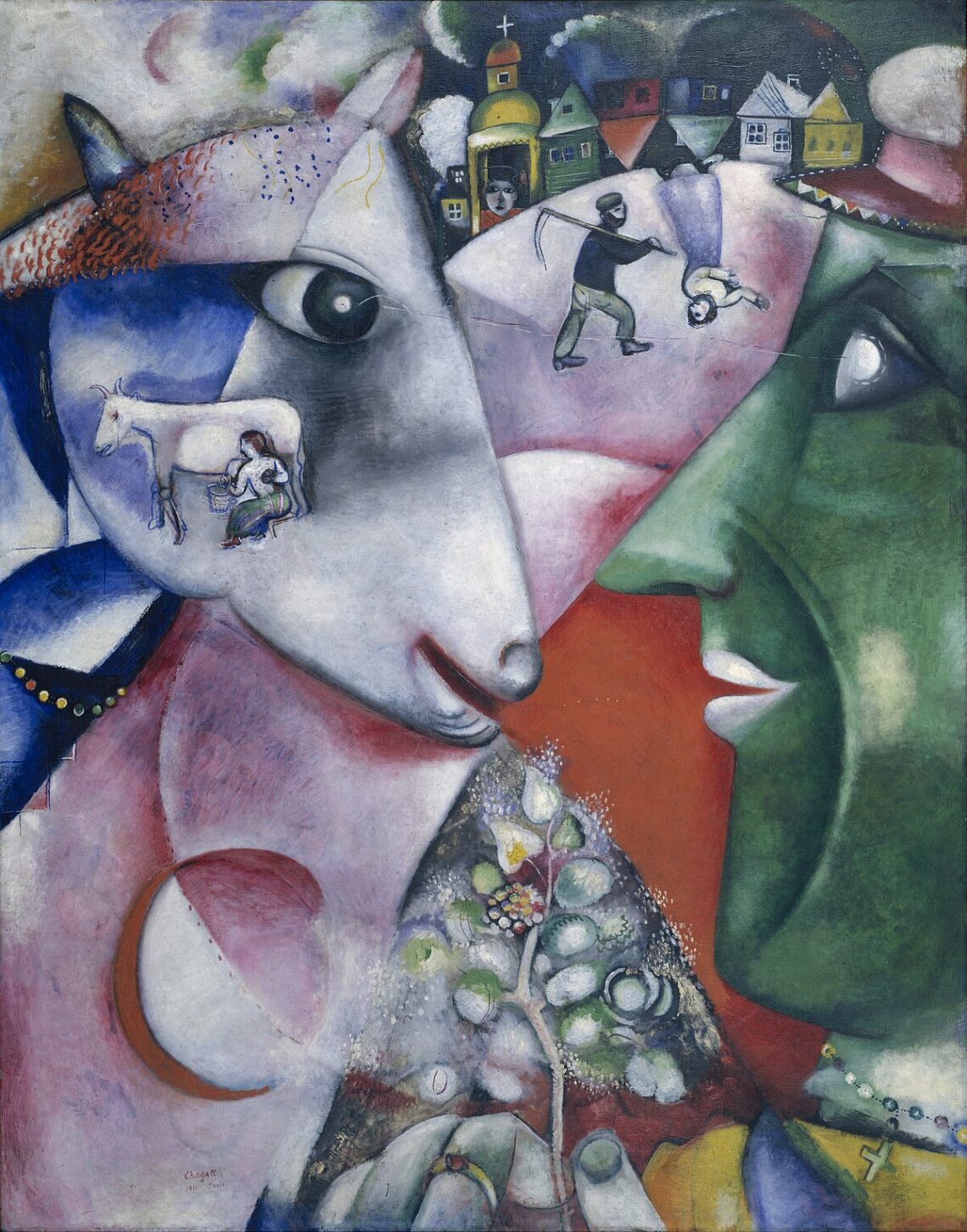
Have you ever found yourself lost in a painting, wandering through a world where reality blends seamlessly with dreams? Marc Chagall’s “I and the Village” is just such a painting—a colorful tapestry of surrealism and symbolism that invites viewers to embark on a whimsical journey through the artist’s imagination. In this article, we’ll delve deeper into the captivating world of Chagall, explore the intricacies of “I and the Village,” and uncover the hidden stories and meanings woven into its vibrant canvas.
Who was Marc Chagall
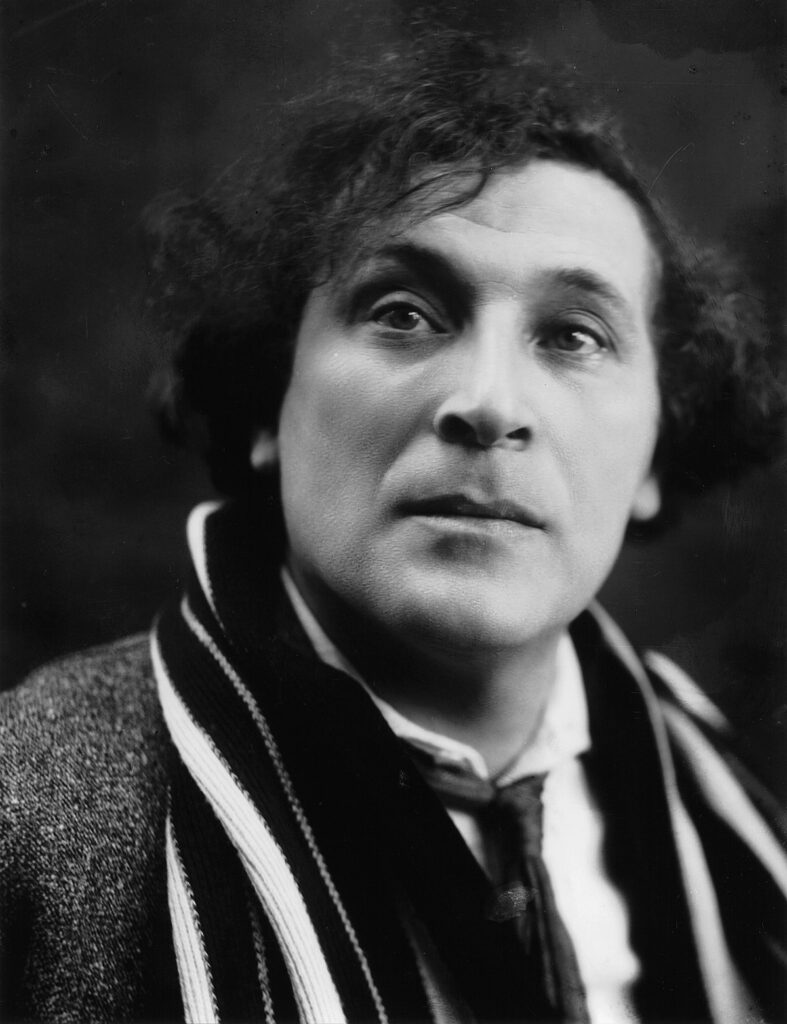
Imagine a young boy growing up in the bustling streets of Vitebsk, a small town in Russia steeped in rich Jewish culture. This was Marc Chagall’s childhood—the backdrop against which his artistic journey began. Born in 1887, Chagall possessed a boundless imagination from an early age, fuelled by the folklore and traditions of his homeland. Later in life, he ventured to Paris, the epicenter of the art world, where he encountered the vibrant colors of the Fauvists, the geometric shapes of the Cubists, and the dreamlike landscapes of the Surrealists. These influences would leave an indelible mark on Chagall’s artistic style, shaping his unique approach to painting.
FUN FACT: Chagall didn’t delve into lithography, a printmaking technique, until he was 63 years old! That’s why SINGULART appreciates Chagall’s constant artistic evolution, showcasing his ability to innovate throughout his career.
Career Overview
Chagall’s artistic career was nothing short of a kaleidoscopic adventure—a journey marked by experimentation, innovation, and a relentless pursuit of creative expression. His early works, imbued with the vibrant colors and folkloric motifs of his homeland, captured the essence of Russian-Jewish life with an enchanting whimsy. As he delved deeper into the avant-garde circles of Paris, Chagall’s art underwent a transformation, embracing the cubist tendencies of Picasso and Braque while retaining his own distinctive poetic vision.
I and the Village – What’s the Story
| Artist | Marc Chagall |
| Date Created | 1911 |
| Medium | Oil on canvas |
| Genre | Surrealism |
| Period | Cubism |
| Dimensions | 75.6 x 62.9 cm |
| Series/Versions | Unique piece |
| Where Housed | Museum of Modern Art, New York |
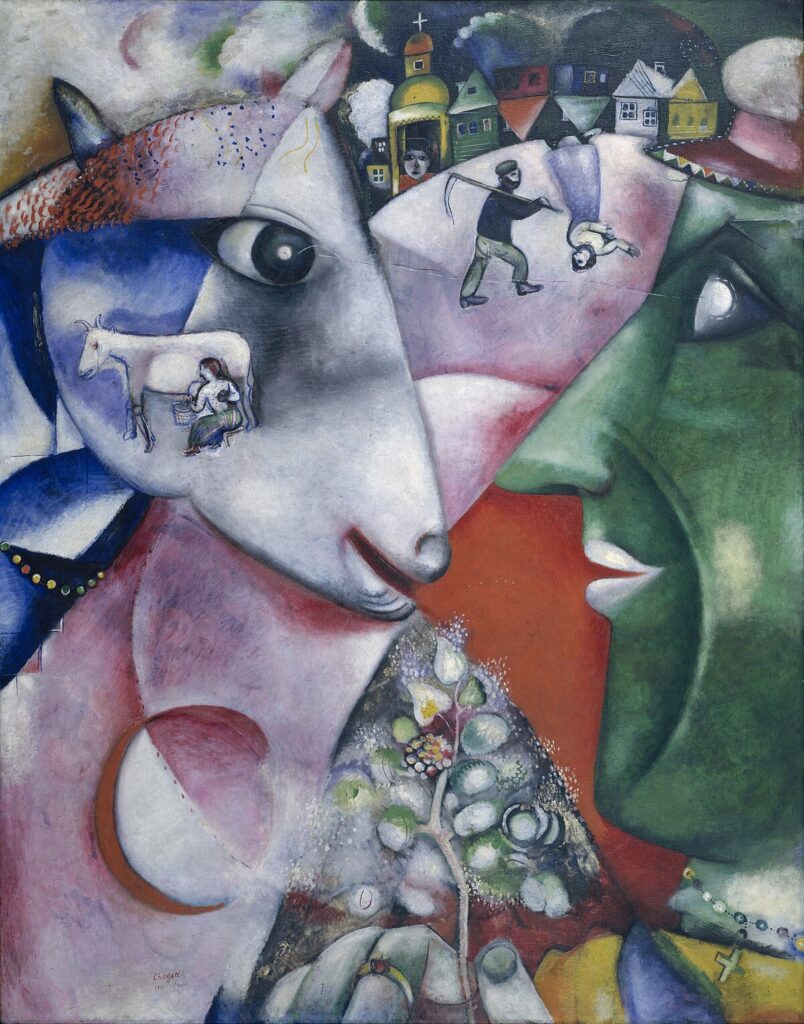
At the heart of Chagall’s oeuvre lies “I and the Village,” a painting that encapsulates the essence of his artistic vision. Created in 1911, this masterpiece serves as a visual autobiography, offering glimpses into Chagall’s past, present, and imagined future. The painting unfolds like a dream sequence, with each element imbued with symbolic significance. At the center of the composition stands a green-faced figure, reminiscent of the artist himself, clutching a bouquet of flowers—an offering of beauty amidst the chaos of life. Surrounding him are a menagerie of creatures—a donkey, a rooster, a woman with a cow—a surreal cast of characters that populate the landscape of Chagall’s imagination.
Let’s Decode the Painting
Peeling back the layers of “I and the Village” reveals a rich tapestry of symbolism and storytelling, each element contributing to the painting’s enigmatic allure. The green-faced figure, with its haunting gaze, serves as a reflection of Chagall’s own introspective nature—an artist caught between the worlds of reality and imagination. The rooster, perched atop a house, heralds the dawn of a new day—a symbol of hope and renewal amidst life’s trials and tribulations. Meanwhile, the donkey, with its steadfast gaze, embodies the resilience of the human spirit, steadfast in the face of adversity. Together, these disparate elements form a cohesive narrative—a visual poem that speaks to the universal themes of love, loss, and the search for meaning in an ever-changing world.
Interesting Facts about I and the Village
Delving deeper into the world of “I and the Village” unveils a treasure trove of fascinating insights and anecdotes, each adding depth and nuance to the painting’s narrative tapestry.
A Love Story Unfolds: Central to the story of “I and the Village” is the enduring love between Chagall and his wife, Bella. Legend has it that the figure of the woman in the painting is none other than Bella herself, her presence serving as a constant source of inspiration and solace for the artist.
Homage to Vitebsk: Despite the allure of Parisian life, Chagall’s heart remained tethered to his hometown of Vitebsk. “I and the Village” serves as a nostalgic tribute to the sights, sounds, and memories of his youth—a celebration of the enduring bond between artist and homeland.
A Cultural Mosaic: Chagall’s art transcends boundaries, blending elements of Russian-Jewish folklore with the avant-garde sensibilities of Parisian modernism. His ability to synthesize disparate influences into a cohesive whole speaks to the universality of his vision—a vision that continues to captivate and inspire audiences around the world.
Artwork Spotlight: Angel Bay
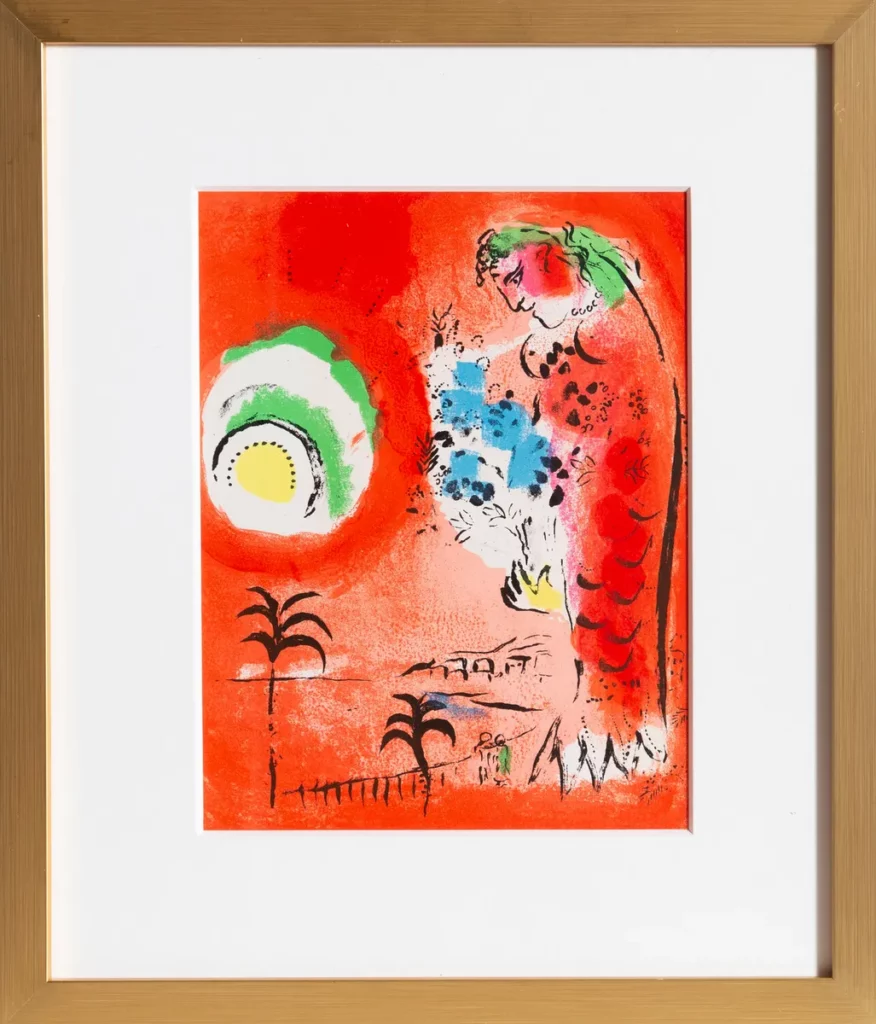
“Angel Bay” is available on Singulart. In this painting, Marc Chagall depicted a surrealistic-like scene with angels and brilliant colours and oeuvres that embrace his feelings. This work can be described as childlike, other-worldly, and dreamlike.
Are you looking for a masterpiece from Marc Chagall?
Singulart offers exclusive limited edition prints of Marc Chagall. If you’re searching for a Chagall artwork to purchase, click on the artwork or the button below to explore further!
Frequently Asked Questions
What is the meaning of the I and the Village by Marc Chagall?
Chagall was raised in a Hasidic community in present-day Belarus. Painted the year following his relocation to Paris, “I and the Village” reflects his recollections of his hometown. In the painting, he depicts individuals and animals coexisting harmoniously, symbolizing their interdependence through a line connecting the gaze of a peasant and a cow.
What is the theme of the book I and the Village?
‘I and the Village’ depicts the dynamic exchange between individuals and the lively natural environment enveloping them. It serves as a compelling representation of the interconnectedness between humans, animals, and flora. Marc Chagall’s “I and the Village” is currently housed at the Museum of Modern Art in New York City, USA.
Is “I and the Village” Surrealism?
“I and the Village exemplifies Chagall’s distinctive brand of nostalgic Surrealism from his early career. Like scenes from a dream, the painting presents a kaleidoscope of themes, images, references, and impressions that converge in seemingly illogical proximity. At the forefront, we encounter a green-faced man engaged in an intimate gaze with a goat or sheep.”
Conclusion
“I and the Village” is more than just a painting—it’s a portal into the boundless imagination of Marc Chagall, a world where dreams and reality intertwine with mesmerizing beauty. Through its vibrant colors, surreal imagery, and rich symbolism, the painting invites viewers to embark on a journey of self-discovery and wonder—a journey that transcends time, space, and cultural boundaries. As we gaze upon the whimsical landscapes of Chagall’s imagination, let us embrace the magic of art and celebrate the enduring legacy of one of the 20th century’s greatest masters.