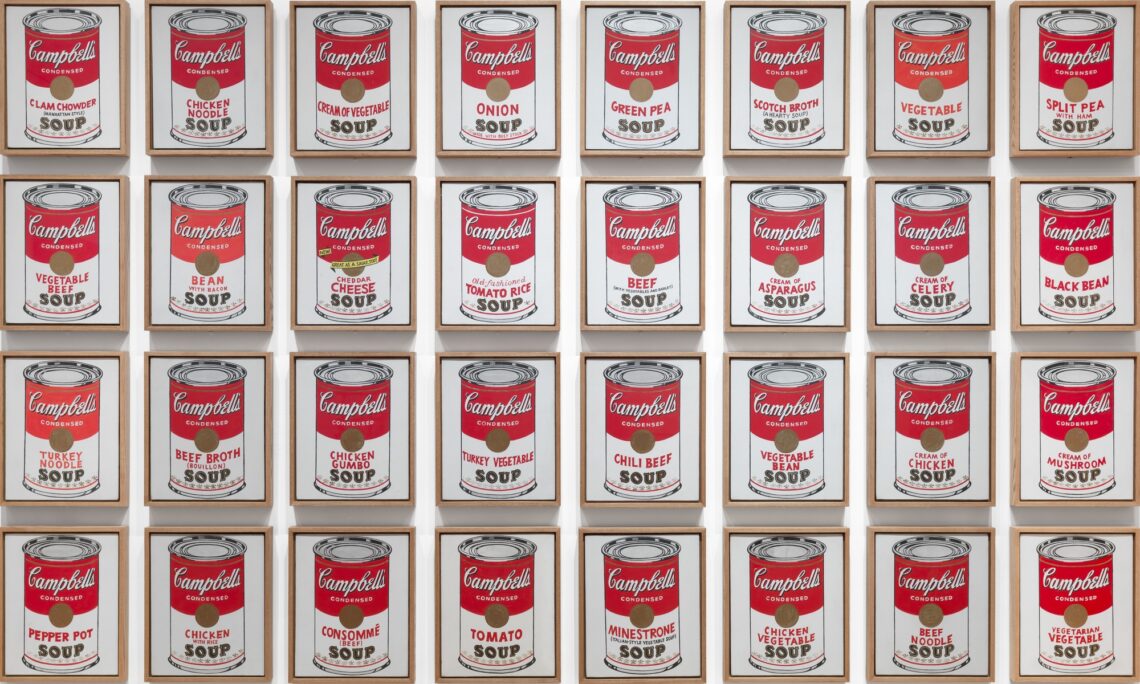
Let’s embark on a journey into the captivating world of Andy Warhol, a trailblazer who reshaped the art scene with his audacious interpretation of everyday objects. Born in 1928 in Pittsburgh, Pennsylvania, Andy Warhol wasn’t just an artist; he was a visionary, a director, and a producer. He catapulted to fame as the flagbearer of the Pop Art movement, a genre that celebrated the mundane and the popular. Think soup cans, soda bottles, and famous faces – that’s the universe Warhol inhabited. At the heart of his artistic legacy lies one of his most iconic creations: “Campbell’s Soup Cans.”
Who was Andy Warhol?
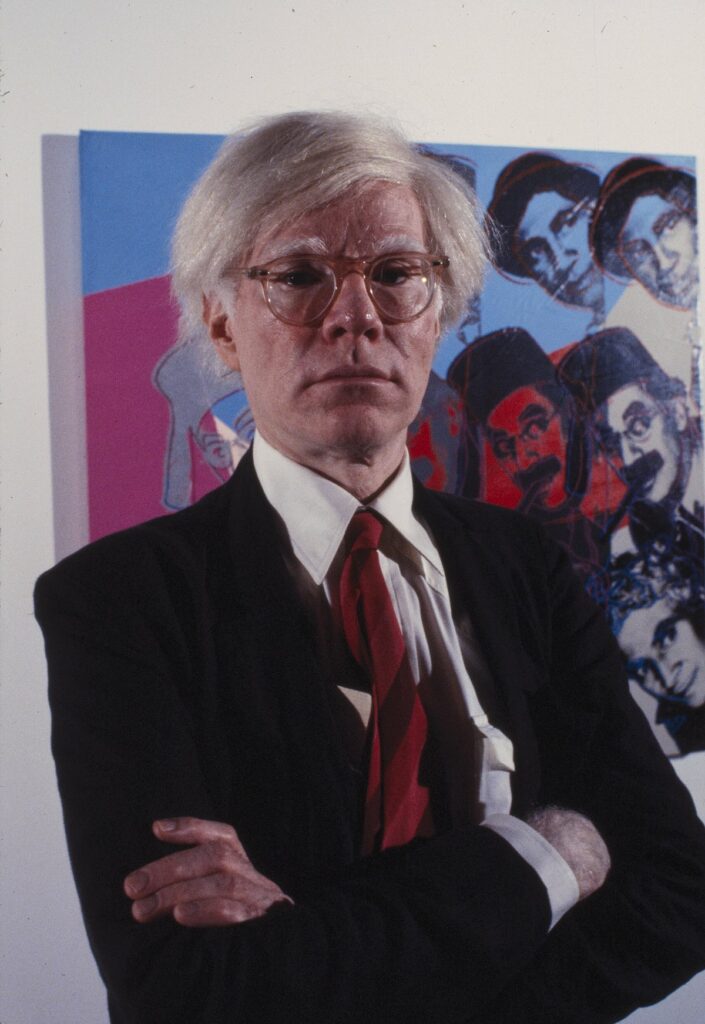
Before he mesmerized the art world with his ingenious creations, Warhol started his career as a commercial artist. His designs graced the pages of magazines and advertisements, earning him recognition for his distinctive style. However, in the swinging sixties, Warhol underwent a metamorphosis, shifting his focus to fine art and establishing his legendary studio known as The Factory. This creative haven became the epicenter of artistic experimentation and cultural revolution.
FUN FACT: “Andy Warhol was the most successful and highly paid commercial illustrator in New York,” before becoming a renowned fine artist. He worked as a freelance illustrator for various magazines and advertising agencies. Read more about Warhol’s career and famous artworks on The Art Story.
What’s happening in Campbell’s Soup Cans?
| Artist | Andy Warhol |
| Date Created | 1961 |
| Medium | Synthetic polymer paint |
| Genre | Pop Art |
| Period | Contemporary |
| Dimensions | Each canvas is 20 x 16 inches |
| Series/Versions | 32 canvases in the series |
| Where is it housed? | Museum of Modern Art (MoMA), New York |
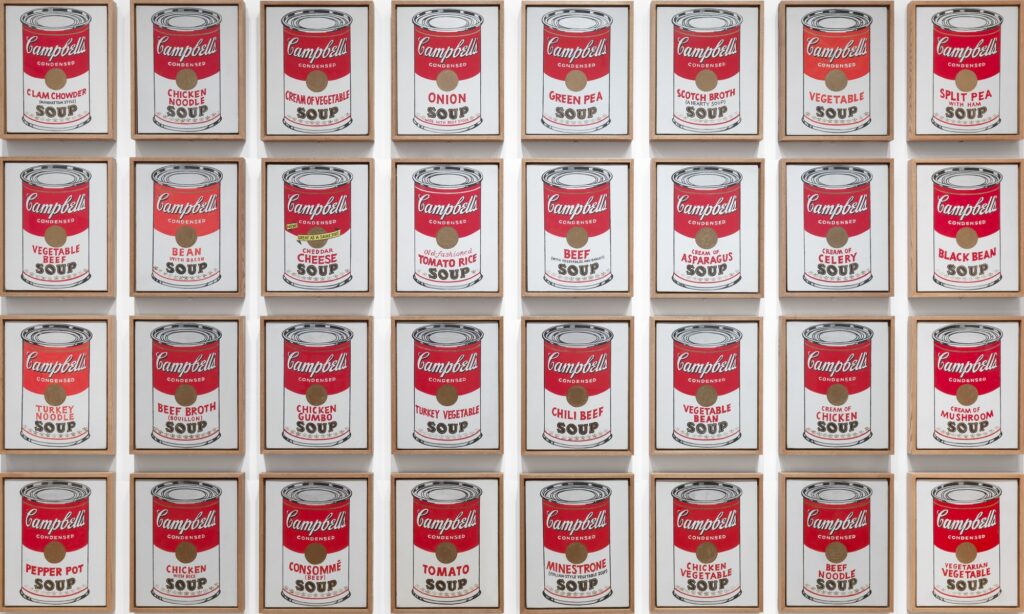
Picture this: a series of 32 canvases, each adorned with a different variety of Campbell’s Soup. That’s the essence of Warhol’s “Campbell’s Soup Cans.” Now, you might be wondering, why soup cans? Well, Warhol was a maverick, challenging conventional artistic norms. Instead of conventional subjects like portraits of landscapes, he opted for the mundane – soup cans. It was his way of proclaiming, “Even the ordinary can be extraordinary.”
Each canvas in the series portrays a soup can with remarkable uniformity, save for the labels denoting the flavor. This deliberate repetition underscores Warhol’s commentary on mass production and consumer culture. Through his art, he shines a spotlight on the homogenization of society, urging viewers to contemplate the implications of a world dominated by standardized goods.
Interesting Facts
Roots in the Grocery Store: Warhol’s fascination with everyday objects can be traced back to his childhood. Growing up, he spent countless hours working in his parents’ grocery store, surrounded by an assortment of products. Thus, when he immortalized soup cans on canvas, it was a nostalgic nod to his formative years.
The Soup Can Obsession: Surprisingly, Warhol’s affinity for Campbell’s Soup extended beyond the realms of art. Legend has it that he consumed Campbell’s Soup for lunch almost religiously. This personal connection imbued the series with a profound sense of authenticity.
Exploring Serial Art: “Campbell’s Soup Cans” exemplifies Warhol’s penchant for serial art, wherein a single motif is reiterated with subtle variations. Each canvas serves as a testament to the power of repetition, challenging viewers to discern nuances amidst uniformity. Warhol’s approach has even extended into contemporary design, inspiring creations like the Campbell’s Soup-themed skateboard decks.
Mixed Reactions: Upon its debut, Warhol’s soup cans elicited a spectrum of reactions. While some lauded its innovation, others dismissed it as trivial or superficial. However, as time elapsed, the series garnered widespread acclaim, solidifying Warhol’s status as a visionary provocateur.
Exploring the Depths
As we delve deeper into the kaleidoscopic realm of “Campbell’s Soup Cans,” we unearth layers of symbolism and significance. At its core, Warhol’s masterpiece transcends the confines of mere representation; it serves as a poignant commentary on the intersection of art, commerce, and culture.
The repetitive nature of the soup cans mirrors the mechanized processes of mass production, wherein individuality is subsumed by uniformity. Yet, amidst this sea of sameness, each flavor label emerges as a distinct entity, offering a glimpse of individuality amidst conformity.
Furthermore, “Campbell’s Soup Cans” invites contemplation on the commodification of art. By elevating a commonplace item to the realm of high art, Warhol challenges traditional notions of value and aesthetics. In doing so, he democratizes art, blurring the boundaries between the elite and the everyday.
Moreover, the series serves as a time capsule, encapsulating the zeitgeist of post-war America. In an era characterized by consumerism and conformity, Warhol’s soup cans serve as a poignant reflection of societal values and aspirations.
Artwork Spotlight: Wild Raspberries (Salad)
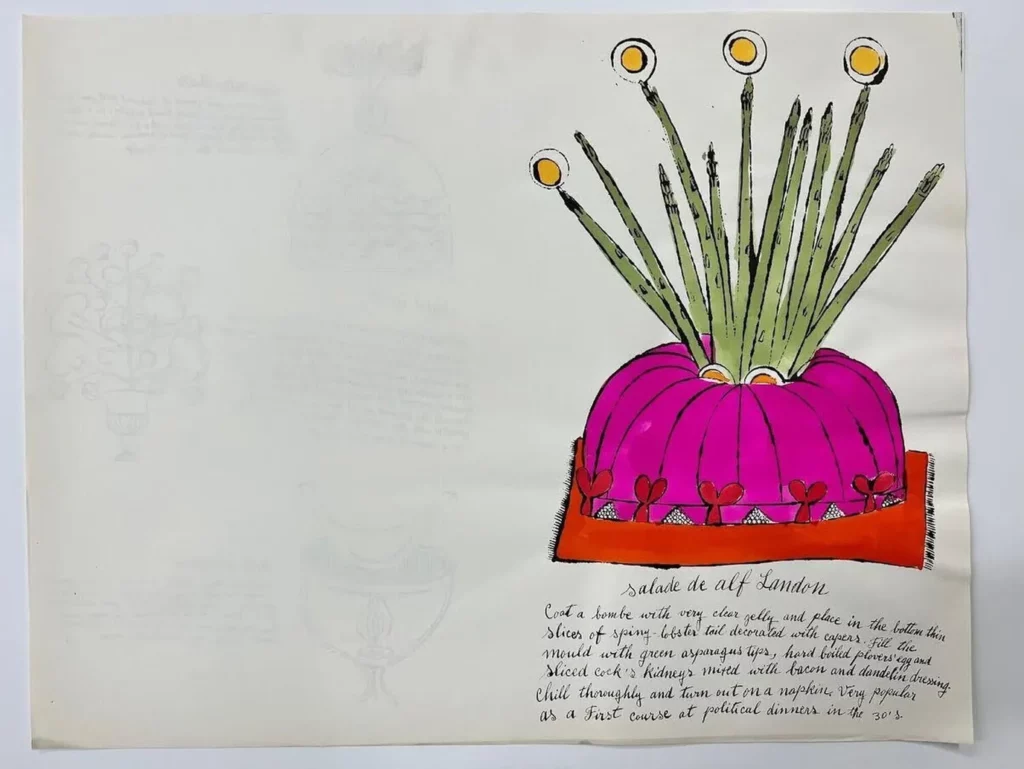
“Wild Raspberries (Salad)” is available on Singulart. It is a joyful and comic cookbook co-collaborated by Andy Warhol and Suzie Frankfurt, with engaging illustrations and quirky recipes. With penciled sketches by Warhol and written humor by Frankfurt, it is an artful and funny sensory exploration that brings art and food into each other’s orbit.
Are you looking for a masterpiece from Andy Warhol?
Singulart presents exclusive limited edition pieces by Andy Warhol. To discover and acquire Warhol’s art, click on the artwork or the button below for more information!
Frequently Asked Questions
What is the meaning of Campbell’s soup cans by Andy Warhol?
Numerous accounts propose that Warhol created the now legendary collection because he frequently enjoyed consuming the renowned soups as a customer. This personal attachment, coupled with a friend’s suggestion to depict something familiar to everyday Americans, prompted the selection of this iconic US brand.
How many Campbell soup cans did Andy Warhol paint?
Warhol crafted a series comprising 32 painted cans, initially showcased at Ferus Gallery in Los Angeles in 1962. These canvases portrayed the entirety of the brand’s soup offerings, spanning from Vegetable Made with Beef Stock to Chicken ‘N Dumplings and everything in between.
How much is Warhol’s soup can worth?
In no time, Warhol began employing silkscreen techniques to produce the celebrity portraits that would propel him to widespread recognition. Presently, the value of Warhol’s Soup Cans has significantly increased. The highest auction price for the series, reaching $11.8 million, was achieved by Small Torn Campbell’s Soup Can (Pepper Pot) in 2006.
Conclusion
Andy Warhol’s “Campbell’s Soup Cans” transcends the realm of mere artwork; it is a testament to the power of imagination, innovation, and introspection. Through his audacious exploration of everyday objects, Warhol invites us to question the very essence of art and its role in society.
As we gaze upon those meticulously crafted soup cans, let us not merely see cans of soup but symbols of defiance, expressions of individuality, and invitations to ponder the complexities of our modern world. In the vibrant tapestry of contemporary art, Warhol’s soup cans stand as beacons of creativity, beckoning us to embrace the beauty of the ordinary and the allure of the unconventional.