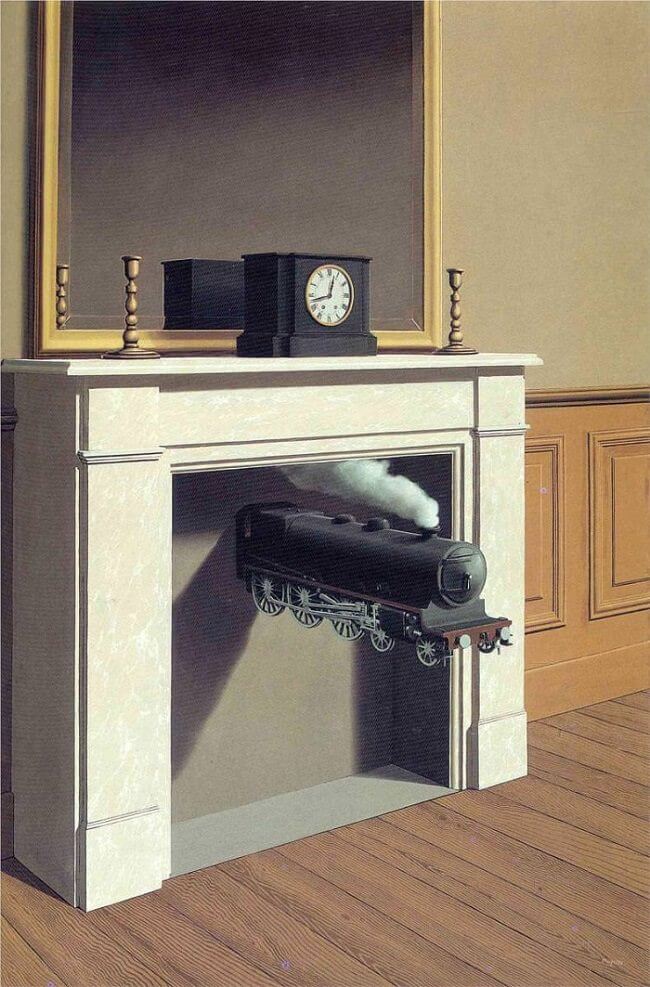
René Magritte, the Belgian predecessor of surrealism, is widely renowned for his peculiar paintings that bewilder the sense of reality and perception. It includes “Time Transfixed” which is a painting that is almost an optical illusion that leads its viewers to another dimension where the usual becomes bizarre. By careful details and extraordinary contrasts, Magritte makes us wonder about the essence of existence and the time flow. Here we go into the mysterious world of “Time Transfixed” and let us try to decipher the hidden mysteries.
Who was René Magritte?
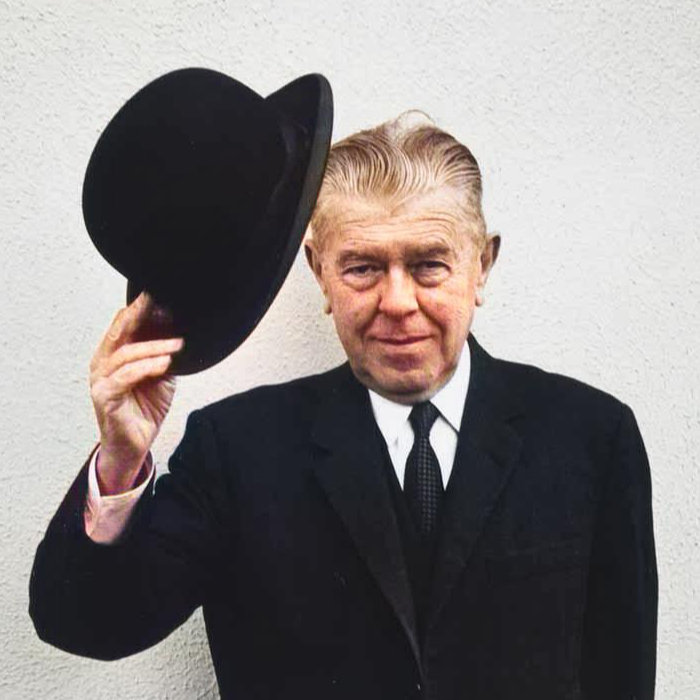
René Magritte (1898-1967) was a Belgian Surrealist painter known for his specific manner and the theme of the subconscious mind. Magritte, who was born in Lessines, Belgium, had the works of Cubism and Futurism as his early artistic inspiration. Nevertheless, it was the Surrealism led by André Breton that had the most far-reaching impact on him as an artist.
Magritte’s art frequently featured everyday objects in original situations, which questioned a viewer’s preconceived notions and invited them to consider the nature of reality. His accurate and detailed technique, as well as humorous imagery and language, led to a one-of-a-kind visual language that keeps attracting audiences even today.
FUN FACT: René Magritte’s artworks often contain hidden symbols and visual puns that offer viewers a deeper, symbolic meaning to ponder. For example, in “The Son of Man,” the apple obscuring the face of the suited figure suggests themes of identity and concealment.
His Career
Magritte’s evolution as an artist included multiple experiments with various styles and techniques, but he is mostly associated with Surrealism and defined by his involvement in it. From the 1920s to 1930s he created some of his greatest masterpieces for example “The Treachery of Images” (1929) which includes the picture phrase, “Ceci n’est pas une pipe” (This is not a pipe).
In contrast to Surrealism, with its improvisation and automatism, Magritte’s art was produced very meticulously and resulted in a precise expression of his ideas. Many of his work included realistic aspects with elements of fantasy creating an atmosphere of dreamlike uncertainty that is still enjoyable to modern viewers.
What is Happening in Time Transfixed?
| Artist | René Magritte |
| Date Created | 1938 |
| Medium | Oil on canvas |
| Genre | Surrealism |
| Period | Modern |
| Dimensions | 100 × 81 cm (39.4 × 31.9 in) |
| Series / Versions | None |
| Where is it housed? | Art Institute of Chicago, Chicago, Illinois, USA |
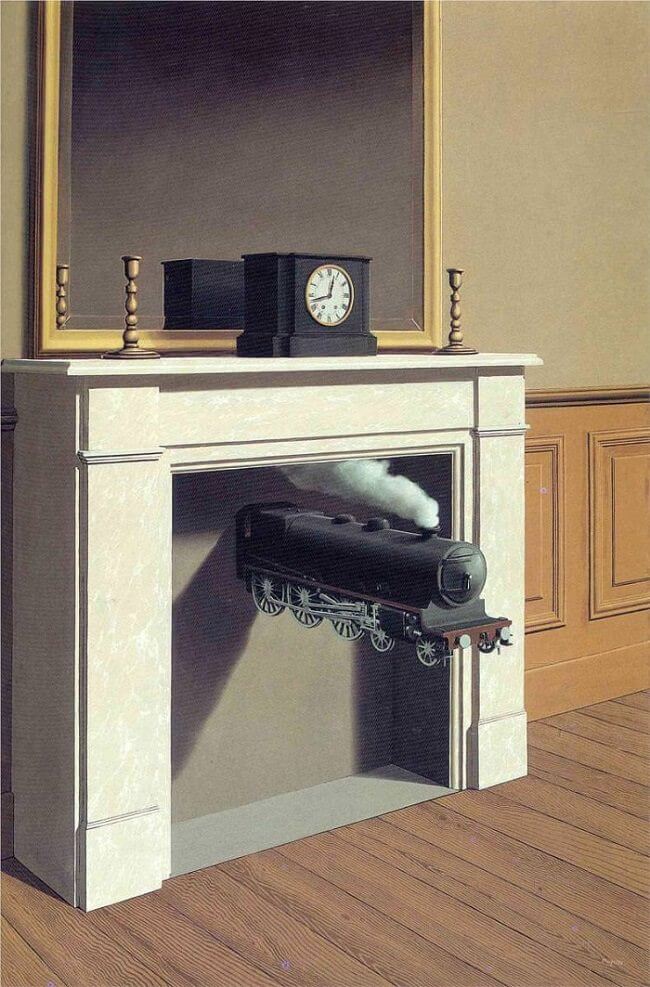
One of Magritte’s most well-known compositions was “Time Transfixed” (La Durée poignardée), which he created in 1938 and still draws crowds of amazed individuals. It is a mesmerizing portrayal of a locomotive emerging from a fireplace. The background is the typical living room in a bourgeois house, with fine accessories and the desirable wallpaper on the wall.
The scene looks routine at first glance but gradually, the viewer notices the abnormalities. Being a symbol of modernity and progress, the locomotive unexpectedly turns up within the domestic setting, which is a rather incredible and intriguing event. This presence is counter-intuitive and refutes the viewer’s sense of space and time.
The fireplace, being a conventional symbol of warmth and comfort, turns into a reality gateway, crossing the line between the normal and the extraordinary. It is the steam bellowing from the locomotive’s chimney, which makes the scenery look surreal, seemingly movement and energy frozen in time.
Interesting Facts about Time Transfixed
Inspiration: Magritte’s inspiration for “Time Transfixed” reportedly came from a childhood memory of seeing a train emerging from a dark tunnel, an experience that left a lasting impression on his psyche.
Double Meaning: The title “Time Transfixed” carries a dual meaning, referring both to the suspension of time and the piercing of duration, highlighting Magritte’s fascination with the fluidity of temporality.
Influence of Freudian Theory: Similar to his surrealist peers, Magritte drew from Freud’s psychoanalytic theories. Specifically, “Time Transfixed” embodies Freud’s notion of the uncanny. Disrupting familiar associations, it evokes unease and fascination.
Artwork Spotlight: Le Seize Septembre
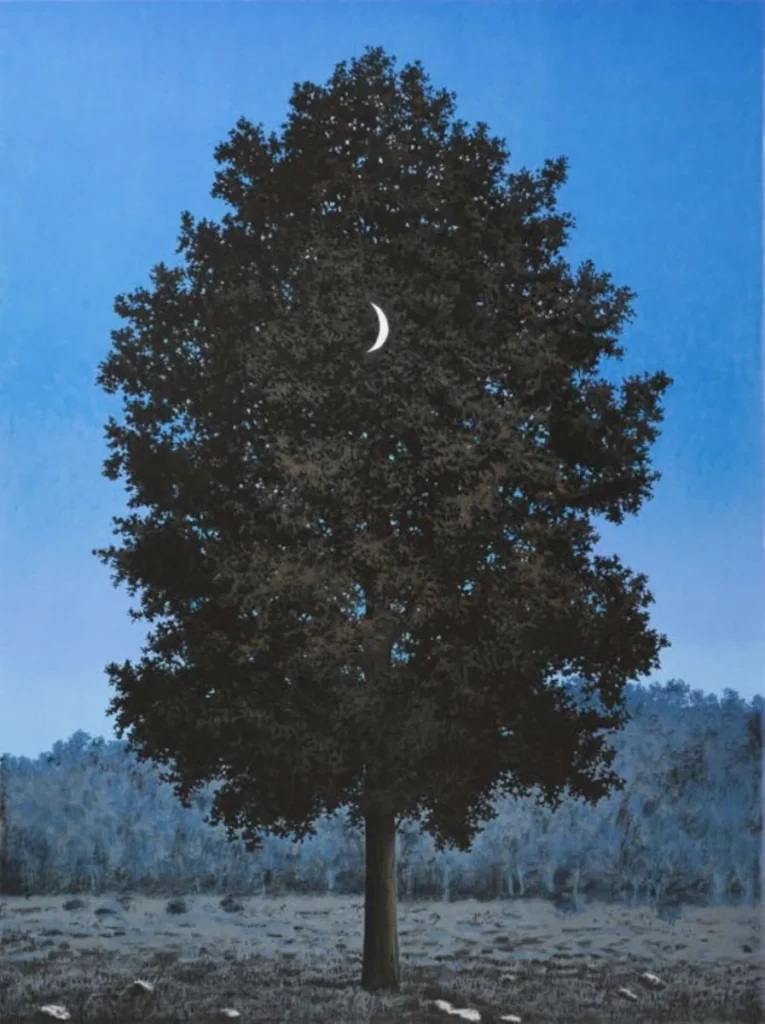
“Le Seize Septembre” by René Magritte is available on Singulart. It is an intriguing creation that is based on the contrast between ordinary objects put in uncommon ways, baffling the viewer’s sense of reality. This artwork, using surrealism, which depicts a comb, a pipe, and glass, stimulates viewers to reflect on the nature of representation and puzzle over the mysteries of the ordinary.
Are you looking for a masterpiece from René Magritte?
Singulart presents exclusive limited edition pieces by René Magritte. To discover and acquire Magritte’s art, click on the artwork or the button below for more information!
Frequently Asked Questions
What is the meaning behind René Magritte’s paintings?
René Magritte, a Belgian surrealist painter, subverted viewers’ conceptions of reality. His works often featured commonplace items in unusual settings, evoking a surrealistic feeling.
Why did René Magritte paint Time Transfixed?
During a period of exploration, Magritte created Time Transfixed. He aimed to reveal “poetic secrets” through contrasts. Challenging himself, he juxtaposed images to imply unseen objects. This approach intertwined philosophy and psychology.
Conclusion
In conclusion, Magritte’s ‘Time Transfixed’ showcases his creativity. Through collisions and signs, it ignites curiosity. The artwork provokes discussions on reality’s mystery. Examining the iron locomotive, emerging from fire, underscores the boundless potential of imagination and art’s power to transcend mundanity.