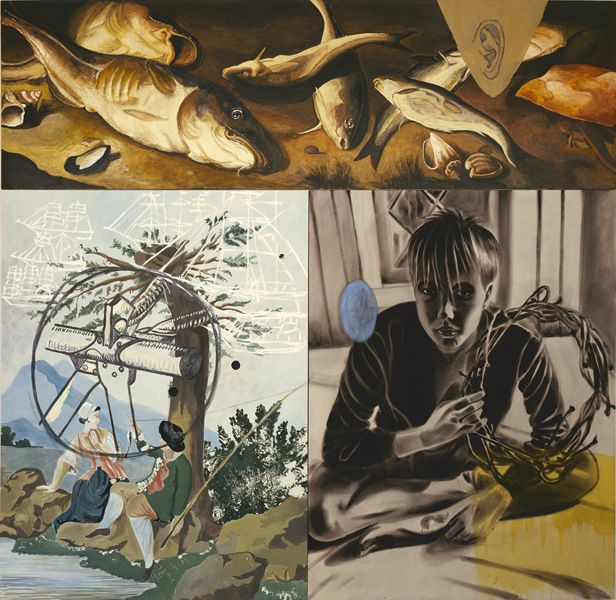
David Salle’s “Byron’s Reference to Wellington” is an example of the artist’s savvy in bringing together diverse parts into an interrelated narrative. This mysterious artwork challenges viewers to interpret and contemplate the layers of symbolism within. This article will take you on a journey through the life and career of David Salle, examine the complicated “Byron’s Reference to Wellington,” and share some unknown truths about Salle’s artistic vision.
Who was David Salle?

David Salle, born in 1952 in Norman and Oklahoma, rose to prominence as the main figure of the Neo-Expressionist movement in the 1980s. He graduated from the California Institute of the Arts and later moved to New York City, where he became an indispensable part of the contemporary art scene. The artist’s paintings are noted for their contradictory nature, cultural allusions, and the study of visual language.
FUN FACT: In the 1980s, Salle collaborated with choreographer Karole Armitage, creating set designs for her avant-garde dance productions.
His Career
Salle built a reputation in the 1980s for his original methods in painting that broke the rules of composition and narrative construction. He often would use details from advertisements, magazine imagery and art historical references in his paintings in order to bring to life vivid and exciting images. Salle has moved from one experiment to another, trying out different mediums like film, photography, and stage design in the recent years.
What is Happening in Byron’s Reference to Wellington?
| Artist | David Salle |
| Date Created | 1982 |
| Medium | Oil on canvas |
| Genre | Contemporary art |
| Period | Neo-Expressionism |
| Dimensions | 244 x 366 cm (96 x 144 in) |
| Series / Versions | “Byron’s Reference to Wellington” |
| Where is it housed? | Broad Art Foundation, Santa Monica, California, USA |
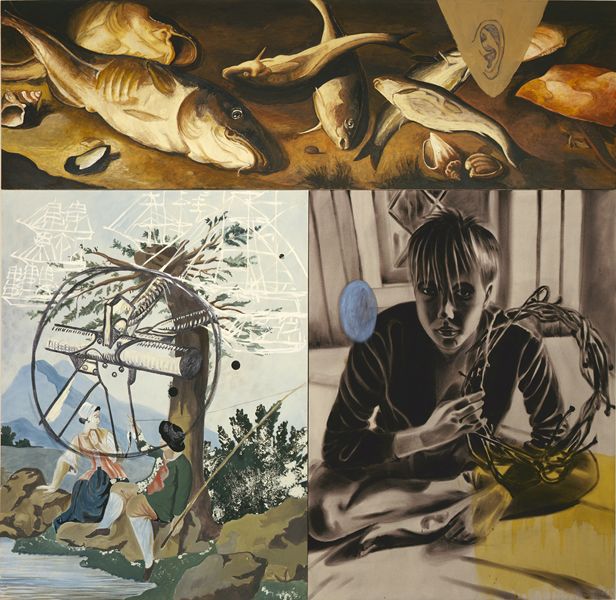
“Byron’s Reference to Wellington” is considered one of the best pieces by David Salle, dating back to 1982. It is the only instance of Salle’s larger group of paintings that often blurs the line between figuration and abstraction, reality and illusion. The title itself hints at the layered nature of the piece, referencing two iconic figures: The Romantic poet Lord Byron and the Duke of Wellington, a prominent military leader and statesman, Arthur Wellesley.
In “Byron’s Reference to Wellington,” Salle uses his customary collage method, juxtaposing different images and themes to produce an aesthetically pleasing composition. The painting shows some bits of objects, human bodies and living things, all together but without any pattern. These factors are painted with bright colors and an expressive brushwork, additionally to the general dynamic of the artwork.
The most intriguing feature of the “Byron’s Reference to Wellington” is its enigmatic narrative. Similar to most of Salle’s paintings, the artwork provokes different perceptions allowing the audience to determine its meaning on their own. The unexpected association of contrasting motifs seems to be about the complex interaction of themes and ideas that cover the issues of identity, memory, and perception.
Interesting Facts about the Artwork
Salle’s use of collage techniques in “Byron’s Reference to Wellington” reflects his interest in the fragmentation of contemporary culture. By appropriating and recontextualizing images from various sources, he challenges traditional notions of authorship and originality.
The title of the painting may allude to the romanticized notion of heroism and the complexities of historical memory. By referencing both Byron and Wellington, Salle raises questions about the construction of myth and the role of individuals in shaping collective narratives.
Artwork Spotlight: OverUnder Portfolio

“OverUnder Portfolio” by David Salle is available on Singulart. This artwork reveals the printmaking abilities of David Salle. The exhibition also shows Salle’s diversity as an artist by showcasing his use of a distinctive visual language across these different artistic platforms.
Are you looking for a piece of artwork from David Salle?
Singulart has limited edition prints of David Salle. If you are looking for a piece of Salle’s artwork for sale, simply click on the artwork or the button below to discover more!
Frequently Asked Questions
What is David Salle known for?
Salle quickly became well-known as a pioneer of the 1980s figurative painting movement. He started creating enormous paintings in 1983, some of which had references to art history. In 1983, the Museum Boijmans Van Beuningen in Rotterdam hosted his first solo museum exhibition.
What inspires David Salle?
His sketch is influenced by the extensive visual language of earlier works. Salle builds assemblages using models from popular culture, advertising, and art history, such as Velázquez, Bernini, Cézanne, Giacometti, and Magritte.
Conclusion
Salle’s “Byron’s Reference to Wellington” can be seen as the manifestation of the painter’s practice that is often marked by the layered imagery and ambiguous narratives. Salle defies us to rethink the nature of depiction and discourse in contemporary art by introducing collage techniques and disturbing subject matter.