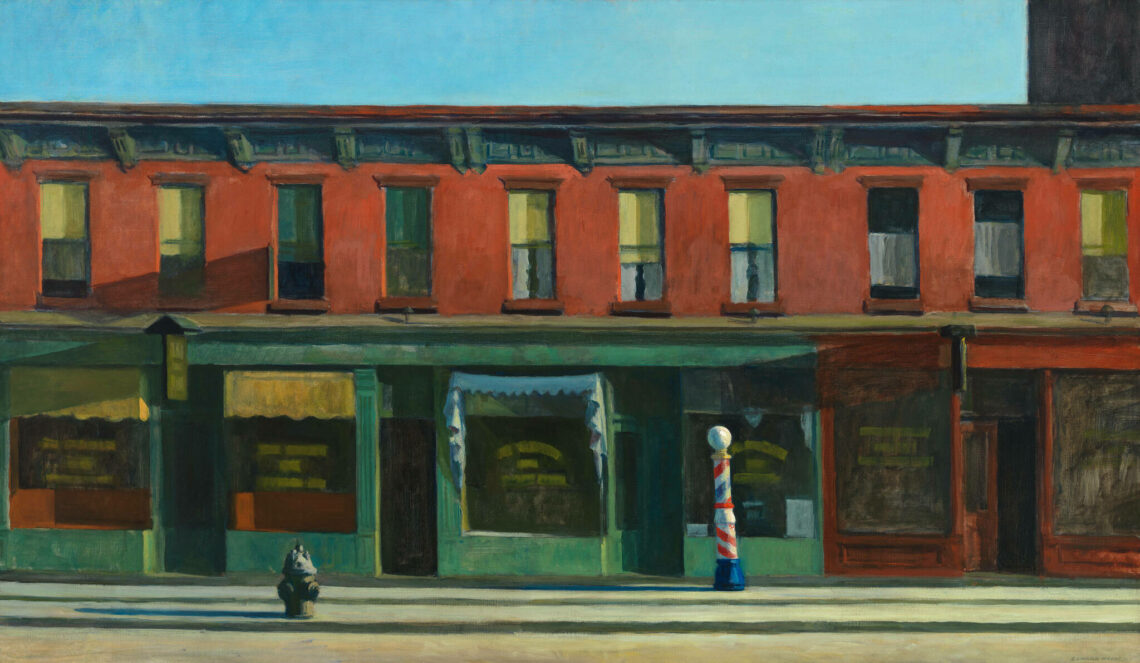
Sip your coffee and come with us to savour the serene streets of New York City where we will embark on Edward Hopper’s masterpiece of tranquility, created by the mood master himself! On a quiet Sunday morning, Hopper’s oil on canvas “Early Sunday Morning” captured the essence of life in America. Let’s explore the world of Edward Hopper, unwind the story behind the painting and make it interesting.
Who was Edward Hopper?
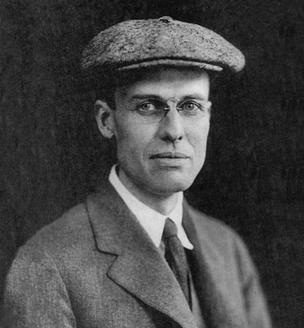
Edward Hopper, an American realist painter, was born in Nyack, New York, on July 22, 1882. He is one of the most acclaimed artists for his subtle and poignant renditions of everyday American scenes that reflect the feeling of loneliness and longing. Hopper manifests his distinctive style, which is characterized by sharp lines, strong contrasts of light and shadow, and the utmost of detail, as a significant contribution to the art world.
FUN FACT: Despite being known for his paintings depicting urban solitude, Hopper was actually quite sociable and enjoyed people-watching.
His Career
Hopper’s real artistic career started off when he enrolled in the New York School of Art and Design in 1900. At first he did not have his own style, he had tried several styles until in the end he found himself in realism. Hopper’s work was consistently critically and commercially acclaimed during his career, thus earning him a reputation as one of the leading American artists of the century.
What is Happening in “Early Sunday Morning”?
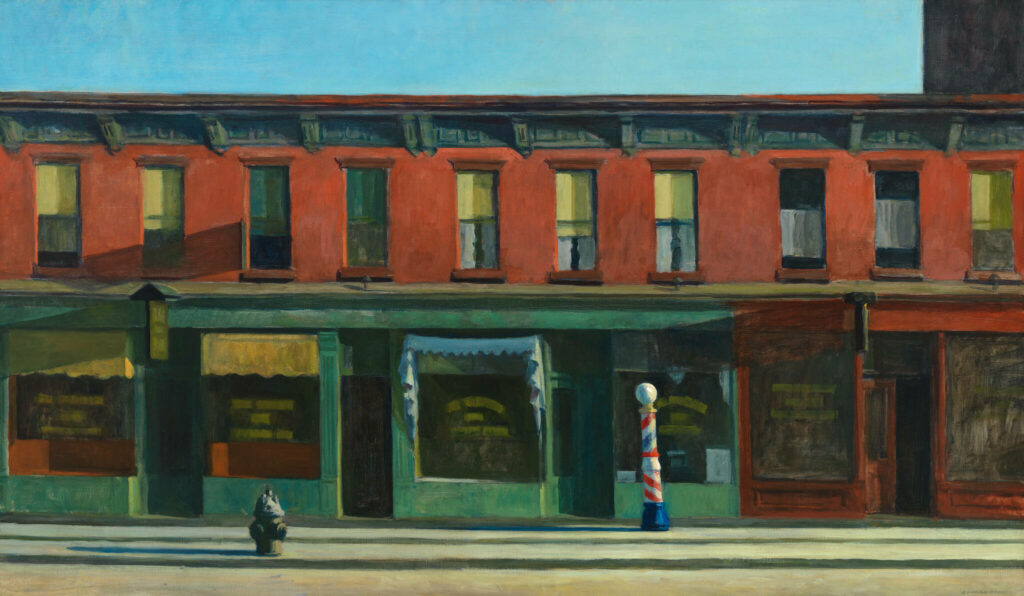
| Artist | Edward Hopper |
| Date Created | 1930 |
| Medium | Oil on canvas |
| Genre | Realism |
| Period | 20th century |
| Dimensions | 56 x 91 cm (22 x 36 in) |
| Series / Versions | – |
| Where is it housed? | Whitney Museum of American Art, New York City |
Now, let’s zoom into one particular masterpiece: “Early Sunday Morning.” It is as if a time machine was dialed back to 1930, where the streets of the city of New York are so empty, you can almost hear the pigeons snoring. Hopper painted a lineup of shops getting some rest,their windows and doors shut tightly,almost as if they were saying”Oh, no folks! Not today! It’s Sunday!”
But here’s the kicker: there’s not a living creature around! It’s like the city’s hit the snooze button, and we had the privilege of viewing the serenity before the storm.The sunlight? Hey, it’s playing peek-a-boo, the sun is creating dancing shadows on the street like they are competing for a Broadway performance spot.
Analysis
Now, let’s don our detective hats and probe the “Early Sunday Morning” painting. Hopper wasn’t there only to depict a scene, but he was carefully crafting an emotional journey that the observer will embark on. An impression of emptiness and places that are out of business may be superficial at first, but as we look closer, we will see layers of meaning and mood.
The lack of human images helps in deeply depicting loneliness and calmness, revealing the silence of early mornings in the city to us. The peacefulness of the beginning of the day seems to have been captured so perfectly that it gives the viewer the chance to soak in the tranquil beauty of the changing season.
However, we think it is those small and unnoticeable touches that make this painting extraordinary. Look deeper into the storefronts and you will find that the windows and doors have complicated patterns, the game of light and shadows moves alternately across the facade. Every detail is meticulously portrayed, contributing to the overall mood and environment of the moment.
Interesting Facts
Hidden Detail: Ever noticed the barber pole outside one of the shops? That’s not just a pole; it’s a timekeeper, reminding us that even on lazy Sundays, time keeps on tickin’.
Influence of Photography: Hopper wasn’t just a painter; he was a visual Sherlock, using his camera like a magnifying glass to capture the perfect shot. No wonder his paintings feel like snapshots frozen in time!
Ambiguous Timeframe: “Early Sunday Morning” might be set in 1930, but guess what? It’s got that timeless vibe that makes it feel like it could be yesterday or a hundred years from now. Talk about staying power!
Emotional Resonance: For a painting with no people in sight, “Early Sunday Morning” sure packs an emotional punch. It’s like the quiet before the storm, inviting us to pause, ponder, and maybe even find a little peace in the chaos of city life.
Legacy: Hopper’s masterpiece isn’t just a pretty painting hanging on a wall; it’s a cultural icon! It’s inspired everyone from artists to filmmakers, proving that sometimes, the quietest moments speak the loudest.
Frequently Asked Questions
What was Edward Hopper best known for?
Most people agree that Edward Hopper (1882–1967) was the most important American realist painter of the 20th century. Even while Hopper also created etchings and watercolors, his oil paintings—which frequently evoke a feeling of sorrow or loneliness—are his most well-known works.
How did Edward Hopper learn to do art?
Hopper’s parents urged him to pursue business illustration rather than fine art after he graduated from high school in 1899. In order to fulfill his dream, he enrolled for a year at the Manhattan-based New York School of Illustration before moving to the more somber New York School of Art.
Conclusion
“Early Sunday Morning” is not just a painting. It is a reflection into the soul of America. It is a captured moment which is frozen in time and a reminder that there can be beauty even in the midst of the busyness of the city life. Thus, the next time you are walking in the city on a lazy Sunday morning, stop and watch around you.Who knows? Now it is possible you could even become the main character of one of his paintings.