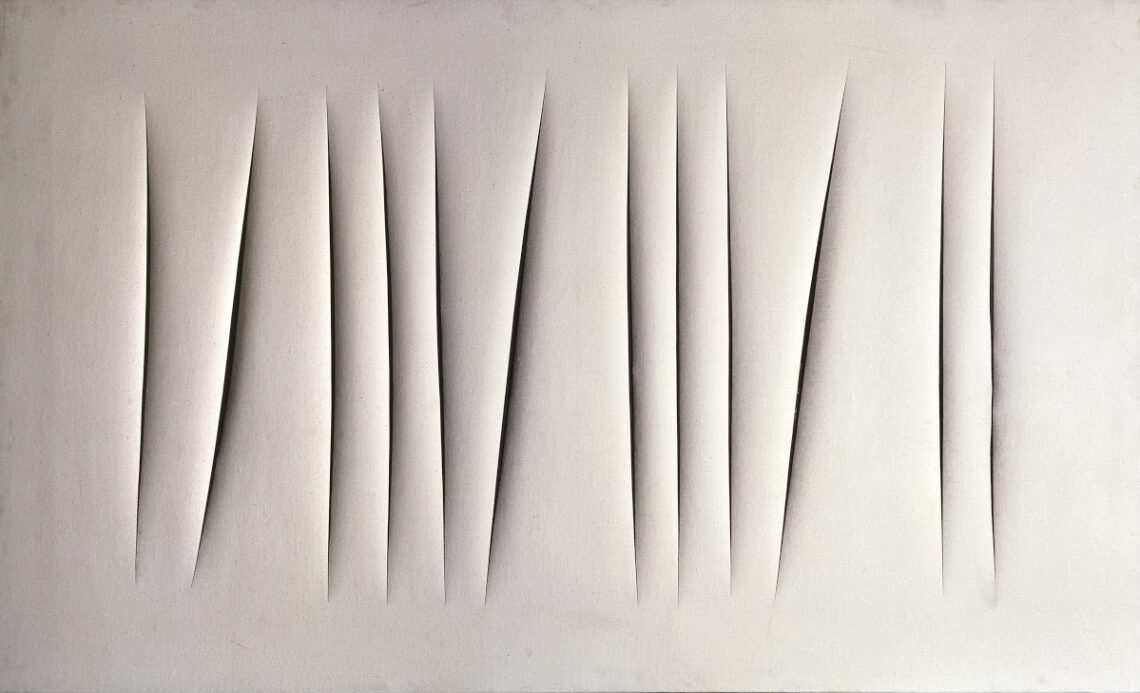
Lucio Fontana, an important figure in 20th-century art community, experiments with the notions of space and form in a new way. One of his most exciting works “Spatial Concept, Waiting” is a manifestation of his cutting-edge ideas and creative sensibilities. In this article, we’ll tell you the life of Luci Fontana, examine his work, analyze the nature of the painting “Spatial Concept, Waiting” and find some interesting facts about this great artist.
Who was Lucio Fontana?
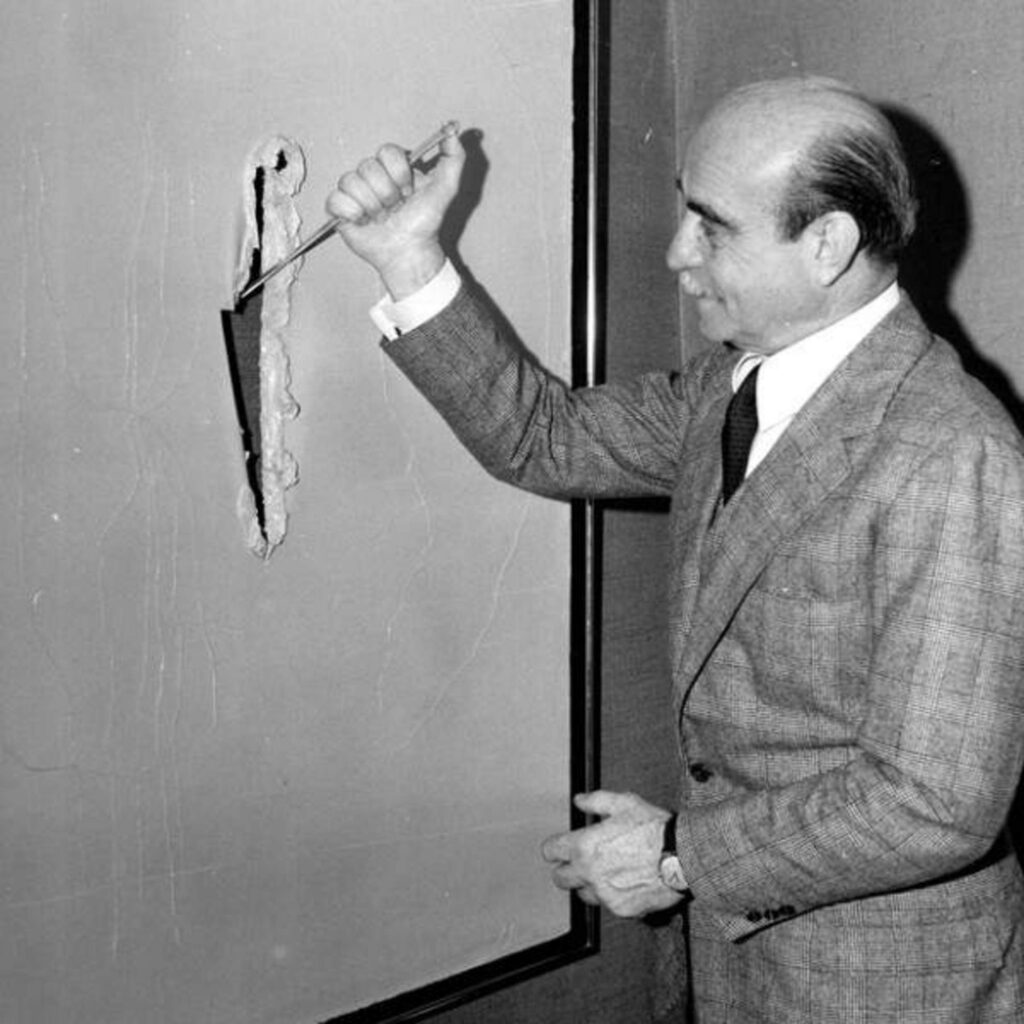
Lucio Fontana (1899-1968) was an eminent artist of Argentinean-Italian origin who created Spatialism, a new movement of artistic expression that involved space as an important artistic element. Born in Rosario, Argentina, Fontana relocated to Italy in his youth, where he enrolled at the Academy of Fine Arts in Milan to study sculpture and painting. His earliest works of his clearly suggest his predilection for the interrelation of light, space, and form which would ultimately be the main focus of his later artistic period.
FUN FACT: Lucio Fontana’s iconic art movement, Spatialism, not only challenged traditional notions of space in art but also inspired the Italian fashion house Versace, who incorporated his punctured canvas motifs into their designs.
His Career
Fontana’s professional career extended over many decades and covered a wide range of artistic activities, such as painting, modeling, and ceramics. Nevertheless, he has become recognized above all for his innovative concept of canvas as a three-dimensional space, which he discovered and explored through his famous “Spatial Concepts” series of paintings. These pieces, with their striking holes and slashes, deviated from tradition and encouraged the audience to explore the inner depths of space within the artwork.
Fontana’s artistic path was paved with unending search for novelty and experimentation. In the 1940s, he established the Spatialist Manifesto, wherein he laid down his idea of the new art form that would go beyond the limits and borders of traditional art forms. All the time, Fontana was pushing the limits of artistic forms, looking for new ways of implementing the space and time in his masterpieces.
What is Happening in Spatial Concept, Waiting?
| Artist | Lucio Fontana |
| Date Created | 1960 |
| Medium | Canvas, cuts |
| Genre | Spatialism |
| Period | 20th Century |
| Dimensions | 73 x 92 cm |
| Series/Versions | Part of the Spatial Concept series |
| Where is it housed? | Private Collection |
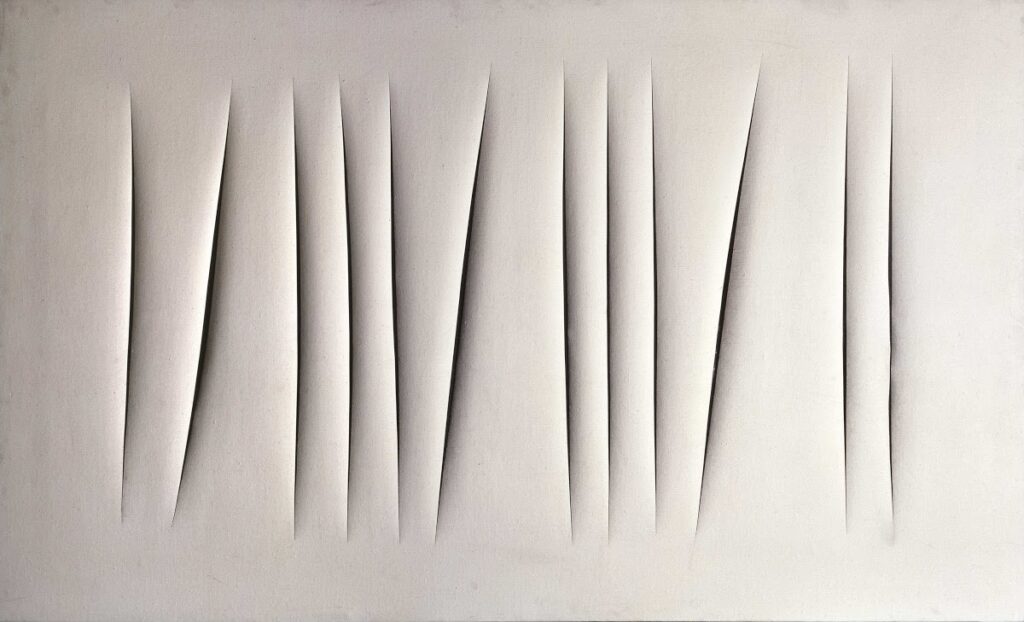
“Spatial Concept, Waiting”, a 1960 work, is an awe-inspiring illustration of Fontana’s unraveling of space and dimensionality. Carried out in his style, the artwork showcases a perfectly smooth white canvas interrupted by a set of accurate cuts that are put together into a free- flowing composition that appears to defy the gravity. The holes, carefully aligned in the circular order, give an impression of the movement and depth and suck the viewer into the boundless world behind the painting.
Additionally, Fontana’s application of punctures is not only a means of disrupting the canvas’ surface but also stands as a metaphor for going beyond the constraints of traditional methods of art. Through stapling the canvas, Fontana blurs the limits between the work of art and its surrounding space, inviting the viewers to interact with the void which goes beyond the surface and speculate the possibilities that the universe offers.
Unveiling the Essence
“Spatial Concept, Waiting” is a work that conveys Fontana’s view of Spatialism, which aimed to emancipate art from the limitations of two-dimensionality and provoke the viewer to take part in space as something fluid. The hole punched into the canvas represents a way of accessing the indefinite, encouraging the visitors to embark on a voyage through space and time. If translated into Fontana’s language, the holes imply “a dynamic plane of the reality that proceeds off the canvas”.
The title “Waiting” emphasizes all the symbolism of the painting, pointing to the expectation of what is on the back side of the painting. It suggests an anticipation impression, as if the art piece is about to unfold a deep truth about the mystery of life. Actually, “Spatial Concept, Waiting” gives us an opportunity to experience the world between reality and the imagination, to think about the mysteries of the universe, and the infinite capability of the human mind.
Interesting Facts about Spatial Concept, Waiting
Interactive Experience: Fontana intended for his Spatialist works to be experienced not just visually, but also physically. He encouraged viewers to interact with the artworks, running their fingers along the punctured surface to feel the texture and depth of the cuts.
Influence on Contemporary Art: Fontana’s Spatial Concepts had a profound influence on subsequent generations of artists, inspiring movements such as Minimalism and Conceptual Art. His innovative approach to space and form continues to resonate with artists and audiences alike, shaping the trajectory of contemporary art.
Multiplicity of Interpretations: “Spatial Concept, Waiting” invites a multitude of interpretations, ranging from philosophical reflections on the nature of existence to contemplations of the cosmos. Its enigmatic title, combined with its ethereal composition, encourages viewers to imbue the artwork with their own meanings and associations.
Artwork Spotlight: Space Concept

The “Space Concept” or “Concetto Spaziale” series of Lucio Fontana is available on Singulart. This artwork consists of simple canvases with cuts or holes made with accuracy. Such works are concerned with the connection of space with matter, thereby crossing the conventional frontier of art.
Are you looking for a piece of artwork from Lucio Fontana ?
Singulart has limited edition prints of Lucio Fontana. If you are looking for a piece of Fontana‘s artwork for sale, simply click on the artwork or the button below to discover more!
Frequently Asked Questions
How did Lucio Fontana cut his canvas?
Fontana would use a Stanley knife to make cuts in his canvases. He worked on the rips and used gauze to hold them in place when the paint had dry. He used both his hands and brushes in this process
What inspired Lucio Fontana?
The idea of space and space travel fascinated the artist. Shortly after the globe saw the first images of Earth taken from space, he established the Spatialism art movement in 1947.
Conclusion
“Spatial Concept, Waiting” still fills the world with its ageless reflection on space, shape, and the endless mastery of art. While viewers are standing here in front of this transformative work of art, they are given an opportunity to go on an astral journey led by the visionary spirit of Lucio Fontana.