Jeff Wall is a towering figure in contemporary photography and is renowned for his innovative approach to image making and his ability to shake established norms of photography. His most famous work, “The Destroyed Room” from 1978, perfectly depicts his compositional skills, stories, and visual narration. Through his thoughtful styling and impeccable attention to detail, Wall hints at a realm of obscurity and mystery for the viewers. This article will reveal the captivating charm of the “The Destroyed Room” and will also discuss its implications on its production, interpretation and influence in the world of art.
Who was Jeff Wall?

Think of a mixtape of art history and photography, in which you will have Jeff Wall, a general, who didn’t just take pictures, but wanted to play the whole symphony with his camera lens. Being the native of Canada and a city of the maple syrup and politeness, Vancouver, Wall stepped into the art scene back in the late sixties, with an ambition to break boundaries and contest norms. Wall didn’t just take pictures of moments. He created stories and blurred the line between reality and imagination, just like a magician of the visual arts should do.
His Career
In an array of colors that modern art offers, Jeff Wall’s work shines like a neon sign in dark night. Wall gained rockstardom in the art world by his larger-than-life pictures that combined the drama of cinema with the accuracy of photography. From carefully staged scenes to eye-catching compositions, he didn’t only attract the public, but he insisted on it. The power of every click of his camera was to let spectators into a place where reality hops with creativity.
What is Happening in “The Destroyed Room”?
| Artist | Jeff Wall |
| Date Created | 1978 |
| Medium | Photograph |
| Genre | Contemporary Art |
| Period | Postmodernism |
| Dimensions | Variable |
| Series/Versions | N/A |
| Where Housed? | Museum of Modern Art, New York |
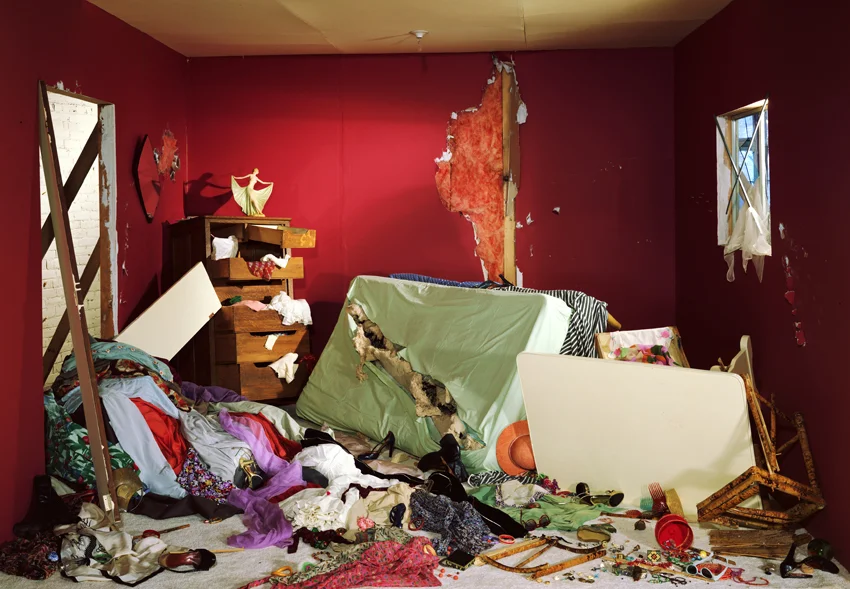
“The Destroyed Room” was made in 1978 and remains one of the most famous paintings by Jeff Wall. Upon closer examination, it becomes evident that the broken furniture and scattered items suggest a moment of extreme catastrophe that was stopped in time. But if you look carefully, the scene is in fact not the original event documented in real life, but a very precisely arranged tableau.
The photograph takes Delacroix’s painting “The Death of Sardanapalus” as inspiration but revisits the chaotic scene in a modern context. Wall’s meticulous attention to detail is unmistakable in every part of the painting, from the well-ordered junk to the dramatic lighting that creates tension and theatrical effect.
Interesting Facts about “The Destroyed Room”
Inspired by Art History: Jeff Wall’s “The Destroyed Room” pays homage to Eugène Delacroix’s 19th-century masterpiece “The Death of Sardanapalus,” a painting renowned for its depiction of excess and decadence. By reinterpreting this iconic work within a modern framework, Wall creates a dialogue between past and present, inviting viewers to reflect on themes of violence, destruction, and consumer culture.
Meticulously Staged: Despite its realistic appearance, “The Destroyed Room” is a meticulously staged tableau, with every element carefully arranged by the artist. Wall’s attention to detail is evident in the composition, with each object and fragment of debris contributing to the overall narrative of the image.
Ambiguity and Interpretation: Like much of Wall’s work, “The Destroyed Room” is imbued with ambiguity, inviting viewers to interpret the scene in their own way. While the image appears to depict a moment of violence, the absence of human figures leaves the narrative open to interpretation, allowing viewers to project their own emotions and experiences onto the scene.
Challenging Traditional Notions of Photography: “The Destroyed Room” exemplifies Jeff Wall’s commitment to challenging traditional notions of photography. By creating elaborate, staged compositions that resemble paintings or film stills, Wall blurs the boundaries between different artistic mediums, expanding the possibilities of what photography can be.
Frequently Asked Questions
How did Jeff Wall create a sudden gust of wind?
In order to create the piece, Wall spent five months taking pictures of actors in a setting outside of Vancouver, British Columbia, often during similar weather. He then used digital collage to combine parts of the shot to create the desired composition.
What is Jeff Wall famous for?
Jeff Wall is a well-known artist most recognized for his large-scale backlit Cibachrome images and writings on art history.
Conclusion
Jeff Wall’s “The Destroyed Room” serves as a proof of the artist’s capacity to defy standards, spark debate, and surmount the obstacles of documentary photography. Its deliberate framing, enigmatic story line and the dominant images all enable the viewers to delve into the multifaceted issues of violence, consumer world and interplay between reality and fiction. “The Destroyed Room” as an integral part of modern art succeeds in bewitching and exalting viewers from all over the globe thus making Jeff Wall one of the pioneers of the media.