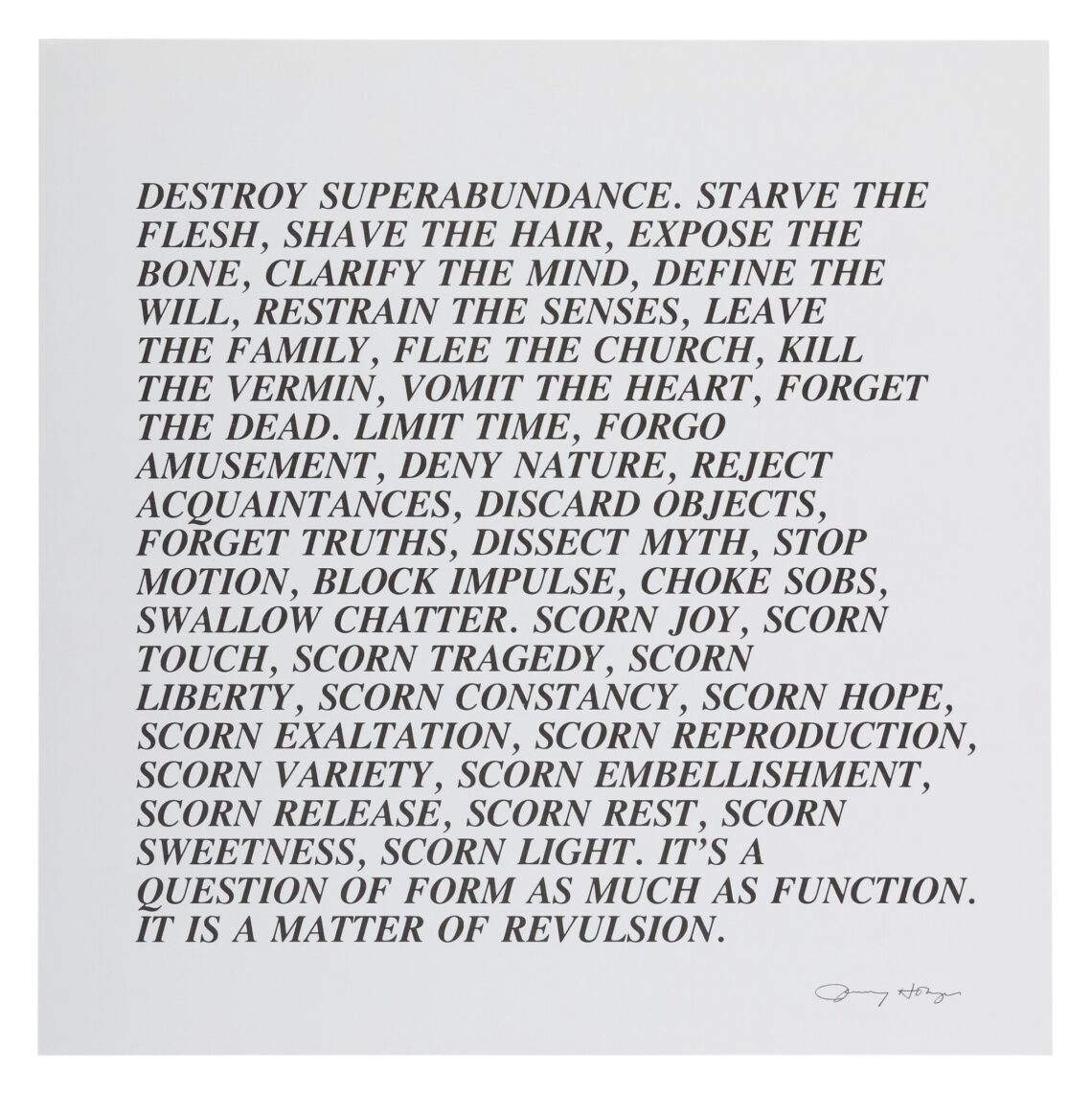
In today’s contemporary art, only a few names can be compared with Jenny Holzer when it comes to recognition and respect. As a renowned artist, her works are always characterized by being both thought-provoking and challenging of common norms and traditions. She has established a special domain in the art world with her influential installations and strong messages. For instance, her well-known series, “Inflammatory Essays,” exemplifies her courage to deal with the critical issues and the unfailing desire to provoke discussion and argument. In this article, we plunge into the mysterious universe of Jenny Holzer to investigate the captivating fascination of “Inflammatory Essays” by highlighting its importance and staying power.
Who was Jenny Holzer?

Jenny Holzer, who was born in 1950, in Gallipolis, Ohio, is an American conceptual artist who has gained both nationally and internationally to scrutinize political issues and instill contemplation on personal questions. Holzer’s artistic career started by creating abstract paintings but in the late 70s she began using language, incorporating words to express her strong messages in public places.
FUN FACT: Did you know that Jenny Holzer originally studied painting before transitioning to text-based art? It’s a fascinating evolution from one medium to another, showcasing her versatility as an artist
Her Career
Holzer gained immense popularity in the 1980s when she created the Truisms series, a collection of aphoristic statements that she placed in public spaces using LED signs, posters, and other mediums. It was then that she embarked on an investigation of the relation between language, power, and the public realm. Throughout the years Holzer has proved to be a controversial artist who carries her torch in the area of installations, sculptures and projections that touch on the reality of war, violence, and consumerism.
What is Happening in Inflammatory Essays?
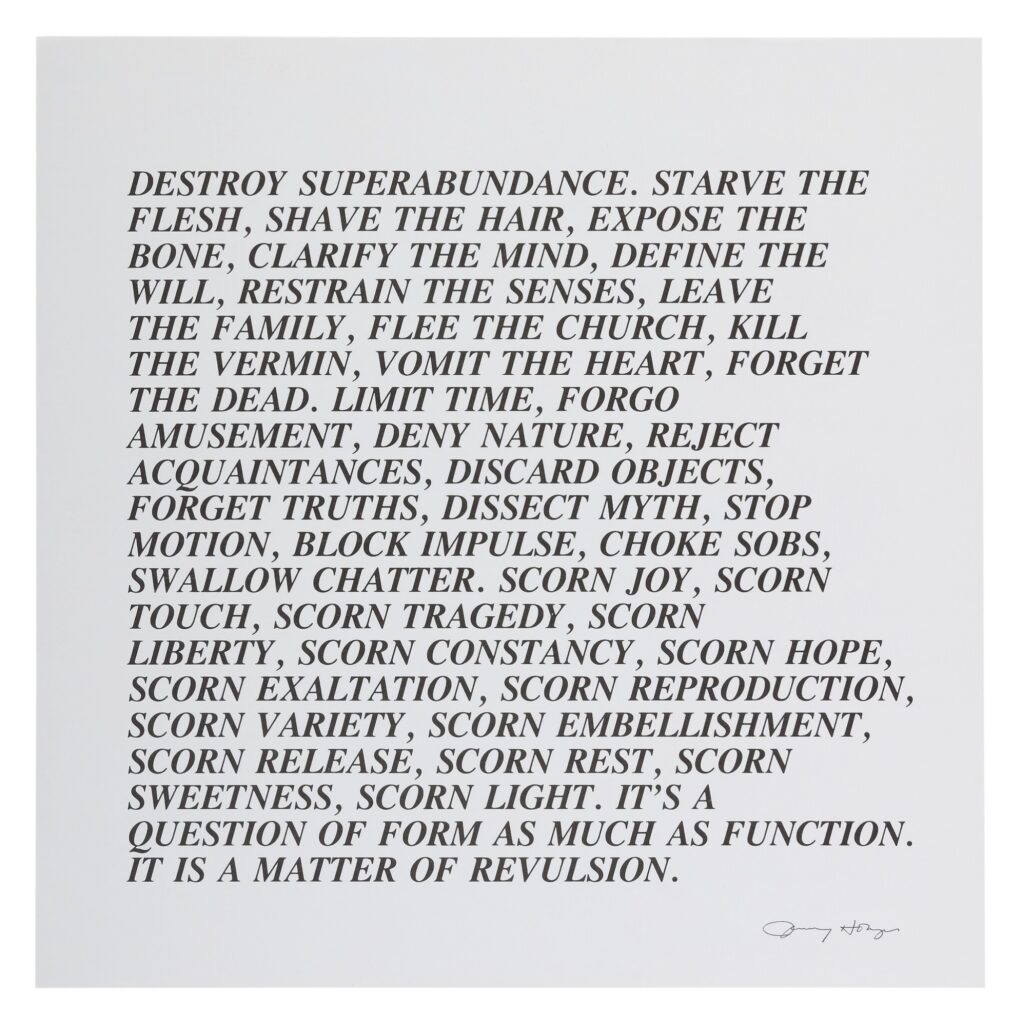
| Artist | Jenny Holzer |
| Date Created | Late 1970s to early 1980s |
| Medium | Printed text on colored paper |
| Genre | Conceptual art |
| Period | Contemporary |
| Dimensions | Variable |
| Series/Versions | 100 essays |
| Where is it housed? | Private collections and museums worldwide |
In the late 1970s, when the socio-political atmosphere was electric with tension and unrest, Jenny Holzer embarked on a fearless artistic project which would become her hallmark – “Inflammatory Essays.” The series consisted of 100 separate thought-provoking statements containing potent messages each specifically created to nudge people towards dialog, shift their mindsets and make them consider.
Holzer’s choice of medium is as precise as it is effectual. The essays, printed in all capitals on colored paper are mind-catching. This technique of deliberately using colors in addition to words gives a sense of being real and stronger which urges the individuals to take action. From the angry reds of revolution to the gentle blues of meditation, each of these colors becomes a visual cue to the observer, guiding him or her through various thoughts and feelings.
Interesting Facts about “Inflammatory Essays”
Bold Statements: Holzer’s essays are characterized by their directness and confrontational tone. Each statement is designed to provoke a reaction, challenging viewers to confront uncomfortable truths about society and themselves.
Colorful Palette: The use of colored paper adds another layer of meaning to the essays, with each hue evoking different emotions and associations. From vibrant reds symbolizing passion and anger to cool blues representing calmness and detachment, the choice of color enhances the impact of the text.
Public Engagement: Holzer originally distributed the essays as posters wheat-pasted onto walls in public spaces, blurring the boundaries between art and activism. By bringing her work outside the confines of traditional gallery spaces, she democratized art and made it accessible to a wider audience.
Endless Interpretations: The open-ended nature of the essays invites multiple interpretations, allowing viewers to project their own experiences and beliefs onto the text. This ambiguity fosters a dynamic interaction between the artwork and its audience, sparking dialogue and debate.
Artwork Spotlight: Sense

“Sense” is also available on Singulart. While the declaration “Sense” is a simple yet powerful statement, it calls us to challenge our view of the world and our place within it.
Are you looking for a masterpiece from Jenny Holzer?
Singulart presents exclusive limited edition pieces by Jenny Holzer. To discover and acquire Holzer’s art, click on the artwork or the button below for more information!
Frequently Asked Questions
When did Jenny Holzer become famous?
In an iconic 1982 event, Holzer displayed on the massive Spectacolor electric signboard in Times Square, made possible by sponsorship from the New York Public Art Fund. With the 1986 piece Under a Rock, Holzer started distributing her texts across larger media.
What materials does Jenny Holzer use?
Jenny Holzer uses a variety of mediums, such as printed materials, billboards, paintings, carved stone, electronic signs, and billboards, to place text in public areas.
Conclusion
Jenny Holzer’s “Inflammatory Essays” has left an indelible mark on contemporary art, as it pushes the limits and defies the norms with its merciless, uncompromising stance. Through the use of words that arouse thought and get you involved, Holzer challenges us to deal with human experience complexity and work for a better and more just world.