In the kaleidoscope of artistic brilliance that defined the Art Deco movement, one name shines brightly: Erté. Born in St. Petersburg in 1892, Erté’s pathway through the gates of creativity ended up in Paris. He became the one with the city’s artistic life that boiled in the 1920s. Recognized by his elegant and sophisticated works, Erté’s legacy lives on in his art, which reflects his unique vision and creation skills. Among his famous pieces, “Symphony in Black” attracts people’s attention with its idea of never-ending beauty and elegance. Let us venture into Erté’s mysterious masterpiece, unveiling its hidden details, unraveling its secrets, and discovering the mysteries within.
Who was Erté?

Erté, born Romain de Tirtoff, the Russian-born French artist and designer, made a great contribution to fashion, theater, and art. Since his childhood, Erté revealed an incredible talent for arts. Later, he developed his skills in St. Petersburg and then moved to the artistic mecca of Paris. His career lasted several decades, during which he gained popularity with the Art Deco style that was known for its elegance, sophistication, and geometric motifs. Erté’s works in fashion illustration, theatre, and visual arts established him as a groundbreaking artist of the 20th-century cultural arena.
FUN FACT: Erté didn’t limit his artistic talents to just one medium. In addition to his iconic fashion illustrations and mesmerizing artworks, Erté also designed sets and costumes for numerous theatrical productions.
His Career
During the 1920s, a golden decade for Erté, his career reached an all-time high fueled by the bohemian spirit of Paris. He made his name as a progressive creator and designer, charming his audiences with his ultra-modern productions. He illustrated for magazines such as Harper’s Bazaar and elevated fashion illustration to a higher level of artistic expression, thus becoming a well-known name. In addition to fashion design, Erté also possessed great skill in designing theater costumes and sets that created magical environments for shows like the Folies Bergère. Erté has always been the guardian of artistic innovations and originality. However, he has continued to break the limits and mark forever to the cultural sphere.
What is Happening in Symphony in Black?
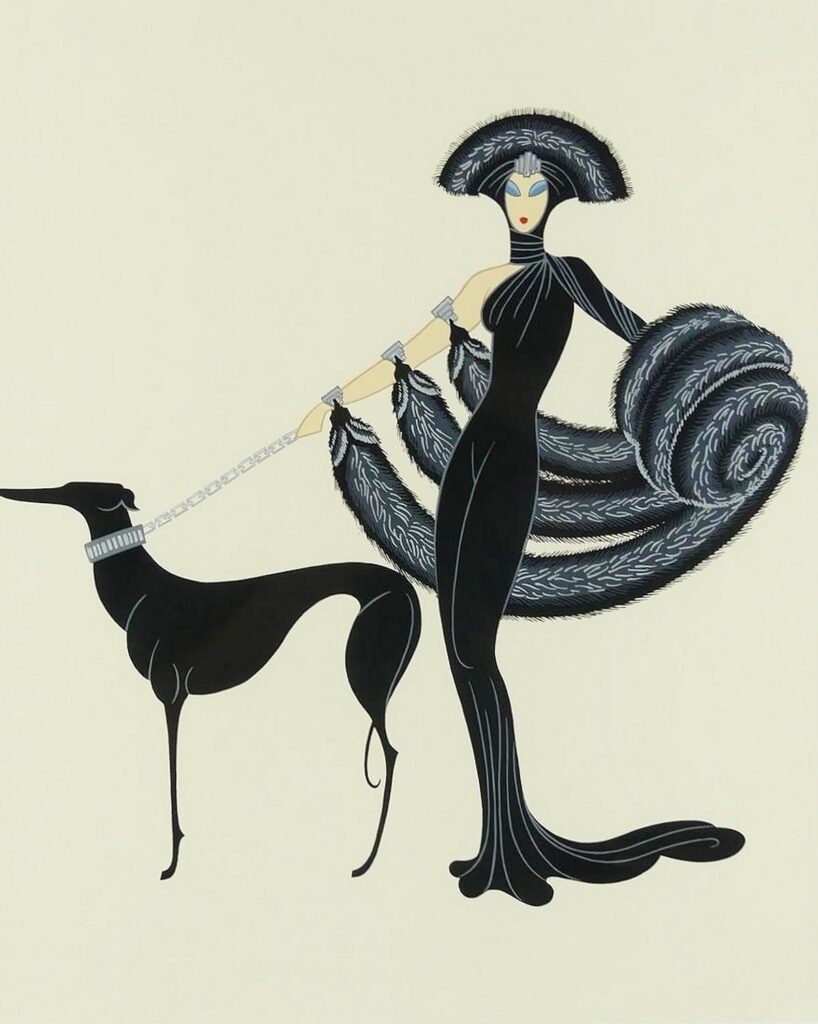
| Artist | Erté |
| Date Created | 1923 |
| Medium | Gouache on Paper |
| Genre | Art Deco |
| Period | 20th Century |
| Dimensions | 62.9 x 42.9 cm (24.8 x 16.9 in) |
| Series / Versions | N/A |
| Where is it housed? | Private Collection |
“Symphony in Black” is a riveting work showcasing his form, composition, and style expertise. Laid in 1923, this painting is evidence of the Erté’s skill to create a feeling of ageless elegance and attraction. In the beginning, the painting initiates the observer into a realm brimming with darkness, where the shadows dance and the shapes emerge from obscurity. In the center of this impressive landscape is a solitary figure, clothed in moving and flowing garments that look like smoke. The color black prevails on the canvas, therefore its density and richness create a whole atmosphere of mystery and delicacy. However, we discover a symphony of light and shade, the intricate rhythm of body and space that enchants the sight and lights up the imagination.
In this mysterious composition, Erté invites you to challenge yourself with the figure standing in the middle. Shrouded in anonymity, the figure exudes grace and tranquil elegance, while the relaxed posture and contemplative expression hint at untold narrative and hidden depths. Many symbols and meanings are woven into diverse patterns, used by the artist to create a canvas. At this point, viewers are completely immersed in the painting; almost becoming a part of the story as they are drawn into the magic of the unknown and the timeless beauty that Erté portrayed.
What’s So Special about Symphony in Black?
Upon first glance, “Symphony in Black” stuns viewers with its captivating beauty and air of mystery. The central figure, draped in flowing robes that seem to dance with the slightest movement, embodies elegance and harmony. However, it’s the intricate details that truly set this piece apart.
Erté’s meticulous brushstrokes reveal his dedication – every line, every shadow, meticulously crafted. From the delicate patterns adorning the figure’s attire to the swirling motifs in the background, each detail plays a role, weaving a tapestry of meaning and symbolism. This depth invites viewers to delve deeper, to explore the secrets held within “Symphony in Black.”
Interesting Facts about Symphony in Black
Despite its title, “Symphony in Black” is not merely a study in monochrome; rather, it serves as a symphony of form, texture, and emotion. Erté’s use of contrasting tones and subtle nuances creates a dynamic interplay of light and shadow, imbuing the composition with depth and dimensionality.
The enigmatic figure at the heart of “Symphony in Black” is a recurring motif in Erté’s oeuvre, representing the embodiment of elegance and refinement. Its timeless allure transcends the boundaries of time and space, captivating viewers across generations.
“Symphony in Black” is but one facet of Erté’s artistic vision, which encompassed a wide range of mediums and styles. From fashion illustration to theatrical design, Erté’s creative output spanned the spectrum of artistic expression, leaving an indelible mark on the cultural landscape of the 20th century.
Artwork Spotlight: Scaramouche – Pierrette

Erté created a key work “Scaramouche – Pierrette,” is available on Singulart. It mirrors the spirit of Commedia dell’arte in a beautiful and entertaining composition. With the help of its bright colors and exciting composition, the image allows a viewer to live in a land of fantasy and imagination, where the line between reality and the unreal is forgotten and there is no limit to what can be achieved.
Are you looking for a masterpiece from Erté?
Singulart presents exclusive limited edition pieces by Erté. To discover and acquire Erté’s art, click on the artwork or the button below for more information!
Frequently Asked Questions
Who is the father of Art Deco?
Erté’s drawings and designs from the 20th century have earned him the title of “Father of Art Deco.”
What was Erté’s famous work?
Symphony in Black features a somewhat stylized tall, slender woman dressed in black carrying a thin black dog on a leash, which is by far his most well-known image. The iconic photo has been copied and recreated innumerable times. Throughout his life, Erté never stopped creating designs for operas, ballets, and revues.
Who is the father of Art Deco magazine?
Erté would eventually be referred to as the “father of the Art Deco” movement as a result of his well-reported achievements. Erté is also renowned for his magnificently ornate stage designs and costumes that he created for George White’s Scandals in New York and the Folies-Bergère in Paris.
Conclusion
More than just a beautiful picture, “Symphony in Black” evokes emotions, ignites imaginations, and transcends time and space. A testament to Erté’s enduring influence as the arbiter of style and luxury, it grants us entry into a world of timeless beauty and captivating mystery.