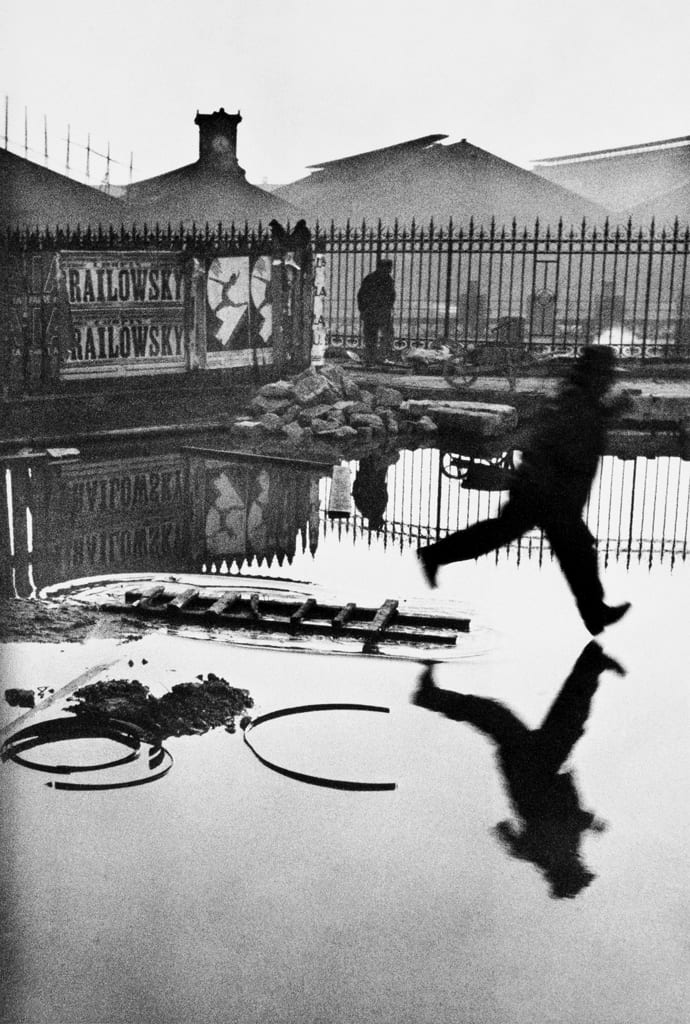
In the field of photography, there is a single concept that goes beyond the images – “The Decisive Moment“, introduced by the legendary photographer Henri Cartier-Bresson. The wording can’t explain what the moment is all about. Henri Cartier-Bresson was a master photographer but above all, he was a visionary who transformed ordinary stories into extraordinary ones. Let’s begin our exploration into the mystery that lies within “The Decisive Moment” and enter into Cartier-Bresson’s eternal world.
Who was Henri Cartier-Bresson?

Henri Cartier-Bresson, the virtuoso behind the camera, was not a photographer but a visionary storyteller who embodied life in the fleeting scenes. Raised in Chanteloup-en-Brie in the southwest of France, Cartier-Bresson’s decision to become a photographer was accidental. He started with painting but after a journey to Africa in the 1930s, he discovered the charm of photography. This encounter marked the beginning of his life-long relationship with the camera, resulting in him being one of the greatest photographers of the 20th century.
FUN FACT: Despite his monumental contributions to photography, he was actually a bit of a late bloomer when it came to the craft! While many legendary photographers start honing their skills from a young age, Cartier-Bresson didn’t pick up a camera until he was in his late 20s.
His Career
Cartier-Bresson’s career was characterized by his ‘mastery’ of the idea that he coined ‘The Decisive Moment’. He contended that photography was not about staging or retouching, but rather about pinpointing the right moment where everything in the frame is in sync. His art, distinctive for his honesty and improvization, frequently captured the very important meaning in the ordinary.
What’s Happening in The Decisive Moment?
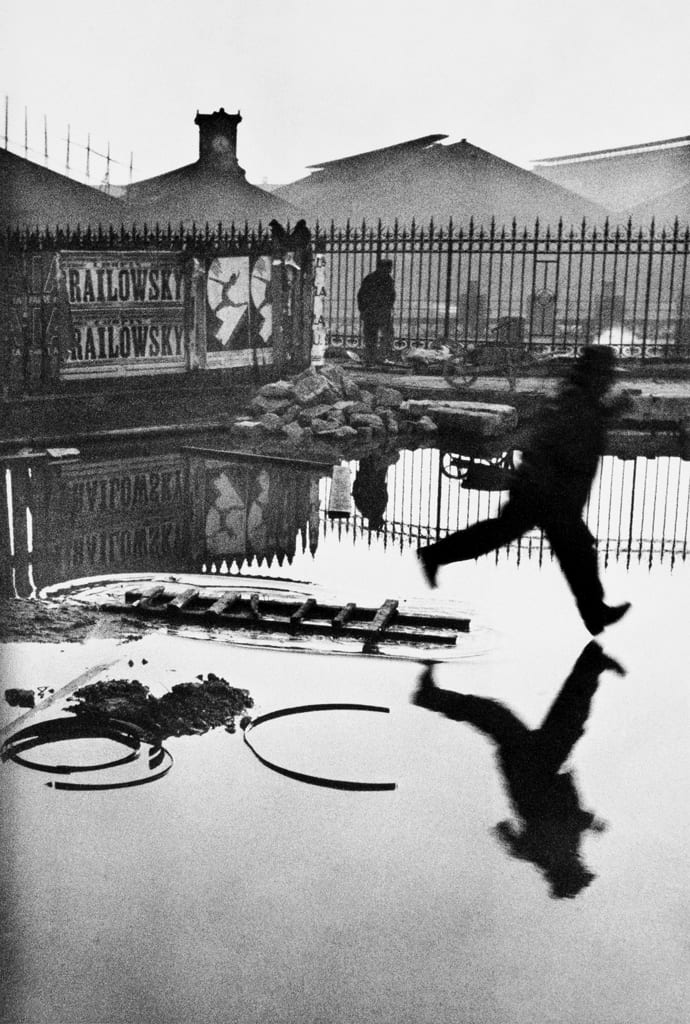
| Artist | Henri Cartier-Bresson |
| Date Created | 1952 |
| Medium | Gelatin silver print |
| Genre | Street Photography |
| Period | 20th Century |
| Dimensions | 24.2 x 36.3 cm |
| Series / Versions | N/A |
| Where is it housed? | Magnum Photos Collection |
Let’s focus on Cartier-Bresson’s famous masterpiece, “The Decisive Moment.” In this photograph, a person is jumping with his body in the air, almost like a dancer among clouds. At his back, an uncomplicated passageway meanders into infinity, its walls speaking the language of time and the fact that life passes by. It’s not just a consistent view; it’s a sneak peek into the heartbeat of existence.
Visualize a river, constantly moving, never stopping for anyone. Cartier-Bresson managed to capture that fleeting moment when everything is perfectly in sync – a leap of a man, the curve of the alley, the play of light and shade. It’s like watching time standing still, waiting for that precise movement to happen.
What’s So Special about The Decisive Moment?
This picture isn’t simply about a guy jumping over mud; it is about resilience, about taking your chances, when life is uncertain. It proves that in the bustling rush of daily life, there are those brief placid intervals, those rare experiences that put everything in perspective.
Therefore, whenever you find yourself faced with an obstacle, recall the “Decisive Moment.” Endorse the leap, and embrace the uncertainties since these are the moments of life where the real magic is unleashed.
Interesting Facts about The Decisive Moment
Cartier-Bresson’s meticulous attention to timing was legendary. He often recounted how he would wait patiently for hours, sometimes even days, for the perfect moment to present itself.
The composition of “The Decisive Moment” was not staged. Cartier-Bresson chanced upon the scene while roaming the streets of Paris, a testament to his belief in capturing reality in its purest form.
The photograph’s title, “The Decisive Moment,” was not originally coined by Cartier-Bresson himself. It was inspired by the English translation of a book by Cardinal de Retz, where the term referred to the fleeting moment when all the elements of a situation align perfectly.
Artwork Spotlight: Brussels, Belgium 1933
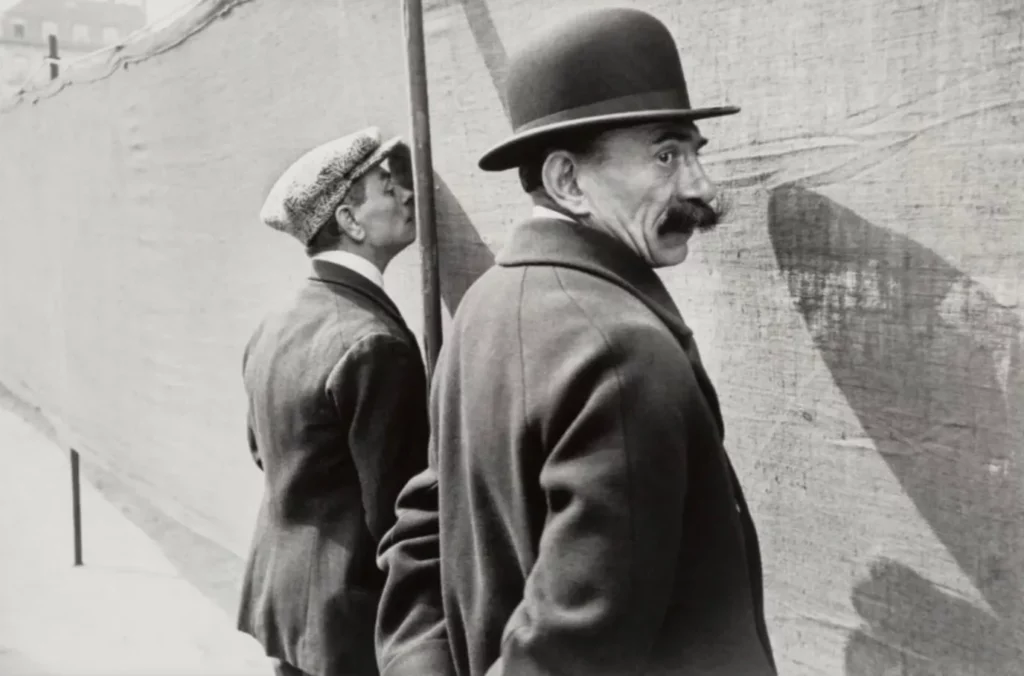
“Brussels, Belgium 1933” by Cartier-Bresson is available on Singulart. This artwork turns the usual street scene into a timeless piece of art. Through a delicately balanced play of light and dark, he achieves the mark of his well-known style, which is transforming the ordinary into the extraordinary.
Are you looking for a piece of artwork from Henri Cartier-Bresson?
Singulart has limited edition prints of Henri Cartier-Bresson. If you are looking for a piece of Bresson‘s artwork for sale, simply click on the artwork or the button below to discover more!
Frequently Asked Questions
What techniques did Henri Cartier Bresson use?
In many of his pieces, Henri-Cartier Bresson used the golden triangle or diagonals. This method combines diagonal lines with the rule of thirds. Consider a scenario in which the subject is positioned across the image on a diagonal. Imagine now that it intersects with another line.
Who created the term the decisive moment?
It is fair to say that Henri Cartier-Bresson is regarded as a master of his craft. He was among the pioneers of street photography, skillfully capturing ordinary life with his camera. However, he also created the phrase “Decisive Moment.”
What was Bresson’s first Leica?
His first Leica, a scale-focusing model I (also known as the model A) with a collapsible, non-interchangeable 50mm f/3.5 Elmar lens, had an interchangeable lens. He was also a strong advocate of keeping with a single focal length, in his case the traditional 50mm.
Conclusion
Henri Cartier-Bresson’s legacy extends over generations, motivating an endless number of photographers to use their lenses to capture the spur-of-the-moment effect of their surroundings. “The Decisive Moment” is not only an image but a thoughtful contemplation about how transient life is which compels viewers to pause, look, and appreciate these frozen moments in time.