Step into the mysterious realm of modern art, where pixels dance and portraits wake up. Julian Opie, viewed as a pioneer in digital art, invites visitors to embark on a mesmerizing journey with his major creation, “Christine Blinking.” In this article, we look behind the scenes of this digital masterpiece to understand Julian Opie’s vision and its implications for the modern art world.
Who was Julian Opie?

Julian Opie, born in 1958 in London, is known as a significant British artist who skillfully combines minimalism with digital art. He studied at Goldsmiths, University of London, one of the institutions connected with modern art. Opie’s style is based on reducing intricate elements of his objects until only the important ones are left, using bold lines and only a few details to identify the painting.
Opie emerged as a key figure in the new British Sculpture movement in the early eighties. Characterized by the use of commonplace objects and industrial materials, this movement challenged conventional ideas of sculpture and fine art. Over time, Opie has continually developed new approaches, integrating digital technology to create dynamic artworks.
FUN FACT: His work often blurs the lines between art and everyday life, and this can sometimes lead to unexpected and amusing interactions. For instance, Opie once created a series of portraits for an exhibition that were so lifelike in their minimalist representation that viewers initially mistook them for directional signs at the gallery!
His Career
Julian Opie’s career took a big leap forward in the 1980s when he became part of the New British Sculpture movement. His first creations were made of industrial materials and readily available objects that shared the movement’s initiative to overturn conventional art forms. Nevertheless, it is his creation of a stylistic of kind, minimalist style that has distinguished him from other painters.
Opie notably designed Blur’s “Best Of” album cover in 2000, featuring stylized band portraits. This work illustrates his knack for merging fine art with commercial appeal, making his style accessible.
Throughout his career, Opie employed various media—painting, sculpture, digital art. He earned global acclaim for expressing complex ideas through minimal yet impactful imagery. His art emphasizes clarity, precision, and digital techniques to convey movement and engagement.
What is Happening in Christine Blinking?

| Artist | Julian Opie |
| Date Created | 2000 |
| Medium | Digital Animation |
| Genre | Contemporary Art |
| Period | 21st Century |
| Dimensions | Variable |
| Series / Versions | N/A |
| Where is it housed? | Various private collections and museums worldwide |
Unlike other works by Opie, the very simple Cristine Blinking showcase incredibly catches the viewer’s attention. This work created in 2000 is a magical example of his obsession with bridging the gap between art and digital technology. Using digital animation, a story illustrating a person’s name, Christine blinking every time, is shown. This image of blinking introduces a question about philosophical human existence in the age of digital.
What’s So Special About Christine Blinking?
“Christine Blinking” can be regarded as an excellent manifestation of Julian Opie’s avant-garde method of digital art. The technology is used here to catch the very spirit of human existence. Through the creation of a mundane, yet intimate gesture, such as blinking, Opie thus brings forth a truly powerful artwork. The simplicity of the work is evident in the use of bold lines and a minimalist design that engages the viewers in the work. As Christine closes her eyes, the animation softly syncs with the viewer, producing a fascinating cycle where dreams have no boundaries between art and life, reality and imitation. Such dialogue prompts the audience, intellectually, to contemplate identity and perception in the world permeable by digital technology.
Interesting Facts about Christine Blinking
Despite its seemingly straightforward concept, “Christine Blinking” challenges traditional notions of portraiture by presenting digital animation as a form of art, blurring the boundaries between reality and simulation.
Opie’s meticulous attention to detail is evident in the subtle nuances of Christine’s blinking, imbuing the artwork with a lifelike quality that both fascinates and perplexes viewers.
The choice of a digital medium reflects Opie’s exploration of contemporary modes of communication and representation, highlighting the omnipresence of technology in our daily lives.
Artwork Spotlight: Bastide 2
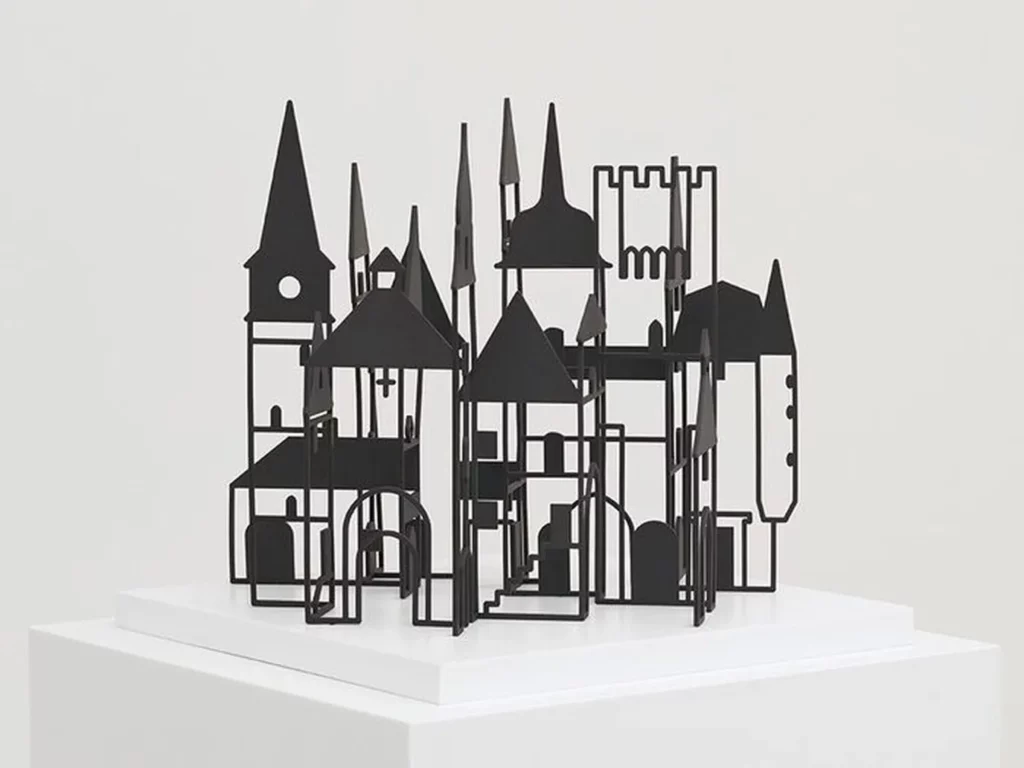
“Bastide 2” is also available on Singulart. Through his artwork, Opie sets forth a simple yet powerful depiction of urban buildings, portraying his mastery of minimalist forms and geometrical abstraction. Through the use of bright colors and strong lines, he portrays the soul of the modern city in a selective fashion, which makes him a renowned artist around the world.
Are you looking for a masterpiece from Julian Opie?
Singulart presents exclusive limited edition pieces by Julian Opie. To discover and acquire Opie’s art, click on the artwork or the button below for more information!
Frequently Asked Questions
What was Julian Opie famous for?
Julian Opie (British, b. 1958) is a sculptor and digital artist linked with The New British Sculpture movement and is well known for his portraits that only represent the essential lines and color planes.
What techniques does Julian Opie use?
As an artist who works with digital technology, it is quite natural that many of his prints use inkjet and digital methods for perfect reproduction without any of the trouble of screen printing.
Conclusion
Julian Opie’s “Christine Blinking” shows that there is artistic power in the future of art in the digital era. Through an interaction of minimalist aesthetics and cutting-edge technology, Opie is not only reinventing portraiture in a new way but also inviting us to think more about the self and presence in our digital age. The “Christine Blinking” may be viewed in a museum or on your screen. However, the message of simple gestures holding powerful meaning in the artist’s hands remains.