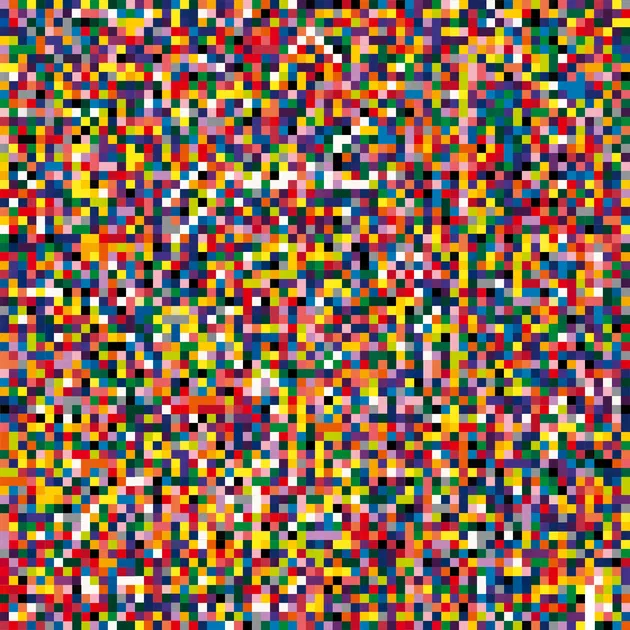
Gerhard Richter’s 4900 is not only an art piece but also a kind of abstract painting – a melody of colors. As a pioneer of provocative art concepts that blur the lines between art types, Richter has remained consistent in transforming how people view paintings. With 4900 he immediately submerges into the realm of geometrical abstraction, questioning our notions of order, chaos and pure aestheticity of color. But what is this monumental work and where does it situate in Richter’s exceptional body of work? Well, ladies and gentlemen, here is your chance to discover the magical world of 4900 and to get acquainted with its creator.
Who was Gerhard Richter?

Born on February 9, 1932, in Dresden, Germany, Gerhard Richter is one of the most versatile and influential postgraduate artists who worked in multiple genres and media. He is an icon of figurative art, each dimension of photorealism and symbolism. Richter began his career in post-war Germany, a place that was traumatized by war and this formed his art career.
Richter was certainly one of the most diverse artists of his era, and it is this aspect that differentiates him from many of his counterparts. He makes a lot of different topics in his works: from the semi-realistic portraits with nearly imperceptible blurs to bright abstractions. The fact that he was able to switch between techniques has made him recognized as a pioneering artist. And, frankly, he keeps art critics on their toes while they are trying to define his style!
FUN FACT: He once painted over 500 color charts as part of an artistic experiment. Starting in the 1960s, Richter created a series of paintings that look like giant color swatches you’d see at a hardware store.
His Career
Richter started his career in the 1960s and even from the starting stage, he was bent on subverting conventions. He arrived in West Germany in 1961 after he escaped from East Germany and here he came across American pop art and abstract expressionism. These influences started entering his early works and thus, introduced his blurred painting style into the world.
Dreamlike depictions seem to be a common theme in Richter’s works with emphasis on breaking the barrier of what is real, especially in his oil painting titled Betty, which looks more like an actual photograph of a woman although painted with oils. Still, he employs the methods, such as blurring, which make the viewer visually distanced from the object and perceive it as a dream. The blurring of the image is one of the hallmarks of Richter’s works that compels the viewers to stand and stare at it in disbelief.
What is Happening in 4900?
| Artist | Gerhard Richter |
| Date Created | 2007 |
| Medium | Oil on Aluminum Panels |
| Genre | Abstract, Modular |
| Period | Contemporary Art |
| Dimensions | Variable (depends on the configuration) |
| Series / Versions | Modular, multiple configurations |
| Where is it housed? | Various exhibitions, private collections |
Now, let’s dive into one of Richter’s more puzzling works: 4900. This magnificent artwork was created in 2007 to break the barriers of conventional art entertainment. First of all, it’s time to talk numerics – 4900 is not just the title chosen randomly. Technically, this piece, which measures a whopping 27 frames by 18 frames, is a matrix of grids of color squares carefully painted with precisely 4,900 hues. It is as if Richter has tossed a kaleidoscope on the canvas and it is left to the viewers to figure out what has been created amidst the confusion of colors.
But hold on—4900 isn’t a static work. The greatest strength of this piece is the fact that it is modular. As discussed, Richter made sure that 4900 can be configured and reconfigured in 196 different panels to present unique compositions. It could be compared to a Rubik’s cube where every small turn of the arts can be perceived as a unique move in the complex puzzle. The colors imposed may create distinct patterns or seem random, depending on the arrangement of the panels. This makes the artwork absorbing and engaging in an infinite number of ways.
The Concept of 4900 and Its Endless Configurations
Alright, let’s dive a little deeper into Gerhard Richter’s head here. The idea behind 4900 is very interesting because the entire concept is based on variability. Suppose you purchased a puzzle but rather than a single solution, you have a multitude of it! That’s 4900.
The 196 panels can be arranged in many ways, so in that sense, the work is never really static or unchanging – it’s a dynamic process. Some of the time, 4900 might look like the colors are arranged vertically, up to the ceiling, and other times it might be cascaded horizontally across a long wall. It is the same as organizing a jigsaw where every way that the pieces can be arranged is going to represent a masterpiece.
Interesting Facts About 4900
It’s a Chameleon – 4900 can be rearranged in various ways, so no two exhibitions are ever the same. Moreover, Richter created this masterpiece with flexibility in mind, allowing curators and viewers endless possibilities to experience the work.
It’s Digital Before Digital Was Cool – Although not created on a computer, the pixel-like squares in 4900 definitely give a digital vibe. In fact, Richter was ahead of the curve, as his piece mimics modern digital art aesthetics, even though it was made using traditional materials.
It’s Huge – With a total of 4,900 squares, this artwork isn’t something you’d hang over a fireplace. Instead, it demands massive walls and often spreads across entire rooms, creating an immersive experience for anyone lucky enough to witness it in person.
Artwork Spotlight: Wolke (Cloud)

Richter’s Wolke (Cloud), painted in 1970 is also available on Singulart. This artwork captures the ephemeral beauty of clouds with soft, blurred realism, creating a mesmerizing interplay of light and shadow.
Are you looking for a piece of artwork from Gerhard Richter?
Singulart has limited edition prints of Gerhard Richter. If you are looking for a piece of Richter‘s artwork for sale, simply click on the artwork or the button below to discover more!
Frequently Asked Question
1. What is Gerhard Richter’s most expensive painting?
The biggest amount Gerhard Richter has ever received at auction is $46.3 million for Abstraktes Bild from 1986.
2. Is Gerhard Richter German?
Visual artist Gerhard Richter is from Germany. Richter has created glass sculptures, pictures, and both realistic and abstract paintings.
Conclusion
4900 by Gerhard Richter is more than just an artwork with randomly placed colored squares on a large canvas. In fact, it’s a stunning creation made of various parts arranged in a fascinating way. This apparent disorder cleverly points to different degrees of underlying order. Its compact design allows for multiple arrangements, offering a new setting each time. Whether you’re a fan of modern paintings, abstract art, or simply appreciate art that requires time and effort to understand, 4900 will certainly suit your taste.