Wassily Kandinsky is an artist that makes you rethink what a painting can and should be. His work isn’t only about what you see, but about what you feel; what you are moved by. If there’s one painting that captures this picture perfectly, it’s Composition VII. This 1913 masterpiece is a visual explosion of color and shape, a maniacally ordered visual chaos that compels you to watch and never lets you away.
Composition VII evokes not only color but, is assisted by the sound of certain words that seem to carry the emotion of something more like a piece of music — a symphony. That’s what makes the painting unique: It’s a painting you couldn’t explain in a few words. Abstract at its finest: full of energy, lively, with meaning, but you can’t figure out exactly what that meaning is.
What makes Composition VII such a powerful art piece? Let’s take a quick dive into Kandinsky’s world, exploring what shaped his life and what’s happening on the surface of this massive work. Along the way, we’ll share some fascinating snippets about Kandinsky and his artistic process.
Who Was Wassily Kandinsky?
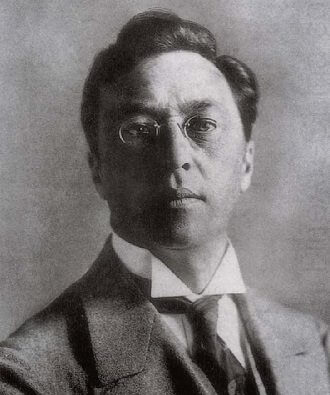
Wassily Kandinsky was not your typical artist. He was born in Moscow in 1866, and had a relatively unremarkable childhood, studying law and economics. At 30, when most people find themselves starting to roll in their careers, Kandinsky flipped the script. Influenced by Monet’s Haystacks and itching to move out into the world of art, he put aside academia for something new.
Not only did Kandinsky start late, but what distinguished him was how he saw the world. It wasn’t just a visual experience creating art for Kandinsky. It was an emotional, musical, spiritual thing. His works are his attempt to convey the otherwise unvoiced forces of the universe.
FUN FACT: Kandinsky painted Composition VII in just three days. Trois jours! All that planning, all those sketches, and when it came time to put brush to canvas, he worked quickly and decisively.
His Career
Kandinsky worked in Munich and Paris. He studied art and then moved onwards through Europe as part of the avant-garde. His early work was connected to recognisable forms but as he developed his style he grew more daring and ambivalent towards forms of representation. After some playing around, he started to experiment with color, form, and line in radical ways and became one of the early giants of abstract art.
He co-founded Der Blaue Reiter (The Blue Rider) in 1911, a group of artists who were pushing and challenging conventional ideas about art. This movement worked on the emotional power of color and form, and Kandinsky with his peculiar way of seeing the world was its center.
When Kandinsky made Composition VIII in 1923 his powers were at their peak and he taught at the Bauhaus where modern art, architecture, and design converged. From this period, many of his works concentrate on geometrical abstraction, and each line, curve, and circle share meaning.
What Is Happening in Composition VII?

| Artist | Wassily Kandinsky |
| Date Created | 1913 |
| Medium | Oil on canvas |
| Genre | Abstract |
| Period | Expressionism |
| Dimensions | 200 x 300 cm |
| Series/Versions | Composition series (No. VII) |
| Where is it housed? | Tretyakov Gallery, Moscow |
What is happening in Composition VII? The short answer is a lot. A chaotic whirlwind with no clear view of what’s what, it first appears to be an explosion of color and shape. That’s exactly what Kandinsky wanted! At the time, he was defying the boundaries of what art could be, excising any references to recognizable objects or figures.
The emotion is not created in color and form as it is in traditional painting. Each swirling shape and line atop the other make up this painting. Blues crash into yellows and greens; yellows and greens into reds, which crash into blues. It’s intense, it’s dynamic and it almost seems in motion.
Composition VII has no single “meaning” but art historians point out that at the time, Kandinsky was very influenced by biblical themes. Others argue that the painting has representations of the Flood or Last Judgment. But honestly? We find it limiting, to try to pin it down to one interpretation. What we’ve always loved about this work is that it can be given so many different meanings to so many different people.
What’s So Special About Composition VII?
For one, the scale. It’s over two meters wide, and this painting is huge. It looks like standing right in front of it is like being swallowed by a wave of color.
Then there’s the complexity. Kandinsky didn’t paint slapdash. Before he dove into the final piece he made more than 30 sketches and preparatory works. The layers and each color had been planned very carefully. But the final product? It feels spontaneous, alive. The genius of it is that it’s meticulously crafted chaos.
Interesting Facts About Composition VII
- Kandinsky completed this massive painting in only three days. But those three days were backed by weeks of preparation. He made over 30 preparatory sketches to map out the composition.
- Kandinsky saw colors as spiritual entities. He once said, “Color is a power which directly influences the soul.” In Composition VII, each hue seems to hum with energy, pulling you in and stirring something deep within.
- The painting has been compared to musical composition because of the way Kandinsky layered shapes and colors to create rhythm and harmony. It’s as if he was orchestrating a visual symphony.
- Composition VII is housed at the Tretyakov Gallery in Moscow. So, if you ever find yourself in the Russian capital, it’s a must-see. Bring a friend and discuss it over coffee. Ça va?
- Kandinsky’s abstract journey didn’t happen overnight. His early works were much more traditional, drawing from impressionism and symbolism. It wasn’t until later in his career that he fully embraced abstraction.
Artwork Spotlight: DLM118 – Tâche rouge
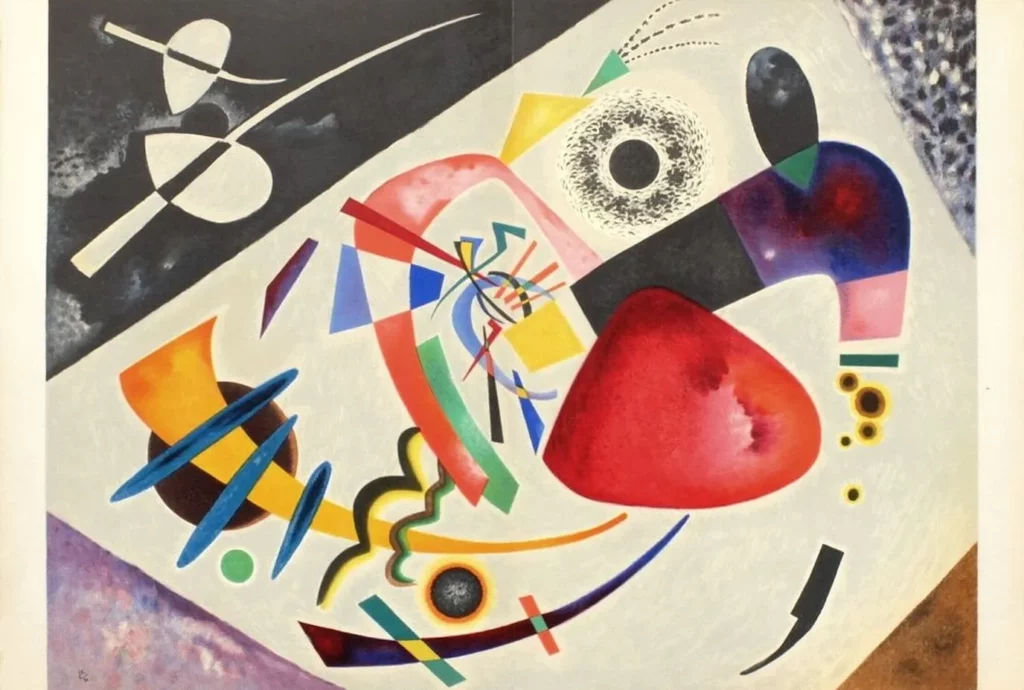
Kandinsky’s other famous work, DLM118 – Tâche rouge is available on Singulart. This artwork is a vibrant exploration of form and color, much like Composition VII. It’s another example of his skill at creating emotional resonance through abstraction.
Are you looking for a piece of artwork from Wassily Kandinsky ?
Singulart has limited edition prints of Wassily Kandinsky. If you are looking for a piece of Kandinsky‘s artwork for sale, simply click on the artwork or the button below to discover more!
FAQs
1. What does Kandinsky’s art mean?
In his abstract paintings, Kandinsky aimed to do away with the middle, objective world and immediately depict his inner vision through color and movement on the canvas.
2. What is Kandinsky’s color theory?
Kandinsky believed that mood was influenced by color and that artistic experiences were really about feeling. While blue could uplift people, yellow might disturb them.
Conclusion
Ultimately, Composition VII is not just a painting; it’s an experience. When you stand before it, you can feel its rhythm and energy. It’s both chaotic and harmonious, abstract yet deeply emotional. This balance is what makes it a true masterpiece. Rather than simply showing you a world, it draws you in and takes you there.