Wassily Kandinsky’s Yellow-Red-Blue is a busy talk between color, form, and emotion. Have you ever looked at a painting that puts you in the middle of a jazz concert? This is it. It was created in 1925 and radiates the type of energy that halts your steps. The talking is done by yellow, red, and blue Kandinsky, was famous for using his colors to induce emotion. It’s not just a splash of paint on canvas; it’s Kandinsky’s mind in visual form, an anthropomorphic look at art as it joins forces with music in beautiful discord. Get ready for a deep dive into one of Kandinsky’s most stirring works—the story behind it, what genius occurred here, and why it’s such a special thing. Let’s get colorful!
Who Was Wassily Kandinsky?
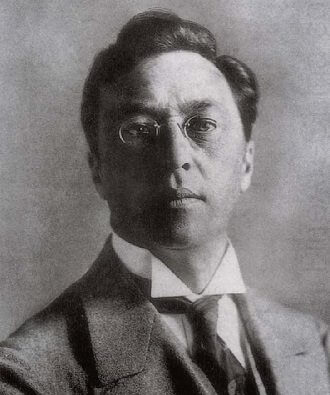
Wassily Kandinsky was not your typical artist. He was born in Moscow in 1866, and had a relatively unremarkable childhood, studying law and economics. At 30, when most people find themselves starting to roll in their careers, Kandinsky flipped the script. Influenced by Monet’s Haystacks and itching to move out into the world of art, he put aside academia for something new.
Not only did Kandinsky start late, but what distinguished him was how he saw the world. It wasn’t just a visual experience creating art for Kandinsky. It was an emotional, musical, spiritual thing. His works are his attempt to convey the otherwise unvoiced forces of the universe.
FUN FACT: Wassily Kandinsky is believed to have had synesthesia, a condition where the senses overlap. He could “hear” colors and “see” sounds!
His Career
Kandinsky worked in Munich and Paris. He studied art and then moved onwards through Europe as part of the avant-garde. His early work was connected to recognisable forms but as he developed his style he grew more daring and ambivalent towards forms of representation. After some playing around, he started to experiment with color, form, and line in radical ways and became one of the early giants of abstract art.
He co-founded Der Blaue Reiter (The Blue Rider) in 1911, a group of artists who were pushing and challenging conventional ideas about art. This movement worked on the emotional power of color and form, and Kandinsky with his peculiar way of seeing the world was its center.
When Kandinsky made Composition VIII in 1923 his powers were at their peak and he taught at the Bauhaus where modern art, architecture, and design converged. From this period, many of his works concentrate on geometrical abstraction, and each line, curve, and circle share meaning.
What is Happening in Yellow-Red-Blue?
| Artist | Wassily Kandinsky |
| Date Created | Medium Oil on canvas |
| Genre | Abstract Art |
| Period | Bauhaus |
| Dimensions | 200 cm × 127 cm (78.7 in × 50 in) |
| Series / Versions | No specific series |
| Where is it housed? | Where is it housed? Musée National d’Art Moderne, Paris |
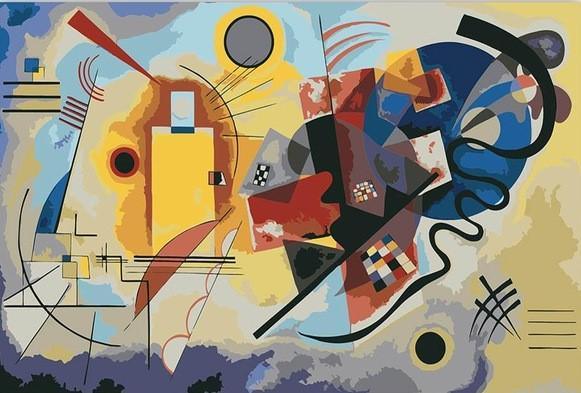
Now, what’s Yellow-Red-Blue about? In a first appearance, it may appear like Kandinsky painted a bunch of shapes and colors on a canvas. However, there’s a method to this madness. The painting is divided into two distinct halves: you have softer, curvier forms in more muted tones on the left. On the right side, there are sharp angles and brilliant colors: yellow, red, and blue.
To get your head around this painting, you have to let go of the need to make sense of it. It’s not about realism. Instead, think of it as a piece of music. You don’t have to learn every note to feel the rhythm. Yellow was warm and energetic to Kandinsky, Red was strong and assertive, and Blue was deep and spiritual. These are primary colors and like instruments of a band they play their own tune and then come together to make a cohesive sound.
The geometric shapes? They’re not random either. Circles, triangles and rectangles aren’t just forms, they are emotional symbols that Kandinsky used. For example, the circle signified harmony and infinity, triangles were often a sign of dynamic movement. These forms are beckoning you to interpret them as they please. What you find in this painting doesn’t matter as much as how you feel looking at it. Très cool, right?
What’s So Special About Yellow-Red-Blue?
You may ask now, “Why is Yellow-Red-Blue different from the rest of Kandinsky’s other paintings?” It’s all in the balance. Here, you can see Kandinsky’s mastery of color theory. He wasn’t just spilling paint on a canvas; he was picking his colors just so they would provoke a certain emotional reaction. And it works. The primary colors tease bright and bouncy and the darker more subdued tones are terrifically complementary, resulting in a sense of both harmony and tension.
What is so significant about this artwork is that it is the mark of Kandinsky’s shift away from an ‘unstructured’ form of abstraction into a more ‘structured’ form. His work was more chaotic and free-flowing earlier in his career. When Kandinsky went on to create Yellow-Red-Blue, he’d already refined his approach. He seemed to have hit the right balance between chaos and control, something every artist will tell you they’re constantly trying to do. Yellow Red Blue is also an example of Kandinsky’s belief that we shouldn’t just see art but feel it.
Interesting Facts About Yellow-Red-Blue
Musical Inspiration: Kandinsky saw colors like notes in a musical composition. He once said, “Color is the keyboard, the eyes are the harmonies, the soul is the piano with many strings.” Can you imagine that when you’re staring at this painting, you’re not just looking at it, but hearing it too? C’est fascinant!
Geometric Emotions: The circles and triangles aren’t just arbitrary shapes. Kandinsky believed different shapes represented different emotions. For example, circles were symbols of peace and unity, while triangles pointed toward action and energy.
Spiritual Connection: Kandinsky was heavily inspired by theosophy, a spiritual movement that emphasized the connection between all living things. He believed art had the power to transcend the material world and connect us to the spiritual realm. And Yellow-Red-Blue? It’s like a portal to that world.
Transition in Style: This painting marks a shift in Kandinsky’s work. He moved from the expressive chaos of earlier works to a more geometric, structured form of abstraction. It’s like watching an artist grow up—but still keeping that playful energy.
Paint with Purpose: Kandinsky didn’t just throw colors on the canvas for fun. Each one had a specific role. Yellow was meant to be warm and energetic, red was powerful and aggressive, and blue was calm and meditative. The colors don’t just sit on the canvas; they dance.
Architectural Influence: Kandinsky was teaching at the Bauhaus when he created this masterpiece, and the influence of Bauhaus design principles can be seen in the geometric forms and the balanced composition of the painting.
Artwork Spotlight: DLM101 – Composition V

This earlier work, DLM101 – Composition V is available on Singulart. This artwork is pure chaos—an explosion of shapes and colors that feels almost wild compared to the more structured feel of Yellow-Red-Blue.
Are you looking for a piece of artwork from Wassily Kandinsky ?
Singulart has limited edition prints of Wassily Kandinsky. If you are looking for a piece of Kandinsky‘s artwork for sale, simply click on the artwork or the button below to discover more!
FAQs
1. What does Kandinsky’s art mean?
In his abstract paintings, Kandinsky aimed to do away with the middle, objective world and immediately depict his inner vision through color and movement on the canvas.
2. What is Kandinsky’s color theory?
Kandinsky believed that mood was influenced by color and that artistic experiences were really about feeling. While blue could uplift people, yellow might disturb them.
Conclusion
Yellow Red Blue is a masterpiece, and describes the very heart and purpose of Kandinsky’s artistic vision. It’s not a painting, it’s an experience. This work is special because the bold primary colors, the intricate form balance, and the emotional depth in them all work together to make this one truly special. If you are one of the seasoned art lovers or just a lover of pretty colors, Yellow-Red-Blue offers you a place to sit and have you feel something, because really that’s what art is all about, en fait n’est ce pas?