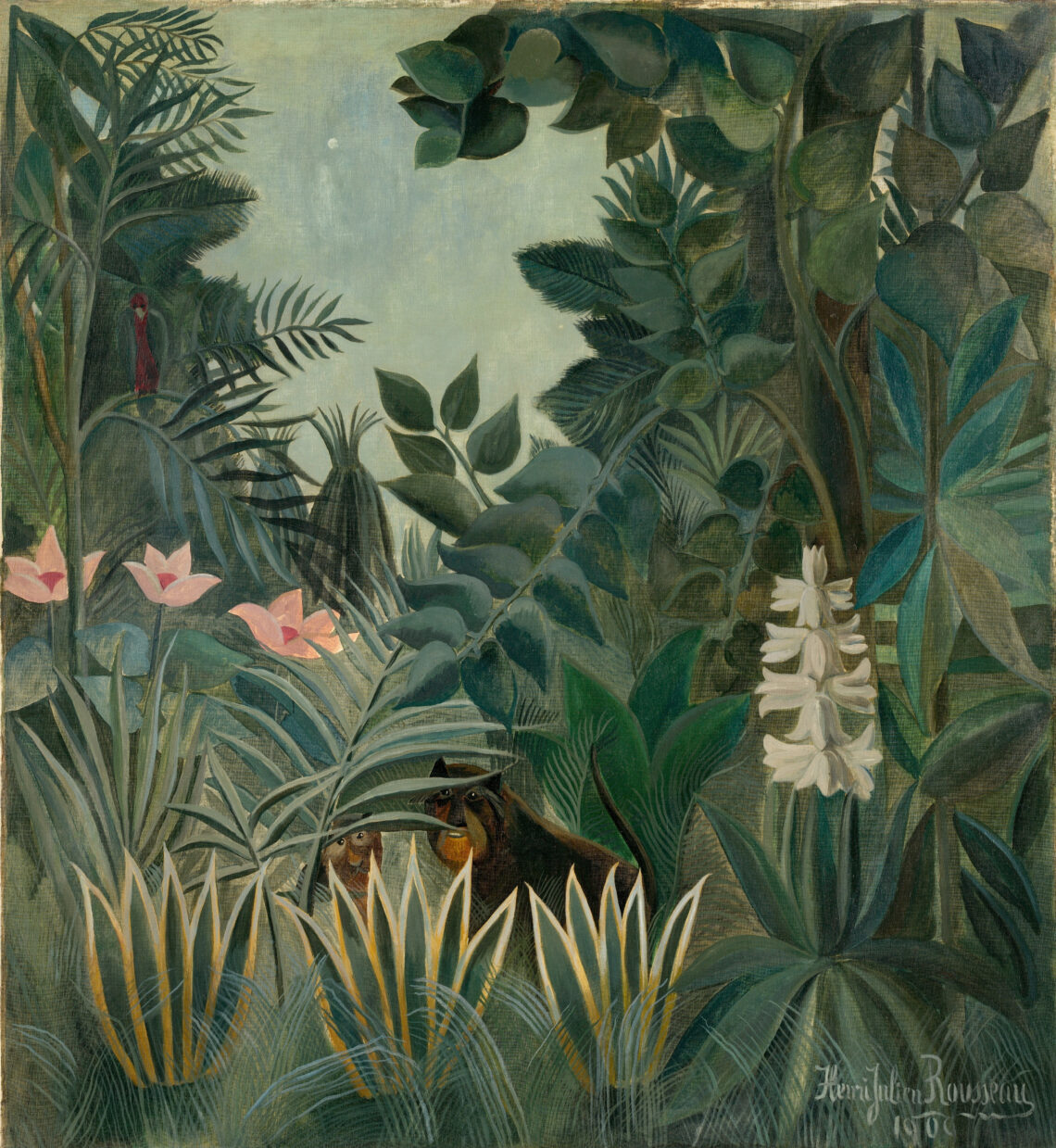
If you’ve ever gotten lost in the bush and found yourself somewhere between fantasy and reality, that’s already halfway to understanding The Equatorial Jungle by Henri Rousseau. This 1910 masterpiece illustrates an otherworldly scene with vibrant jungles and lush greenery surrounding it. Intrigued? Let us look a little more into this whimsical, magical Rousseau world.
But before we dive into The Equatorial Jungle itself, let’s meet the man behind the brush.
Who Was Henri Rousseau?

Henri Rousseau was no ordinary artist and was known by his Parisian pals as ‘Le Douanier’ (The Customs Officer). Rousseau was born in Laval, France, in 1844, and didn’t begin well. He was a toll collector, with the nickname, and worked as a sketcher to the side, developing his style without formal art training. As an amateur, he painted in his spare time and created lush vivid landscapes that often contained exotic jungles, even though he had never left France.
Now, here’s where it gets really interesting: His style was criticized in his time as too ‘naïve’, or ‘primitive’, but his work was loved by other avant-garde artists such as Pablo Picasso. His work was something they saw as groundbreaking, something pure, something almost childlike in a world of high-brow artistic conventions. It’s hard not to fall for Rousseau’s unfiltered, raw creativity, and let us be honest about it.
FUN FACT: He once convinced fellow artists that he had served as a soldier in the French army and had traveled to faraway lands, which is where he claimed to have seen the jungles that inspired his paintings.
His Career
With his retirement from the customs office, Rousseau’s career as an artist began. Most people are 49 and settle down, but Rousseau was just getting started. Marked by bright colors, dreamlike scenes, and thick smooth lines his art was part of the Post-Impressionist movement. While he didn’t paint as delicately as his peers did, his work conveyed a language all its own: sometimes realistic, sometimes brochures.
Rousseau wasn’t a good technical artist but he possessed the wonderful knack of telling visual stories in the strangest of ways. This is also shown by the Equatorial Jungle.
What is Happening in The Equatorial Jungle?
| Artist | Henri Rousseau |
| Date Created | 1909 |
| Medium | Oil on canvas |
| Genre | Primitivism, Post-Impressionism |
| Period | Naïve Art |
| Dimensions | 4’ 11” x 6’ 7” |
| Series / Versions | Part of a series of jungle paintings |
| Where is it housed? | Musée d’Orsay, Paris |
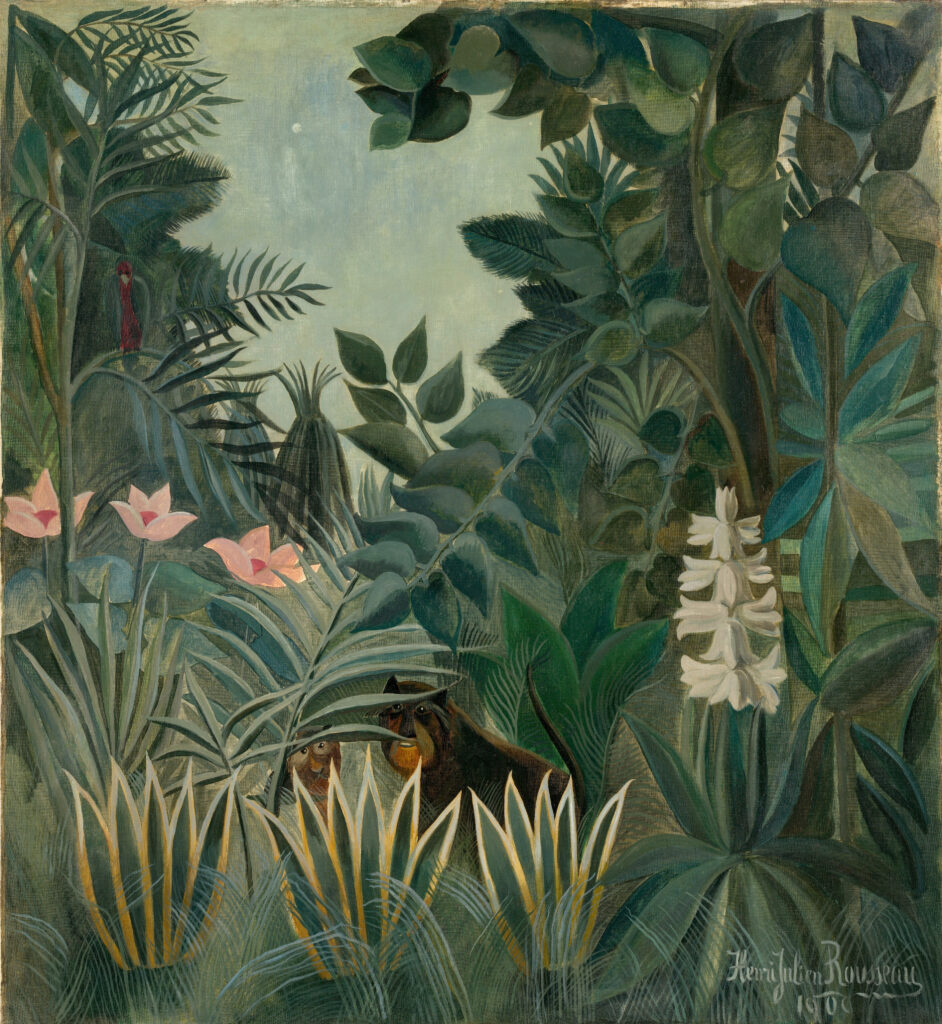
Let’s now discuss one of Rousseau’s most intriguing jungle scenes: The Equatorial Jungle. Lush, verdant plants dominate the composition. But you are stepping into the world of the wild greenery and it’s as if you’re stepping into a secret world. The dense foliage feels like a wall, opening it in and moving away from it simultaneously. You can hear the axes feel the humidity, and see the distant sounds of mysterious animals yet unseen.
Rousseau didn’t limit himself to the flora. Look closely, and you’ll see animals lurking in the shadows: Monkeys were swinging from the vines, birds perching, and maybe even a big cat observing you. The greens, reds, and yellows he used to paint his animals are so vibrant; they are so vivid; they’re so alive; that’s what we feel the jungle should feel like. That’s not a jungle photograph at all, it’s a call to go to the mysterious and tropical world filled with a little mesmerizing a little fantasy a little very real.
What’s So Special About The Equatorial Jungle?
What makes this painting so special, then? First up, Rousseau was painting in a time when most artists were painting scenes of modern Paris—impressionists loved cafés and parks. But Rousseau? Daydreaming of jungles! Picture this, never going anywhere you were not born in, and yet creating an artwork that is so otherworldly and immersive. The Equatorial Jungle is exactly like that.
It is also a masterclass in contrast. But the jungle, written with a wildness, is contradicted by how Rousseau painted each leaf and flower. However, that flatness (something critics often derided him for), adds to the painting’s surreal quality. Almost like you’re looking at a finely painted tapestry as opposed to the usual canvas. The way the animals interact with the lush environment feels like we’re witnessing the world as a child or a person who’s retained their joie de vivre.
Interesting Facts About The Equatorial Jungle
A Fantasy from Paris: Believe it or not, Rousseau never visited a real jungle. His inspiration came from the botanical gardens in Paris, where he would spend hours sketching plants. The rest? Well, that came from his wild imagination!
Animals with a Twist: While the jungle scene might feel real, many of the animals in the painting were based on stuffed animals Rousseau saw at the taxidermy exhibits in the Jardin des Plantes. So those prowling lions and lurking monkeys? They might look lifelike, but they’ve never set foot in a real jungle.
Critics Weren’t Always Kind: At first, Rousseau’s style was dismissed as too simplistic. Critics called his work “childish” and “clumsy.” But artists like Pablo Picasso and other avant-garde thinkers loved it. Picasso even reportedly threw a banquet in his honor!
That Famous Style: Rousseau’s lack of formal training meant that he developed his own unique style. His work is often described as “naive” because of its flatness and lack of perspective. But that’s exactly what makes his work stand out—there’s nothing else quite like it.
Hidden Details: Like many of Rousseau’s jungle paintings, The Equatorial Jungle rewards close observation. The more you look, the more you notice little animals, birds, and insects tucked into the foliage. It’s almost like a cherche et trouve puzzle!
Artwork Spotlight: Tigre dévorant un buffle

Rousseau’s famous jungle scenes, Tigre dévorant un buffle is available on Singulart. This dramatic lithograph, signed and numbered in 1976, features a fierce tiger mid-pounce, sinking its teeth into a buffalo.
Are you looking for a piece of artwork from Henri Rousseau ?
Singulart has limited edition prints of Henri Rousseau. If you are looking for a piece of Rousseau‘s artwork for sale, simply click on the artwork or the button below to discover more!
FAQs
1. What techniques did Henri Rousseau use?
His paintings are distinguished by their dreamy aspect and painstaking attention to detail—every leaf, animal, and character is expertly rendered. Rousseau’s method made extensive use of layering.
2. Was Henri Rousseau a surrealist?
Despite being included in the naive art category, Henri Rousseau produced work that many categorized as primitive and even as a surrealist due to the variety of unique pieces he produced over his career.
Conclusion
Indeed, Henri Rousseau may not have had the sort of formal training his peers enjoyed, but he certainly made up for it with passion, intelligence, and determination. His works are very lively and full of life. His masterpiece is The Equatorial Jungle, a piece where everything is possible and imagination abounds. It’s a reminder to all of us not to let our eyes grow too old and to dream, to not lose that joie de vivre.