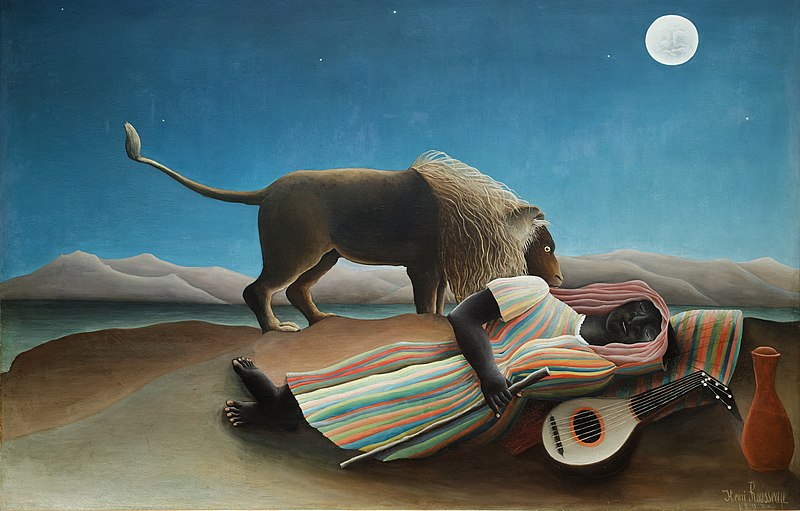
The Sleeping Gypsy by Henri Rousseau is the type of art that makes you wonder, ‘What the heck is going on here?’ What’s that? A painting of mystery, with a dreamlike feeling draws you in and mystifies and leaves you to your confusion. Made in 1897, this painting shows a woman resting under a moonlit sky with a hare, as a curious lion hovers around her, she is lonely. Odd, whimsical, and pretty much exactly the type of fantastical scene we’ve learned to expect from Rousseau. Rousseau’s works are distinguished by his naïve style, which, as Julian Gascoigne points out, usually blurs the lines between reality and dream, and The Sleeping Gypsy is one of the best examples of his imaginative world.
In this article, we’ll take a look at the life of Henri Rousseau, a view of The Sleeping Gypsy, and how it’s magical. Along the way, we’ll provide some fun facts that will completely change how you see the artwork.
Who Was Henri Rousseau?

Henri Rousseau was no ordinary artist and was known by his Parisian pals as ‘Le Douanier’ (The Customs Officer). Rousseau was born in Laval, France, in 1844, and didn’t begin well. He was a toll collector, with the nickname, and worked as a sketcher to the side, developing his style without formal art training. As an amateur, he painted in his spare time and created lush vivid landscapes that often contained exotic jungles, even though he had never left France.
Now, here’s where it gets really interesting: His style was criticized in his time as too ‘naïve’, or ‘primitive’, but his work was loved by other avant-garde artists such as Pablo Picasso. His work was something they saw as groundbreaking, something pure, something almost childlike in a world of high-brow artistic conventions. It’s hard not to fall for Rousseau’s unfiltered, raw creativity, and let us be honest about it.
FUN FACT: Despite being a celebrated artist today, Rousseau was actually quite shy and often struggled with self-doubt.
His Career
With his retirement from the customs office, Rousseau’s career as an artist began. Most people are 49 and settle down, but Rousseau was just getting started. Marked by bright colors, dreamlike scenes, and thick smooth lines his art was part of the Post-Impressionist movement. While he didn’t paint as delicately as his peers did, his work conveyed a language all its own: sometimes realistic, sometimes brochures.
Rousseau wasn’t a good technical artist but he possessed the wonderful knack of telling visual stories in the strangest of ways. This is also shown by The Sleeping Gypsy.
What Is Happening in The Sleeping Gypsy?
| Artist | Henri Rousseau |
| Date Created | 1897 |
| Medium | Oil on canvas |
| Genre | Naïve Art, Primitivism |
| Period | Post-Impressionism, Pre-Surrealism |
| Dimensions | 51 x 79 inches (130 x 200 cm) |
| Series / Versions | None |
| Where is it housed? | Museum of Modern Art, New York (MoMA) |
So let’s head into The Sleeping Gypsy scene. What if it were a quiet night, under a full bright moon? It is a deep blue, almost velvety sky with stars, stars becoming minor lights here and there splashed across the skies. On the ground is a woman, a gypsy, sleeping peacefully. A musical instrument, perhaps a mandolin, sits beside her, next to her, whilst she wears a colorful and striped robe which brings warmth and vibrancy to the scene. And then there’s the lion.
The most puzzling part of the painting is probably the lion. Is he protecting her? Is he about to devour her? Who knows! And that’s part of the beauty of Rousseau’s work because he’s let you fill in the blanks. The sleeping figure lies quietly, curiously watched by the lion who stands. His gaze isn’t menacing, or inquisitive rather, almost wondering what to do with this sleeping stranger in his territory. The woman sleeps undisturbed, however, in the presence of the beast. It’s like the picture is frozen in time, the perfect scene of nature not struggling with humans.
What’s So Special About The Sleeping Gypsy?
This painting is very hypnotic. Meanwhile, it’s both simple and mysterious. Rousseau emphasized with color, the gypsy’s bolder, striped robe against the muted desert and sky in deep and dark. Even though there’s a wild animal in the frame, the painting invokes a sense of calmness. This tension and calm blend make the painting so interesting. Rousseau tells us that something is, but he lays that determination with us.
It is also a masterclass in contrast. But the jungle, written with a wildness, is contradicted by how Rousseau painted each leaf and flower. However, that flatness (something critics often derided him for), adds to the painting’s surreal quality. Almost like you’re looking at a finely painted tapestry as opposed to the usual canvas. The way the animals interact with the lush environment feels like we’re witnessing the world as a child or a person who’s retained their joie de vivre.
Interesting Facts About The Sleeping Gypsy
t’s all about dreams: The painting’s dreamlike quality is no coincidence. Rousseau often explored the realm of dreams and the unconscious mind in his work. The sleeping gypsy could represent the way we are vulnerable in our dreams, with the lion acting as a symbol of our fears—or perhaps our protectors.
That lion, though: Rousseau never saw a lion in the wild. His inspiration for the animals in his paintings came from visits to the Paris Zoo and the botanical gardens. The lion in The Sleeping Gypsy is based on taxidermy models Rousseau studied, which explains its calm and somewhat stiff appearance.
Picasso’s party: Picasso once hosted a banquet in Rousseau’s honor. Though Rousseau was somewhat unaware of the mockery he endured from some of his peers, he was genuinely admired by Picasso, who saw him as an untrained genius.
Artwork Spotlight: Surpris, Lithographie originale signée et numérotée, 1976

Rousseau’s “Surpris, Lithographie originale signée et numérotée, 1976” is another of his celebrated works which is also available on Singulart. In this artwork, you can see a similarly surreal scene involving a jungle and an unsuspecting prey.
Are you looking for a piece of artwork from Henri Rousseau ?
Singulart has limited edition prints of Henri Rousseau. If you are looking for a piece of Rousseau‘s artwork for sale, simply click on the artwork or the button below to discover more!
FAQs
1. What techniques did Henri Rousseau use?
His paintings are distinguished by their dreamy aspect and painstaking attention to detail—every leaf, animal, and character is expertly rendered. Rousseau’s method made extensive use of layering.
2. Was Henri Rousseau a surrealist?
Despite being included in the naive art category, Henri Rousseau produced work that many categorized as primitive and even as a surrealist due to the variety of unique pieces he produced over his career.
Conclusion
The Sleeping Gypsy by Henri Rousseau is a painting that calls us to stop, to consider, and to use our imagination. It is an enduring charm with bold colors, a mysterious subject, and a dream-like atmosphere that keeps us coming back to have another look. When you do next time stand face to face with this piece, let yourself float into the world that Rousseau has created, a world where a lion and a woman sleeping can have a night of peace under the stars.