You may think of Monet’s shimmering lilies or Degas’ ballet dancers when you think of Impressionism. However, we shouldn’t forget Berthe Morisot, who disrupted this male-dominated scene gracefully. Among the few women who made a name for themselves in this milestone movement, Morisot stamped her mark with tender, light-filled pieces that refracted the quieter, more intimate aspects of life. Of all her work, Summer’s Day (Jour d’été) is perhaps her most enchanting. It is a piece that pulls you to a moment, and its finishing is like a soft breeze on a warm day.
In this article, we’ll go through who Berthe Morisot was, what’s going on in Summer’s Day, and why it’s such a big deal in the art world. Of course, we’ll also include some snarkily delightful facts that might have you falling in love a little bit more with this painting. Alors, let’s dive in!
Who Was Berthe Morisot?

She wasn’t just any artist, not by any means, she was a force of nature when it came to 19th-century French painting. Born in Bourges, France, in 1841, into a wealthy bourgeois family, Morisot was fortunate enough to have been encouraged to take up painting from an early age, something women did not do at the time. By the 1860s, she was regularly exhibiting her works alongside established artists at the prestigious Paris Salon. However, it wasn’t long before she felt constrained by the rigid conventions of the Salon and joined the up-and-coming rebels: the Impressionists.
Morisot was known for her soft brushstrokes, a small palette, and a treatment of domestic scenes and landscapes. Her art was not about big historical subjects, her art was about the here and now, and often was women’s art. She did all that, and she did it while being a wife and mother, something that makes her even more impressive. Édouard Manet wasn’t just a close friend of Morisot’s but he also painted a few portraits of her! Their relationship resulted in a great deal of artistic exchange, producing some of the most beautiful works of the Impressionist era.
FUN FACT: She wasn’t just a talented painter, but also a bit of a rebel! While her family wanted her to follow the traditional path of a respectable woman, Morisot broke away and joined the avant-garde Impressionists.
Her Career
She was a co-founder of the Société Anonyme Coopérative des Artistes Peintres, Sculpteurs et Graveurs—otherwise known as the very first Impressionist exhibition. Always a shining piece, Summer’s Day was one of the pieces she presented at this exhibit in 1879. She defined her career as an ability to translate the ephemeral action of light and atmosphere, especially in her representations of women, children, and gardens. She got the intimate, serene scenes—like Summer’s Day and her viewers resonated with them.
What is Happening in Summer’s Day?
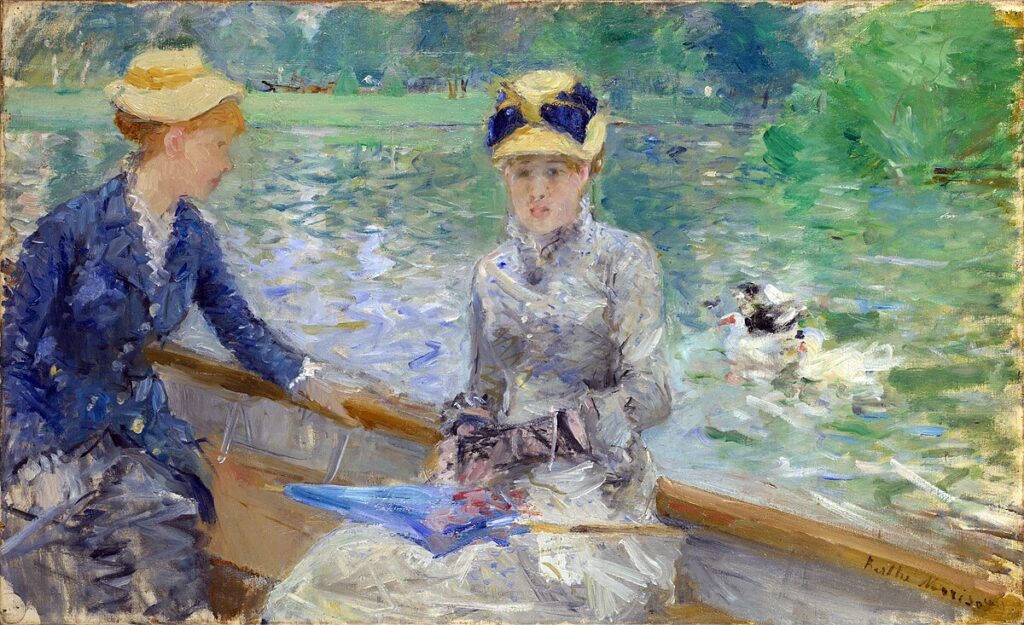
| Artist | Berthe Morisot |
| Date Created | 1879 |
| Medium | Oil on canvas |
| Genre | Impressionism |
| Period | Impressionist Era |
| Dimensions | 45.7 x 75.2 cm |
| Series / Versions | Part of a series of boating scenes |
| Where is it housed? | National Gallery, London |
Take a moment to picture it: The Bois de Boulogne’s Lac d’Enghien, Paris, with a lazy, sunlit afternoon. Two women sit dressed in summer dresses, and hats that seem to be straight out of the slick pages of Gucci’s summer couture collection, sitting in a small boat, hopefully enjoying a calm break from the hustle of Parisian life. The painting has a dream-like haze created by Morisot’s soft brushstrokes over the entire scene, but they’re deliberate. It’s a calm, rippled water, reflecting the lush greenery around them. The world pauses just for a moment to let these women savor it in the peace of a summer’s day.
Summer’s Day is beautiful in its subtlety, but that is the beauty of it. Instead of trying to conjure up grand and dramatic action, Morisot chooses a moment to show the women enjoying themselves. They aren’t talking or doing anything in particular. It’s an intimate, almost private moment, and we are invited to watch it. The heat appears to have sweetened them, to have lured them into a state of ease and comfort. Très charmant, no?
What’s So Special About Summer’s Day?
Curious, what was different about Summer’s Day in Morisot’s body of work? For one, it’s the way she plays with light and color. The water is soft blues, the foliage is greens and the women’s dresses are pastel tones that all dance together in a beautiful blend. Morisot doesn’t give us sharp lines, or clear markings between objects. Rather, the whole thing is joined in such a way that the painting seems to come to life and the scene could melt into the warm air any second.
Interesting Facts About Summer’s Day
Now for some fun tidbits about this lovely piece:
The Lac d’Enghien: This isn’t just any old body of water! The Bois de Boulogne, where this scene is set, was a favorite leisure spot for Parisians. A day on the lake was the 19th-century equivalent of a chic weekend escape.
A Family Affair: Morisot came from a creative family, but her connections extended beyond her bloodline. Did you know that her brother-in-law was Eugène Manet, the brother of Édouard Manet? Talk about an artistic family tree!
Series of Boats: Morisot had a thing for boats. This isn’t the only time she painted such a scene. She revisited this subject in other works, always capturing that delicate interplay of light, water, and leisure.
A Woman’s World: Morisot’s focus on women in everyday life wasn’t just an artistic choice—it was a reflection of her belief that these moments were worth capturing. She brought a feminine perspective to a world that was, at the time, overwhelmingly male-dominated.
Artwork Spotlight: Jeune femme décolletée, Lithographie signée

Morisot’s work Jeune femme décolletée, Lithographie signée which is also available on Singulart. Though it’s a simple portrait, it captures the same lightness and delicacy as her painted works. It’s like a whisper of a moment, frozen in time.
Are you looking for a piece of artwork from Berthe Morisot?
Singulart has limited edition prints of Berthe Morisot. If you are looking for a piece of Morisot‘s artwork for sale, simply click on the artwork or the button below to discover more!
FAQs
1. When did Berthe Morisot paint?
In 1864, at the age of twenty-three, Morisot debuted at the Salon de Paris with the approval of two landscape works. Until 1873, the year before the First Impressionist Exhibition, she kept up her usual Salon exhibition schedule and received generally positive reviews.
2. Who was Berthe Morisot friends with?
Morisot had strong relations with numerous Impressionists throughout her career, including the poet Mallarme, Degas, Monet, and Renoir. Except in 1878, she remained a regular exhibitor with the Impressionist group.
Conclusion
Summer’s Day by Morisot is a great piece of painting and not just because it is gorgeous; but because Morisot was able to paint it as a testament to her skill of capturing the sheer beauty in the everyday. You either know you saw it or you don’t and if you do, it stays with you.