When an artist who is also known for his poetry, filmmaking, and theatrical flair considers entering the field of fine art, what exactly happens? That’s something as alluring and otherworldly as Mythologie Blonde. This piece was created by legendary Jean Cocteau; it’s an artistic expression that merges surrealism with mythology. But before we talk more about the artwork, let’s understand the mind behind it—Jean Cocteau, a man who was as complex as his creations.
Who Was Jean Cocteau?
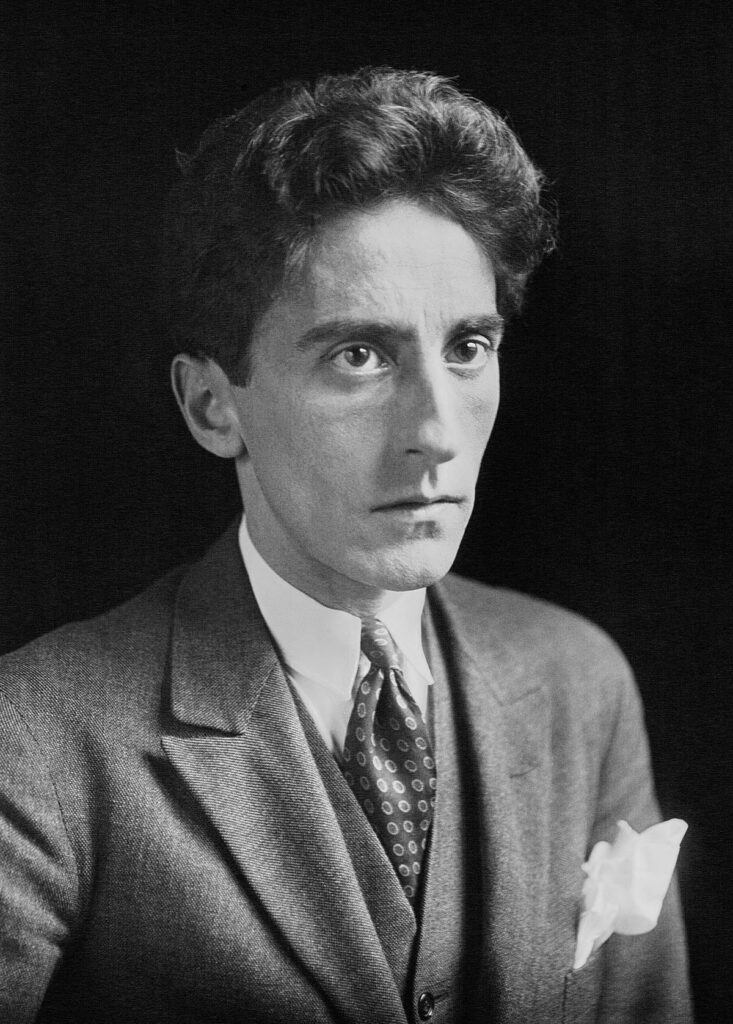
Jean Cocteau was a multi-faced artist who wore a lot of hats throughout his life. He was born in 1889, and time spent growing up saw Paris at the epicenter of artistic innovation. By his early 20s, his career took off, and he started horn mingling with an equally creative set of Pablo Picasso and Erik Satie. His literature, theater, and film works such as Beauty and the Beast (1946) had great success and brought him his reputation as a creator of avant-garde. As already said, this did not stop in words and film, but in artistic matter, he painted and sketched his perspective of the world.
He was more widely influential than in his lifetime, and his works are still praised not only for their daring and creativity but for their emotional depth. It is evident in Cocteau’s work, especially in Mythologie Blonde, that his world was a place where dreams and reality intersect.
FUN FACT: Cocteau had a very eclectic circle of friends. In addition to his collaborations with famous artists like Picasso and designers like Coco Chanel, Cocteau was good friends with none other than French singer Édith Piaf.
His Career
Cocteau’s life is quite a grand and complex story. His poetry and writing helped to thrust him into the spotlight during his earliest years. La Voix Humaine showed him combining emotion with experimental form. This wasn’t good enough, Cocteau concluded. He had an insatiable thirst for creation, wandering into the world of cinema to create timeless films that played out in the margins between dream and reality.
Beauty and the Beast (1946), his film masterpiece, left audiences with an impression of its surreal stories and visually beautiful scenes. Cocteau also worked with ballet composers and choreographers, creating a portfolio of work exploiting the interplay of visual and auditory senses. However, Cocteau did much more in literature and film, and his work as a visual artist usually played no small role, which is a shame because it’s just as fascinating.
What is Happening in Mythologie Blonde?

| Artist | Jean Cocteau |
| Date Created | 1950s |
| Medium | Ink and watercolor on paper |
| Genre | Surrealism, Mythological |
| Period | Mid-20th Century |
| Dimensions | 40 x 30 cm |
| Series / Versions | Mythology-themed works |
| Where is it housed? | Private Collection, Paris |
In many ways, Mythologie Blonde is a visual puzzle. Cocteau’s displacement between mythology and surrealism is a striking representation in the artwork. When you first look at it you’re entranced by its soft hues that seem to exist in another realm, flooded with figures that seem to float upon the scene.
Cocteau gives the impression of weightlessness, as if the figures are beyond time, in their word. It had the quality of life but there’s something fundamentally human about it. The figures express their expressions, the slight tension in their postures, and their interaction, like they’re fighting between their mythological duties and their very human desires.
Is it an old myth they’re retelling or is it Cocteau’s idea of his own version of one? That’s where the magic lies. The viewer is left to decide. The figures, yellow and white pale, are almost divine, but beautiful and vulnerable.
What’s So Special About Mythologie Blonde?
Mythologie Blonde is quite captivating. Well first, Cocteau blends all his mythology and surrealism, his world is a combination of ancient and modern and it feels like both at the same time. Classical mythology is used by him but not just for the retelling. Instead, he spins his version of these ancient tales—as if shadows pass over between what we know and what we don’t know, between dream and reality.
The lines are soft and the color palette is calm, they invite you in but the depth of the imagery keeps you lingering. With every glance, you discover something new: a forgotten gesture, a figure in the background, or an element you never took the time to notice. This balancing act of simplicity and complexity is what makes Cocteau’s mastery. The longer you look, it seems serene but the more alive it becomes.
Interesting Facts About Mythologie Blonde
Mythologie Blonde is not a standalone artwork—it is part of a series where Cocteau explores different mythological themes, often blending them with his surrealist tendencies. So, if this piece intrigues you, there’s a whole world of similar works to discover.
The term “blonde” refers to the golden-haired figures that dominate the painting. Cocteau often used hair color as a symbolic element in his art, with blonde figures often representing divinity or otherworldly beauty.
Cocteau loved to toy with the tension between myth and reality. In this piece, the figures are not just mythological; they embody human-like emotions, making them more relatable and less distant than the gods we often read about in mythology.
Artwork Spotlight: L’âge du verseau: faces multiples

L’âge du verseau : faces multiples is also available on Singulart. This artwork pushes the boundaries of what we perceive as identity and how we interact with time. He used faces and symbols to represent the fluidity of time, as seen in this two-dimensional exploration.
Are you looking for a piece of artwork from Jean Cocteau?
Singulart has limited edition prints of Jean Cocteau. If you are looking for a piece of Cocteau‘s artwork for sale, simply click on the artwork or the button below to discover more!
FAQs
1. What happened to Jean Cocteau?
At the age of 74, Cocteau passed away from a heart attack in his château in Milly-la-Forêt, Essonne, France, on October 11, 1963.
2. Is Jean Cocteau a surrealist?
Cocteau’s films and the Surrealist movement of the late 1920s and early 1930s have been closely associated. However, Cocteau never saw himself as a Surrealist.
Conclusion
Mythologie Blonde is not a simple artwork. It’s an experience. The way it plays with color, the way it references myth, the way it has a surrealist charm — all of that is a gateway for you to another world that somehow feels both old and new. What distinguishes Jean Cocteau’s art is his ability to create art through his ability to reach the emotional and intellectual way of his work.
Whether you’re a fan of mythology or simply someone who appreciates the beauty of visual art, Mythologie Blonde has something to offer. It’s a piece that continues to intrigue, inspire, and captivate anyone who encounters it.