


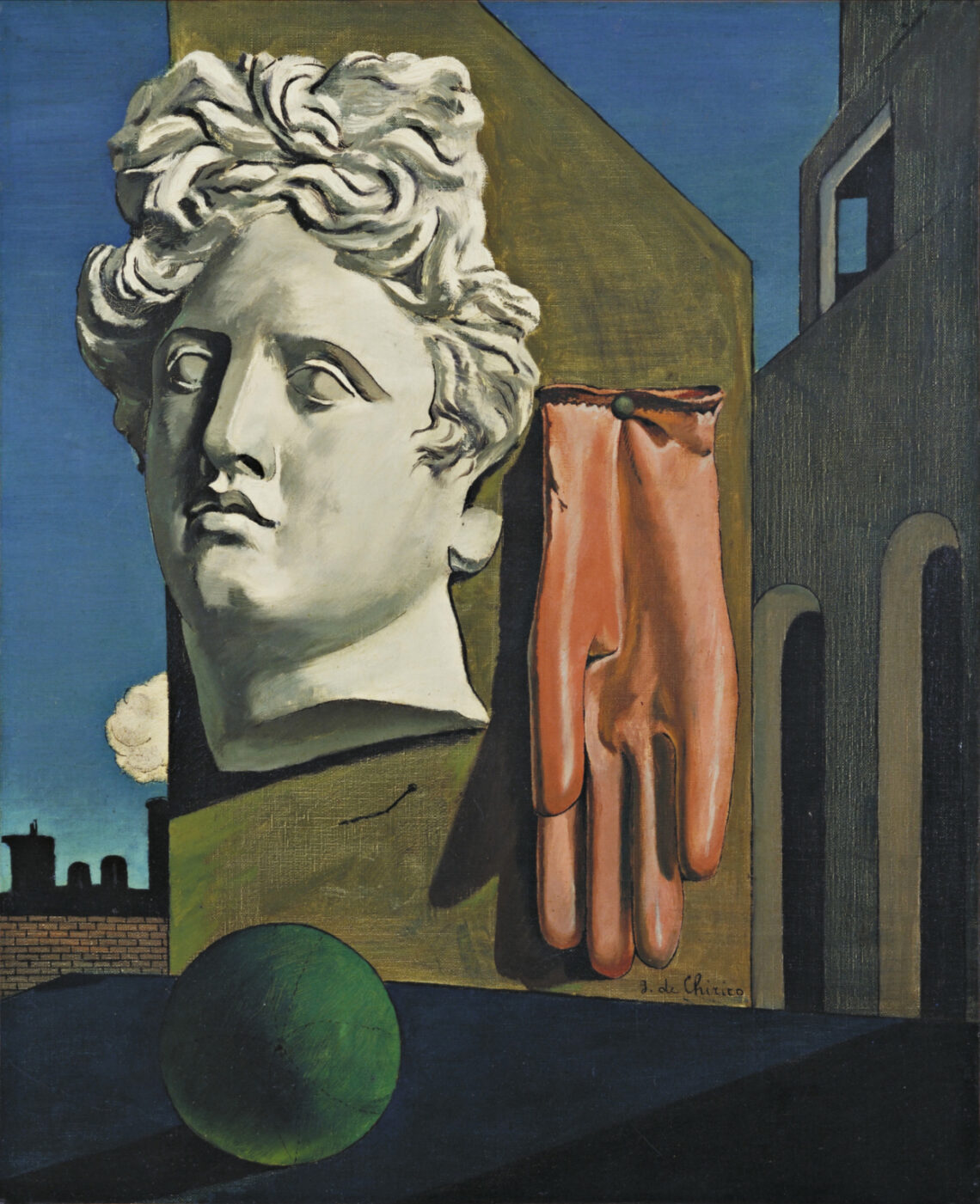
Giorgio de Chirico’s The Song of Love is a painting that makes you stop and think. At first glance, it looks like a strange mix of objects: a bright red glove, a green ball, and a classical Greek statue, all set against a mysterious cityscape. There’s more to it than meets the eye, as with all great art. This painting is a good example of de Chirico’s ability to blend the past with the present, the real with the unreal – as it was created in 1914. The painting is dream-like with things not quite adding up, but there’s an oddly familiar quality to it.
In this article we’ll look into the life of Giorgio de Chirico, what’s going on with The Song of Love, and how an artwork still lingers in our brain years. We’ll also add a couple of interesting facts to view this artwork in an entirely new light. Ready to explore? Let’s jump in!
Who was Giorgio de Chirico?
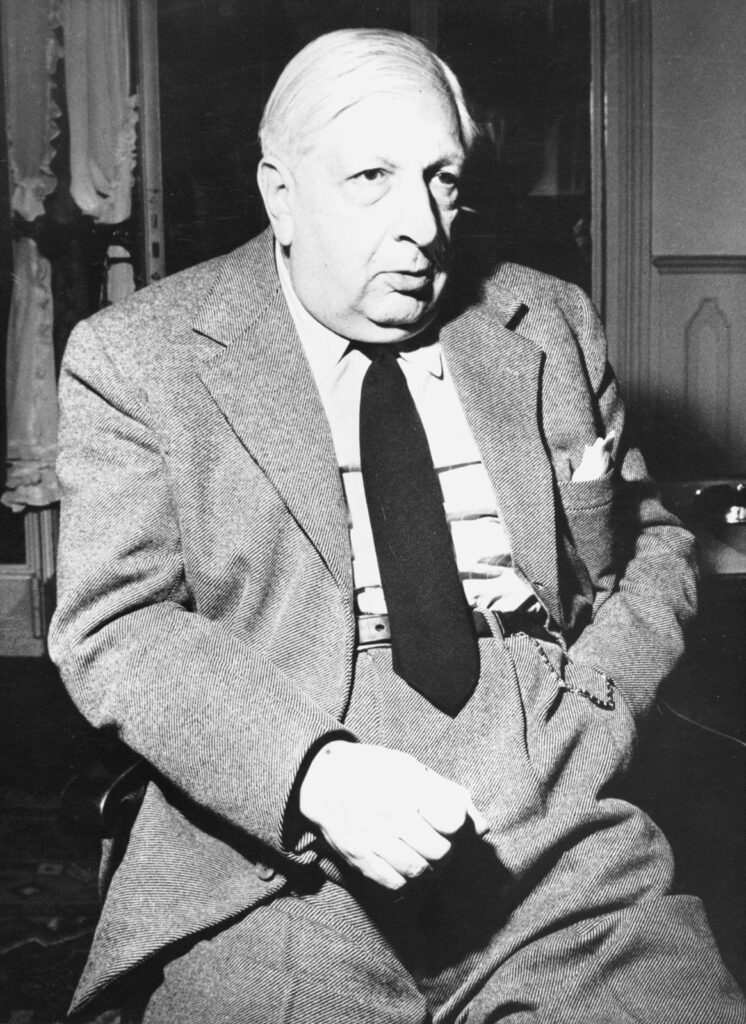
Giorgio de Chirico transformed art, forever changing how we see the world. Born in Greece in 1888, he grew up surrounded by ancient myths and stories. However, his work didn’t directly reflect these traditional tales. Instead, he took old ideas and gave them modern, unexpected twists. He blended the familiar with the strange, creating dreamlike scenes that feel both comforting and mysterious. His unique style eventually inspired the Metaphysical Art movement. While the term sounds grand, it simply explores deeper meanings and emotions hidden in everyday life.
You feel like you’re walking through a still, quiet city, wondering if you are awake or dreaming, as you do when you look at one of de Chirico’s paintings. His combination of shadows, long empty streets, and mysterious figures is unforgettable and a little spooky—in a good way. He wasn’t just a regular painter; he wanted to reinvent our perception of life, our clock, and the world around us in a new, magical way.
FUN FACT: He once painted copies of his own earlier works! In his later years, de Chirico became so nostalgic for his early Metaphysical period that he recreated many of his famous paintings.
His Career
After finishing studies in Athens, Florence, and Munich, De Chirico absorbed classical and contemporary art. From ancient Greek and Roman art to allusive dreamlike work in Paris after 1911, his early career was oriented on it. In Paris, he became friends with other artists and joined the avant-garde scene. He really developed his Metaphysical Art style there that would subsequently inspire movements like Surrealism.
Throughout his career, de Chirico continually chipped away at boundaries. He experimented with different techniques of light, shadow, and perspective. You quite often feel you have stumbled into a forgotten world with his paintings. Although there’s always something personal in his work, almost as if it’s a secret message waiting for you to discover.
What is Happening in The Song of Love?
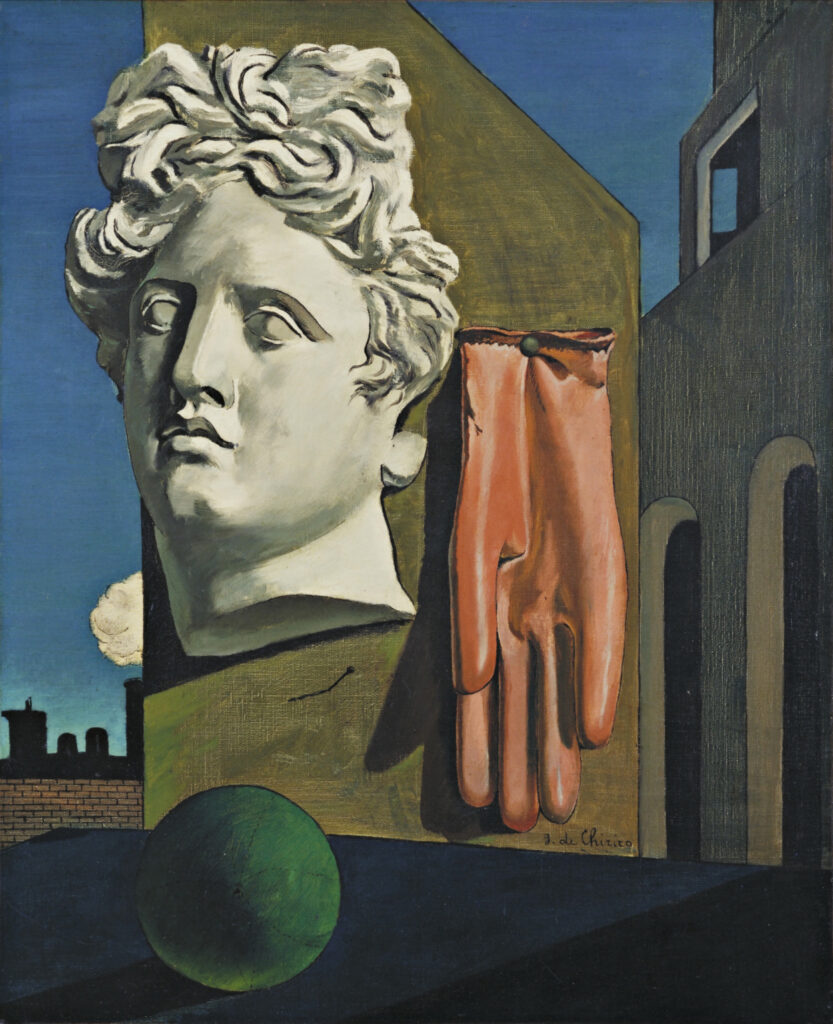
| Artist | Giorgio de Chirico |
| Date Created | 1914 |
| Medium | Oil on canvas |
| Genre | Metaphysical Art |
| Period | Metaphysical period (1909-1919) |
| Dimensions | 73 cm x 59.1 cm |
| Series/Versions | Standalone work |
| Where is it housed? | Museum of Modern Art (MoMA), New York |
At first glance, The Song of Love appears to be a random accumulation of objects of no apparent purpose. However, if you pay attention, you’ll learn that everything has something to serve. It’s left behind, forgotten by time – almost sitting against a wall. On the wall, there is an oversized red rubber glove, dangling to the right of the statue. Why a glove? That’s part of the mystery. Others say it’s symbolic of the hand of the artist, while others say it’s symbolic of the rise of industrialization, a modern object against an ancient symbol.
It’s a painting of a moment where nothing is happening, but you can’t shake the feeling that it all could end any moment now. You watch the painting that is a moment when nothing is happening, but you just can’t shake the feeling that something is about to. It’s a calm before the storm, expecting and dreading at the same time. The long shadows, the deep distance all pull you in, so that you feel like part of this quiet, spooky world. De Chirico is always introducing you to a dream where everything seems at once both familiar and strange.
A green ball just sits at the bottom of the painting being quiet and unassuming. A shadowy street lies behind it all, rows of arches going to where there is no end. The long shadows and space make us feel like something shouldn’t be there or is about to happen. The viewer must then look for his or her meaning, leaving the questions open-ended, as does De Chirico.
What’s So Special About The Song of Love?
What then makes The Song Of Love memorable? Now to start it was painted in 1914, just before the outbreak of World War I. De Chirico’s painting seems to catch the world on the edge of change. A world of old traditions being disrupted by new ideas, the mix of the classical statue with the industrial glove is a meld of ancient and modern elements.
This painting is special for another reason in that it helped lead to Surrealism. De Chirico wasn’t strictly a Surrealist even if artists such as Salvador Dalí and René Magritte were influenced by his work.
Interesting Facts About The Song of Love
Apollo’s Head: The plaster head in the painting is believed to be Apollo, the Greek god of music and poetry. Apollo represents beauty and art, making his presence here even more intriguing, especially when paired with such an industrial object like the red glove.
That Red Glove: The bright red rubber glove has sparked a lot of debate. Some art experts think it symbolizes the intrusion of modern industry into the classical world. Others suggest it might represent the artist’s hand, as gloves are often associated with manual labor and creation.
Architectural Mystery: The arches in the background of The Song of Love are a recurring theme in de Chirico’s work. They give the scene a sense of depth and mystery, as if the arches lead to somewhere unknown. De Chirico loved to play with perspective, making us question what lies beyond the horizon.
The Influence on Surrealism: Though de Chirico never officially joined the Surrealists, his influence is undeniable. Artists like Dalí admired de Chirico’s ability to create dreamlike scenes. The Surrealists took this idea and ran with it, exploring the world of the subconscious.
A Reflection of the Times: Painted right before World War I, The Song of Love captures a moment in history when the world was about to change forever. The painting reflects this uncertainty, with its odd mix of old and new, calm and unsettling.
Artwork Spotlight: Il Trovatore
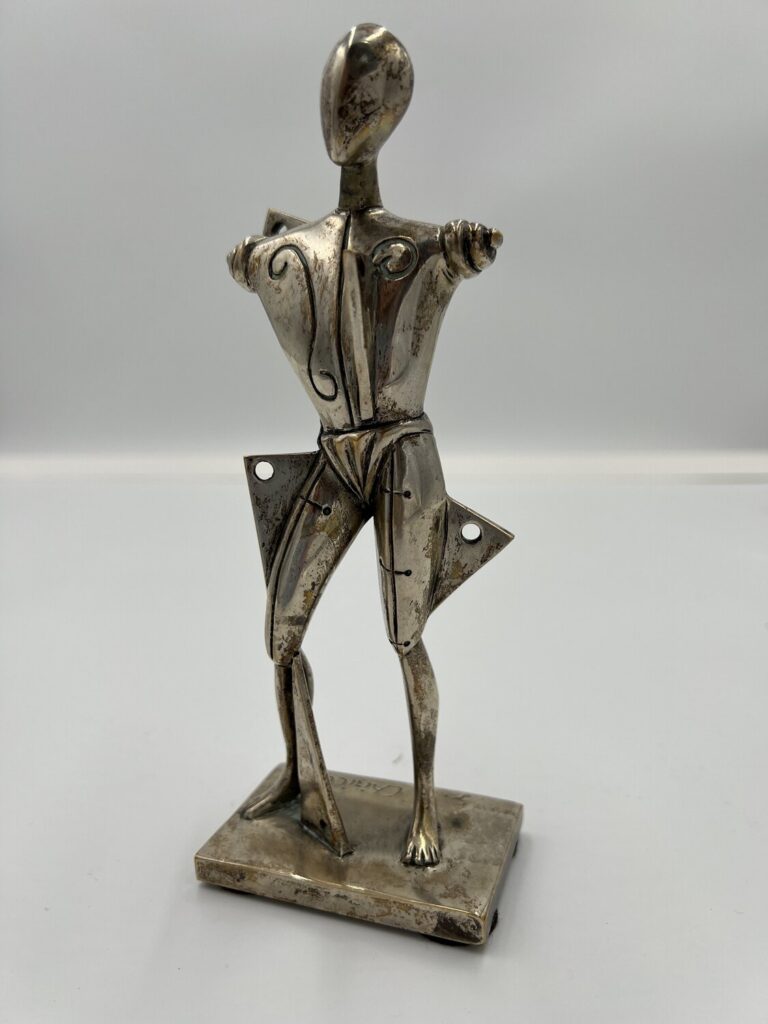
In 1917, de Chirico created Il Trovatore which is also available on Singulart. Like The Song of Love, this painting features classical sculptures set against a mysterious background, evoking feelings of both nostalgia and dislocation.
Are you looking for a piece of artwork from Giorgio de Chirico?
Singulart has limited edition prints of Giorgio de Chirico. If you are looking for a piece of de Chirico‘s artwork for sale, simply click on the artwork or the button below to discover more!
FAQs
1. Was Giorgio de Chirico a futurist?
De Chirico seemed to be choosing the Renaissance in terms of plastics and even iconography, whilst the Futurists were building on the base of Cubism.
2. What was Giorgio de Chirico famous for?
The Italian artist Giorgio de Chirico (1888–1978) is most recognized for having established the metaphysical painting or metaphysical art movement.
Conclusion
The Song of Love is at the core of a painting, a painting that lingers between the past and the future. It reminds us of the beauty of classical art, and it now also hints at the industrial changes that were remaking the world. The way it conveys these elements is what makes it truly special.


