It is a puzzle to see in Georges Braque’s Man with a Guitar, not only a painting but a composition of shapes and lines inviting you to play with it. This piece was born from the collaboration between Braque and Pablo Picasso, the height of Cubism a movement that shattered the art world. In Man with a Guitar, Braque makes us look at the world from many points of view, not just one.
However, what makes this painting so significant? What is going on with all those abstract shapes anyway? So, for what it is worth, it’s time to explore the life of Georges Braque, his career, and the magic behind Man with a Guitar. Along the way, we’ll discover how this quiet, revolutionary piece has changed the way we view the world at large.
Who Was Georges Braque?
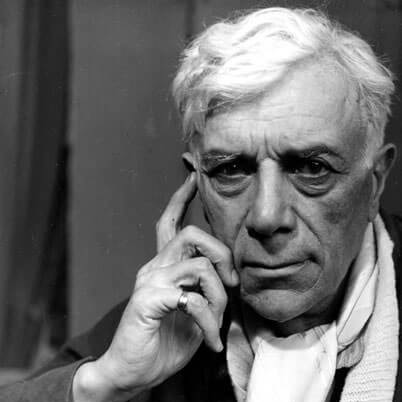
Georges Braque was born in 1882 in France in Argenteuil. He was always around color and design because his father was a house painter. When he grew up, his love for art developed and he chose to study painting. Braque experimented with different styles early in his career. His first foray was into bold colors and light via Impressionism and Fauvism.
When Braque encountered the work of Paul Cézanne, an artist famous for stripping natural forms of their angularity, something had changed. Braque was inspired to try a new way of painting, painting that would lead to Cubism with Picasso. With Cubism, an entirely new way of considering how we see objects and spaces was opened up.
FUN FACT: He was not only a pioneer of Cubism, but also an avid musician! Braque loved to play the accordion, and music was a huge influence on his artwork.
His Career
Evolution is the right word for Braque’s career. Initially, his colors were bright but bold and inspired by Fauvism, and he later became fascinated with geometry and form. He worked closely with Picasso to develop Cubism, a style that breaks down objects into simple shapes and then reassembles the objects on the canvas from multiple perspectives.
From about 1908 to 1914, Braque and Picasso kept pushing one another toward great art. At this time, apart from Analytical Cubism, Braque’s paintings grew more abstract. Instead of coloring, he focused on the structure of what he was painting. Braque continued to develop as an artist after World War I. He resumed working in color and began to lose the fluidity while still being concerned with form.
What is Happening in Man with a Guitar?
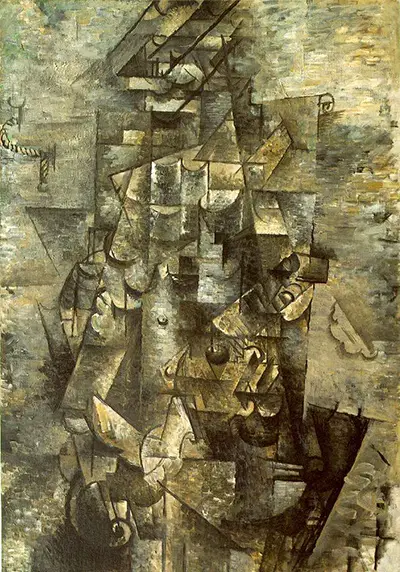
| Artist | Georges Braque |
| Date Created | 1911 |
| Medium | Oil on Canvas |
| Genre | Cubism |
| Period | Analytical Cubism |
| Dimensions | 45 7/8 × 31 7/8 in. |
| Series / Versions | Part of the Guitar series |
| Where is it housed? | The Museum of Modern Art, New York |
So if you think that you will see a clear portrait of a man playing a guitar in this painting, think again. Man with a Guitar (1911) by Braque challenges you to see that which is not there. At first glance, a muddled configuration of geometric shapes in muted tones, but within that monotone, these contours, these shapes, this abstraction is the musicianship and instrument.
This is a perfect embodiment of Analytical Cubism, which is where Braque demetaphorises the subject to fit bits of flat plane on top of each other. The man and the guitar are split into the figure and rearranged as a system that forces you to engage with the painting to understand what it means. Solving a puzzle is how you describe it, Braque gives you all the contacts but you have to solve them.
What’s So Special About Man with a Guitar?
What makes this painting so real magic is that it shakes us out of the way that we understand art and perception. Braque wasn’t after a literal reconstruction of what was taken. What he really wanted was to capture the experience of looking, how we do it with our eyes and minds in bits and pieces.
Interesting Facts About Man with a Guitar
Partners in Art: Braque and Picasso worked so closely during the Cubist period that they were almost indistinguishable. Picasso himself once said that he and Braque were “roped together like mountaineers,” pushing each other to explore new artistic heights.
Hidden Musicians: The fragmented style of Man with a Guitar makes it easy to miss the musician at first glance. But if you look closely, you’ll start to see the outlines of the guitar and the figure of the man emerge from the jumble of shapes.
Music and Art: Braque was deeply influenced by music, and this piece reflects his fascination with how musical compositions could be represented visually. The rhythm of the lines and the balance of the shapes mirror the structure of a musical composition.
Muted but Powerful: While Braque’s early works were full of bright colors, Man with a Guitar opts for a more subdued palette of browns, grays, and blacks. This restrained use of color allows the focus to remain on the structure and composition of the piece, highlighting Braque’s mastery of form.
Artwork Spotlight: Les oiseaux I
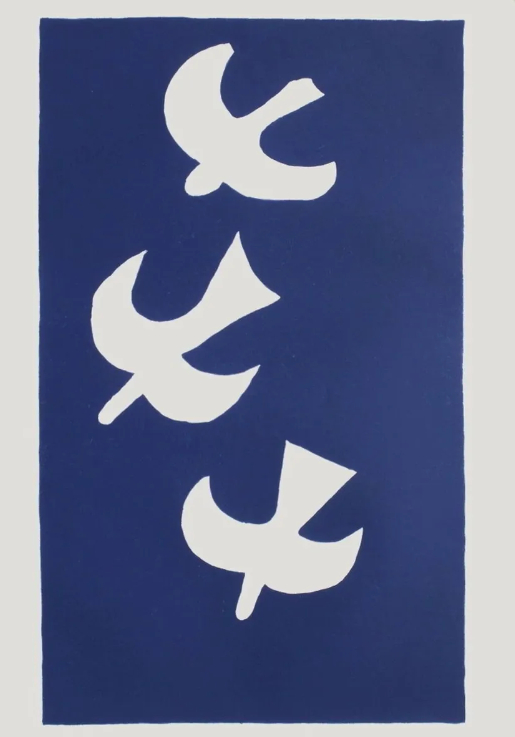
Braque’s later work, Les oiseaux I is available on Singulart. This artwork is a peaceful and elegant representation of birds in flight. It reflects the softer, more lyrical style Braque embraced toward the end of his career.
Are you looking for a piece of artwork from Georges Braque?
Singulart has limited edition prints of Georges Braque. If you are looking for a piece of Braque‘s artwork for sale, simply click on the artwork or the button below to discover more!
FAQs
1. How did Georges Braque contribute to Cubism?
Georges Braque was a leading figure in the groundbreaking Cubist art movement. Throughout his life, Braque’s art was primarily still lifes and ways to use color, line, and texture to see objects from different angles.
2. What was Georges Braque’s art style?
The Cubist style is the basis for George Braque’s well-known paintings. The reason it is termed Cubism is that the objects shown in the artworks appear to be constructed from cubes and other geometric shapes. Despite working on a variety of subjects, Braque is best known for his masterful still-life paintings.
Conclusion
Man with a Guitar isn’t a painting, it’s something more. Georges Braque asks that you look at the world in a way not with a single lens, but with many lenses. Every glance is just a new thing, and with every look, you’re reminded that art isn’t about what you see but how you feel.
So, the next time you’re at the museum, take a moment with Braque. Let the lines and shapes guide your imagination, and you might just hear the faint strum of a guitar in the distance.
Bonne journée!