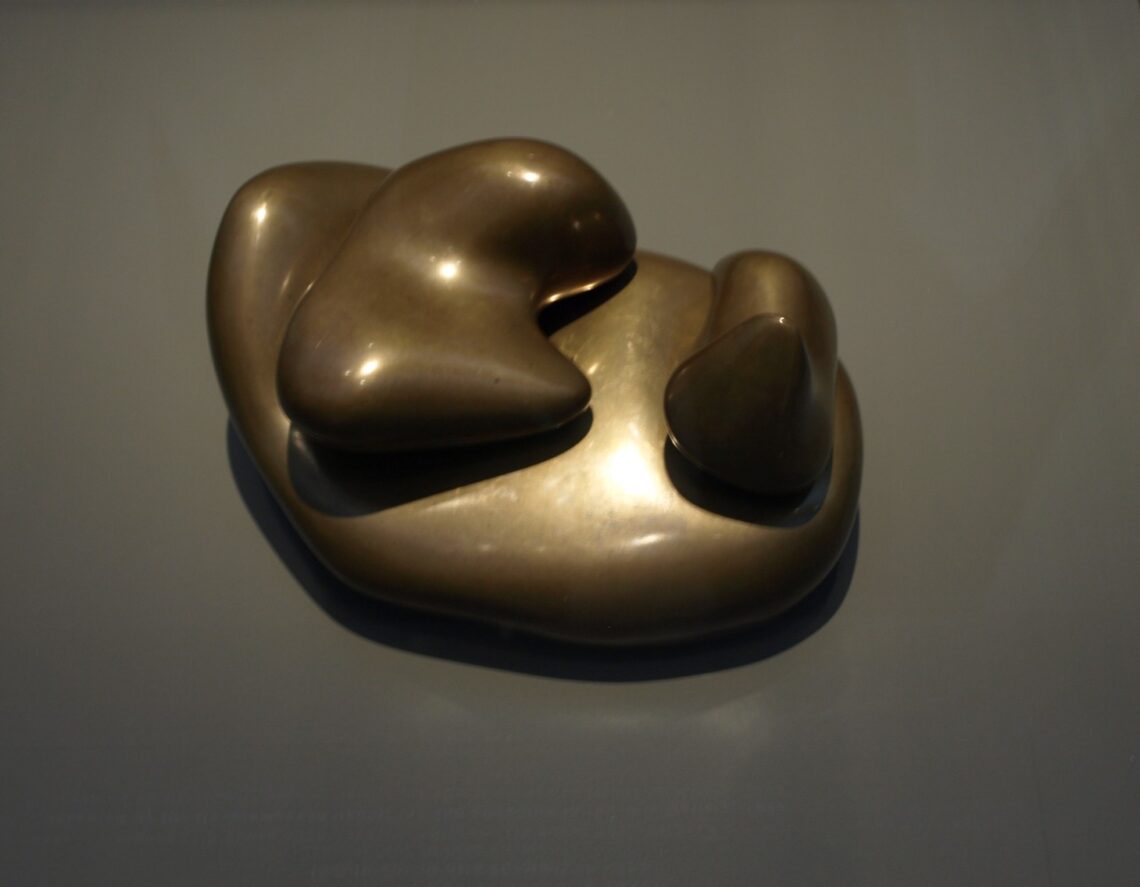
Jean Arp’s work has a magnetic quality that draws you in—not by demanding understanding, but by feeling unexpectedly alive. For example, take his piece Sculpture to be Lost in the Forest. It’s a sculpture you might easily mistake for a natural formation, quietly nestled among trees. Yet, each curve and detail is so thoughtfully crafted, that it invites a closer look.
Sculpture to be Lost in the Forest is an artwork that dances the edge between form and formlessness, disappearing into nature, creating and then making us question, where exactly is the boundary between the two. Who was Jean Arp and how did he end up creating such organic almost otherworldly art? Let’s find that out in this article!
Who Was Jean Arp?
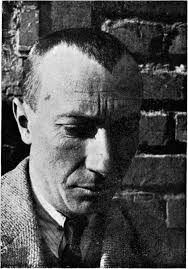
Jean Arp was born in 1886 in Strasbourg which has both French and German roots. His unique background played an important part in the shaping of his style. Arp co-founded the Dada movement in Zurich early in his career. The art movement Dada was a wild, rebellious art movement, born in response to the chaos of World War I. For Arp art didn’t have to be ‘serious’ to be important. It was Dada, full of breaking rules, adding humor, and making the unusual special.
After Arp’s Dada days, he moved toward Surrealism, in which he allowed his imagination to run even more freely, producing dream-like works. He eventually ended up with abstract art, working with simple, flowing lines in that he was able to remind people of their nature. Arp’s pieces were often round, with soft curves, and were seemingly shaped gently by nature itself, like by wind or waves.
FUN FACT: Jean Arp was known for his spontaneous approach to creating art. He often let chance play a role in his process, embracing randomness to shape his works.
His Career
Arp’s life was like a voyage through the most daring art world ideas. After Dada, he took on traditional ideas about art, first with humor and later with spontaneity. He became a Surrealist later and used his work to add a dream quality. He finally resorted to doing abstract art, which involved painting and creating sculptures of soft shapes and flowing forms. This became his style.
Arp didn’t want art to be about exactly capturing a person or an object. Instead, he wanted to capture feelings, life, and movement. His pieces don’t attempt to look identically like actual things; they are hints or whispers of what might be there, with you able to imagine.
What Is Happening in Sculpture to Be Lost in the Forest?
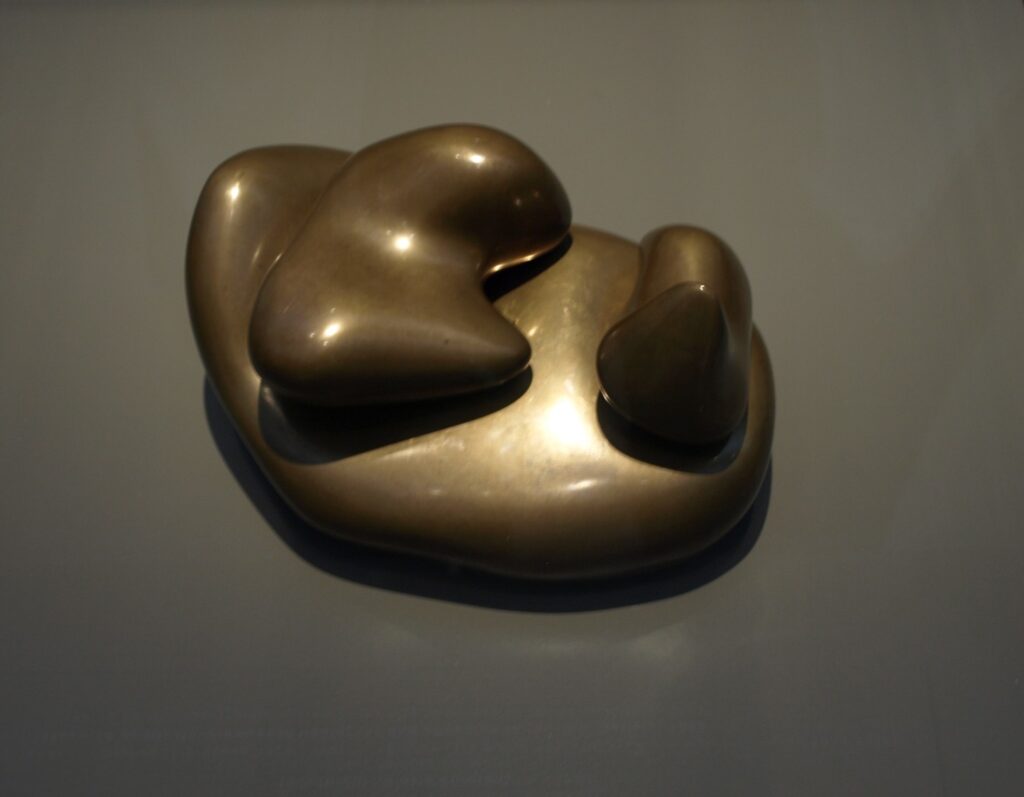
| Artist | Jean Arp |
| Date Created | 1932 |
| Medium | Bronze |
| Genre | Abstract, Biomorphic Sculpture |
| Period | Surrealist |
| Dimensions | 3 ft (approximate) |
| Series / Versions | Unique piece, though Arp created several sculptures inspired by nature |
| Where is it housed? | Various outdoor installations, mostly in Europe |
What is happening in Sculpture to be Lost in the Forest? Arp’s forms are nonmeaningful and are never mere abstractions. With its polished but biomorphic curves, this sculpture has the appearance of a large pebble or alien seed, waiting to sprout. It’s smooth and offers a tantalizing gleam of light past that hints at its interior.
There’s even something a little weird about the shape in itself, as if maybe it’s part of a forest and you might find yourself stumbling across it on a quiet stroll through the trees. Arp wanted art and nature to merge so seamlessly that you could not distinguish one from the other. It’s a whispering sculpture, more than a shouting one, that draws you closer to contemplate its basic, graceful forms. This piece allows you to forget about itself and lets you immerse in the springtime of a forest for a short while.
What’s So Special About Sculpture to Be Lost in the Forest?
Why is Sculpture to be Lost in the Forest such a special thing? It’s not just about celebrating nature’s quiet beauty, it’s also a smart comment about how we see art. Arp’s piece commands to be observed and admired in stark galleries or gardens, but not like most sculptures; it beckons itself into the wilderness. He did not want this sculpture on a pedestal, he wanted it to melt into the forest as if it were a forgotten artifact.
Interesting Facts About Sculpture to Be Lost in the Forest
Dual Identity: Arp’s dual identity—French and German—adds a unique layer to his work, blending cultural influences into one artistic voice. He grew up in Strasbourg, a city that toggled between French and German rule, and this fusion is evident in his eclectic, boundary-crossing art style.
Nature Inspiration: Arp was deeply inspired by nature’s forms, which he once called “the master of all artists.” This sculpture epitomizes that admiration, as its organic shape looks as though it could have grown from the forest floor.
Organic Beauty: Though Arp’s work often looks simple, there’s a profound beauty in its organic form. He aimed to create pieces that mimic natural patterns, almost as if they’re breathing alongside you in the forest.
Perfect Imperfection: Arp had a philosophy of “embracing the imperfect.” He intentionally avoided strict symmetry, believing that organic, imperfect shapes were more reflective of life itself.
Artwork Spotlight: DLM033 – Palette de nuage

DLM033 – Palette de nuage by Jean Arp is available on Singulart. This artwork features floating, cloud-like forms that are as elusive as they are serene.
Are you looking for a piece of artwork from Jean Arp?
Singulart has limited edition prints of Jean Arp. If you are looking for a piece of Arp‘s artwork for sale, simply click on the artwork or the button below to discover more!
FAQs
1. What techniques did Jean Arp use?
Arp uses a variety of techniques, particularly collage and unorthodox materials. Plaster and wood reliefs were the two primary materials that Arp employed to create his sculptures.
2. What movement was Jean Arp a part of?
Arp sought safety in Zürich during World War I, and in early 1916 he helped establish the Dada movement there.
Conclusion
Arp’s Sculpture to be Lost in the Forest offers a quiet, subtle revolution in how we think about art and its place in the world. In a fast-paced society, this piece gently reminds us to slow down, look closer, and appreciate the simple, serene forms that surround us every day.
Adding Sculpture to be Lost in the Forest to any collection, even if only mentally, connects you with nature in a way that feels timeless and, frankly, a little magical.