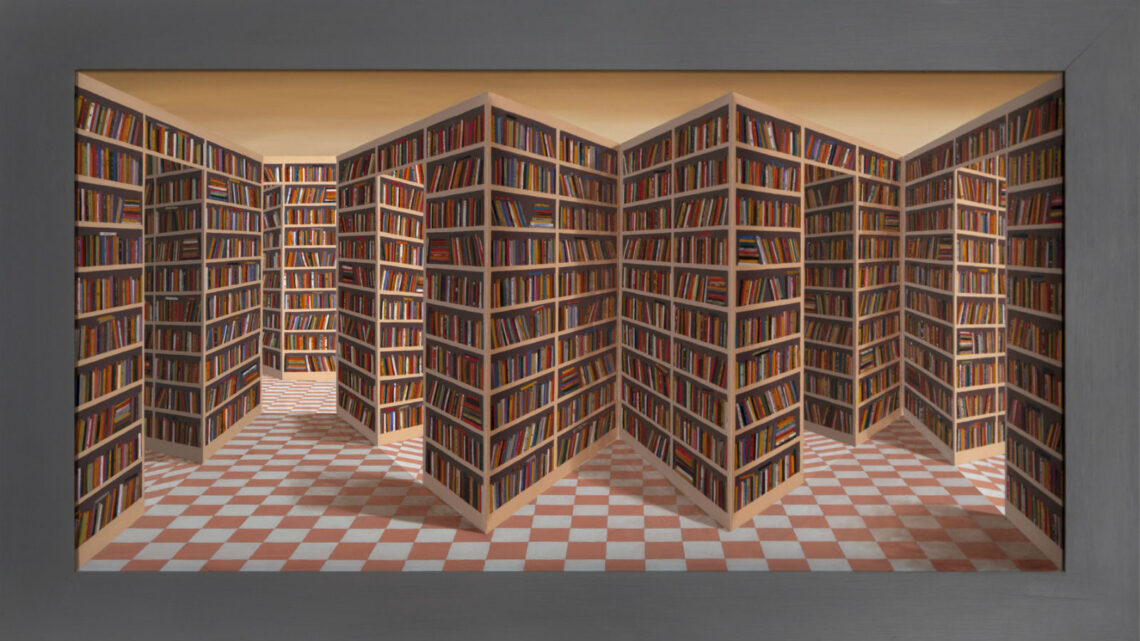
Picture this: a feeling of art that’s moving right before your eyes. The British artist Patrick Hughes has produced a fascinating piece called Paradoxymoron. It looks like a simple painting of a library, but it morphs and twists and shifts around you, playing tricks on depth and perspective. Often referred to as the ‘illusionist of art,’ Hughes makes flat images look three-dimensional. Paradoxymoron makes the invitation to the viewer to step into the world of reality and illusion that blur into a moment of pure puzzle.
Today, let’s take a look at the journey of Patrick Hughes as an artist; the magic behind Paradoxymoron as a virtual experience, and why it’s such a special experience. As we go through each section, we will discover additional layers of this artwork and wonder why it still amazes and pleases.
Who Was Patrick Hughes?
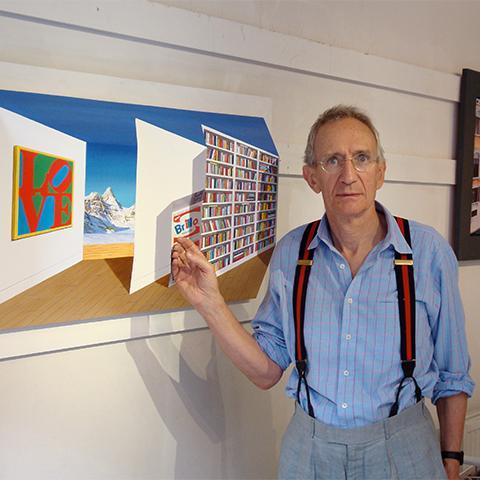
Patrick Hughes is a British artist, known for his “reverspective” technique, creating a twist to the norm of how we see depth and space in art. Growing up in Birmingham in 1939, Hughes had already had enough of flat images. He wanted to play with our sense of perspective: how we look at things and how we think about distance. So, he made pieces that meddle with these ideas and play with them, and in doing so, he allowed people to move around and see the art changing.
In the 1960s, Hughes became well known when artists, musicians, and writers all attempted new things. Sticking-out Room was one of his early works that showed his love for humor, perception, and visual puzzles and what would become his own design style. Today, Hughes’ paintings are shown in museums and galleries around the globe and he is not only celebrated for his work as a painter but as a bit of a magician of the visual world.
FUN FACT: Hughes often jokes about his reverspective art being “anti-gravity” because of the way it seems to defy the normal rules of depth and perspective.
His Career
Starting in the 1960s, Hughes carved a place for himself in the art world. Other artists might create realistic portraits or abstract pieces, but Hughes went for something else. He developed “reverspective,” a technique that reverses perspective. Viewers are entreated to move around the piece, which creates new shapes and angles.
Sticking-out Room was one of his early well-known work, which focused on the way we label and think about art. Throughout his work, Hughes has kept that playful spirit alive, bringing viewers right into his creations using perspective.
What’s Happening in Paradoxymoron?
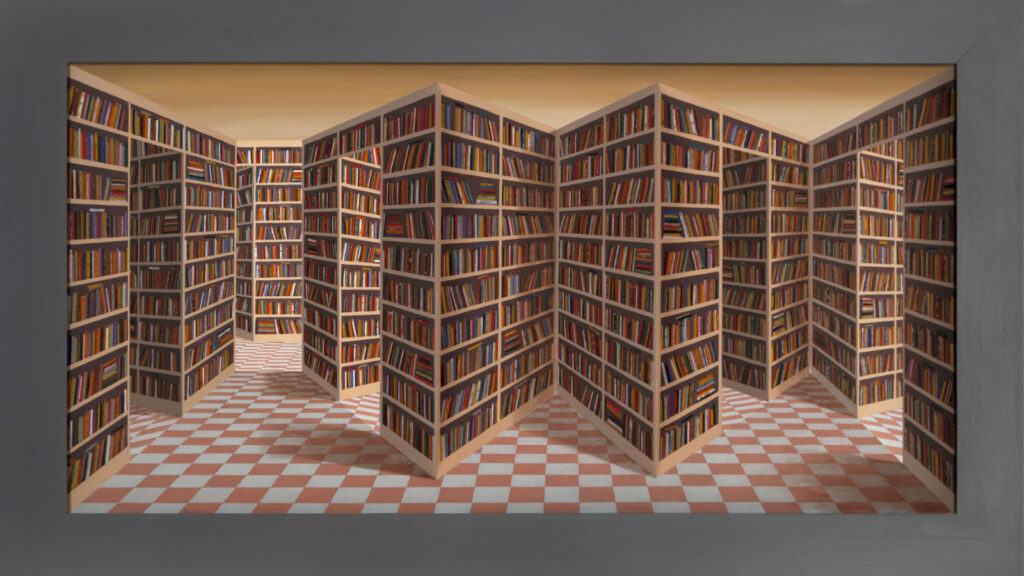
| Artist | Patrick Hughes |
| Date Created | 1996 |
| Medium | Oil on board |
| Genre | Optical Illusion, Reverspective |
| Period | Contemporary |
| Dimensions | 60 x 90 cm |
| Series / Versions | Part of the Reverspective Series |
| Where is it housed? | Private Collection |
In Paradoxymoron, Hughes describes an ordinary library, with colorful bookshelves. However, as you walk around the artwork you see the shelves and books moving, too. All of a sudden, the library seems either to be stretching out dangerously far inwards or coming right at you.
The artwork puts a spin on what we expect. You want the shelves to not move, but they do. It’s like walking through a world where reality is a blob and follows you around. The actual bookshelves seem to be very deep, but believe it or not, they are just painted on a flat surface.
What’s So Special About Paradoxymoron?
Paradoxymoron is cool because it’s not just something to see, it’s an experience. Hughes has created both a simple scene and a magical library. This one doesn’t feel like most paintings, it moves as you move. It’s the artwork that encourages the viewer to question how they view the world and ask themselves what they’re seeing and what they are not.
This kind of art is rare. Hughes mixes color, shadow, and perspective to give a sense of depth. It feels fun and mysterious at the same time. This surprise element makes Paradoxymoron an artwork you can’t just walk past. It draws you in, makes you curious, and leaves you questioning.
Interesting Facts About Paradoxymoron
The Magic of Reverspective: Hughes invented the term “reverspective” to explain his special style. Instead of the image receding into the distance, parts of it appear to pop out toward you.
A Hint of Paris: Hughes’ love for perspective could almost be seen as an atelier of illusions. Though his work is British, there’s a touch of Parisian charm in its daring and avant-garde feel.
Constant Movement: Paradoxymoron isn’t just a static piece of art. As you move around, the shelves seem to follow you, creating a sense of shifting space.
Playing with Space: Hughes’ work explores space in a new way, blending real-world physics with a painter’s trickery. It’s like walking into a dream world where rooms expand and contract at will.
Art for the Mind: This piece does more than please the eye. It plays with the mind, making you question what’s real. It’s a reminder that our sense of reality isn’t always as solid as we think.
An Interactive Experience: People often describe viewing Paradoxymoron as an interactive experience, where the art changes depending on where you stand.
A Library of Ideas: Hughes chose a library setting for Paradoxymoron because it represents knowledge and discovery, both of which shift and change, just like our understanding of perspective.
Artwork Spotlight: Studio

Studio by Patrick Hughes is available on Singulart. This artwork shows his unique perspective magic, offering a playful and personal peek into his creative space. It’s a snapshot of the artist’s world, brought to life by Hughes’ one-of-a-kind style.
Are you looking for a piece of artwork from Patrick Hughes?
Singulart has limited edition prints of Patrick Hughes. If you are looking for a piece of Hughes‘ artwork for sale, simply click on the artwork or the button below to discover more!
FAQs
1. What is Patrick Hughes famous for?
As the forerunner of ‘Reverspective’ art, Patrick Hughes is a significant figure in modern British painting.
2. How does Patrick Hughes create his optical illusions?
Patrick Hughes crafts his illusions using a technique called “reverspective,” where he paints on three-dimensional, protruding surfaces instead of a flat canvas.
Conclusion
Patrick Hughes in Paradoxymoron doesn’t hand you a painting, he gives you a window to another way of seeing. Art draws our curiosity, leaving unanswered questions that force us to remember that the reality we live with isn’t as rigid as the view we see. It’s this sort of artwork that turns perception on its head, creating a joyous experience that is equal parts play and profound.