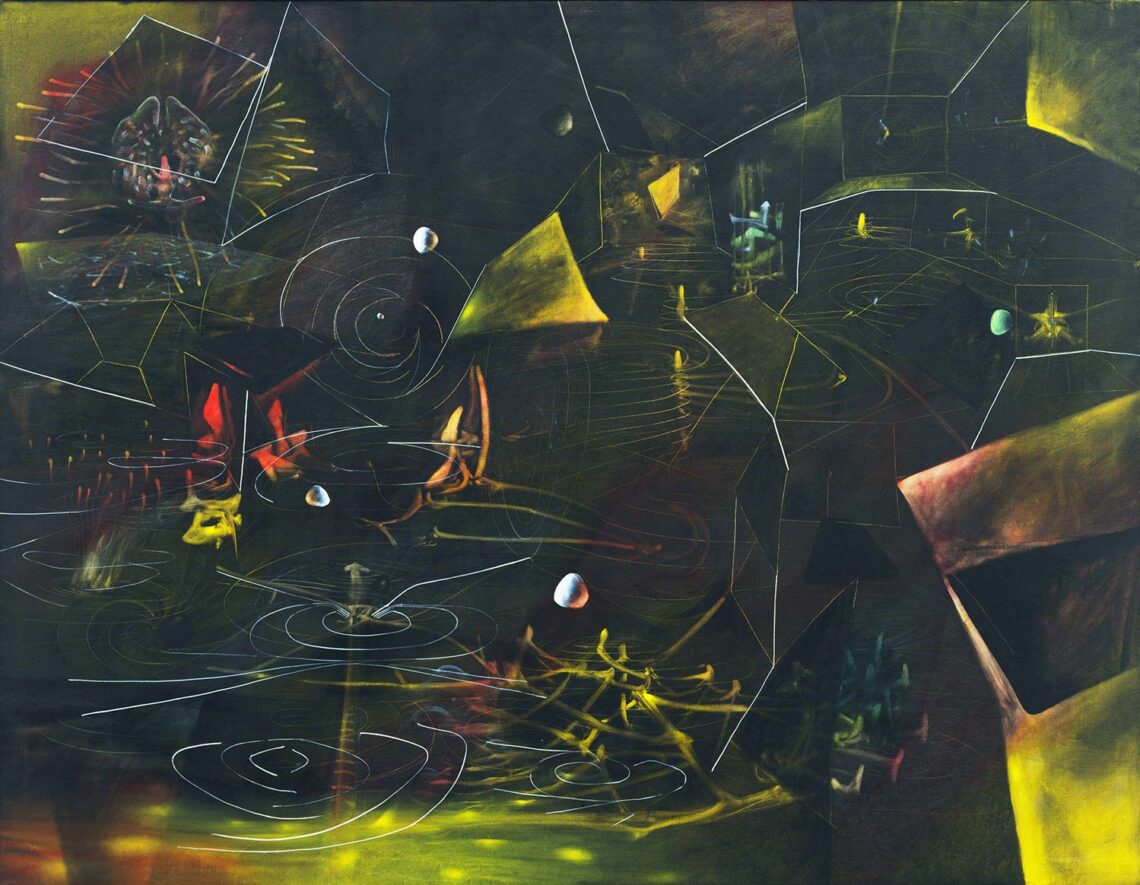
The Vertigo of Eros by Roberto Matta is not only a painting; it’s an experience. Picture yourself in a place where everything moves, where no objects are ever the same, as though you just fell asleep. Finishing in 1944, this is a piece about the burst of emotions – love, passion, just a hint of mystery. This vibrant, chaotic scene pulls in the Chilean artist Matta, a man with the gift of imagination mixed with emotion, inviting us into his mind. Learning about the man behind The Vertigo of Eros and why it feels so magnetic and alive, we’ll dive into Matta’s life and career. So we will step in and discover Matta’s world.
Who Was Roberto Matta?

Roberto Matta was born in Chile in 1911 and embarked on a career as an artist that was out of the ordinary for his profession – he was trained as an architect! In 1935 he moved to Paris where he met some of the biggest names in art, such as Salvador Dalí and André Breton. This led him to begin painting and in a short time, he became one of the movement’s leading figures, Surrealism, a movement based on dreams and imagination.
Matta was incredibly curious about the human mind. He did more than just paint. Rather than paint the outer world, he painted the spaces of our minds full of emotions and thoughts. With The Earth is a Man, he went further imagining the Earth itself as a living organism.
FUN FACT: Roberto Matta was a friend and collaborator of some of the biggest names in surrealism, like Salvador Dalí and André Breton. But he also hung out with emerging abstract artists in New York, influencing people like Jackson Pollock.
His Career
Matta’s fame grew worldwide, but he made his career in Paris. He became associated with the Surrealist movement, which flourished in the late 1930s. As Matta’s voice began to develop, he began to mix Surrealism with Abstract Expressionism, creating large, colorful, and dynamic works.
In the early 1940s, Matta moved to the United States, where he flourished. He served as a mentor to many of the leading American artists of his era like Jackson Pollock and Arshile Gorky, guiding them into new possibilities for form, space, and emotion. With his dynamic, swirling forms and cosmic landscapes, his work would serve as touchstones for the nascent Abstract Expressionist movement, which celebrated spontaneity and emotional intensity.
What’s Happening in The Vertigo of Eros?
| Artist | Roberto Matta |
| Date Created | 1944 |
| Medium | Oil on canvas |
| Genre | Surrealism |
| Period | Mid-20th Century |
| Dimensions | 81 x 116 cm (approx.) |
| Series / Versions | No known series or versions |
| Where is it housed? | Museum of Modern Art, New York |
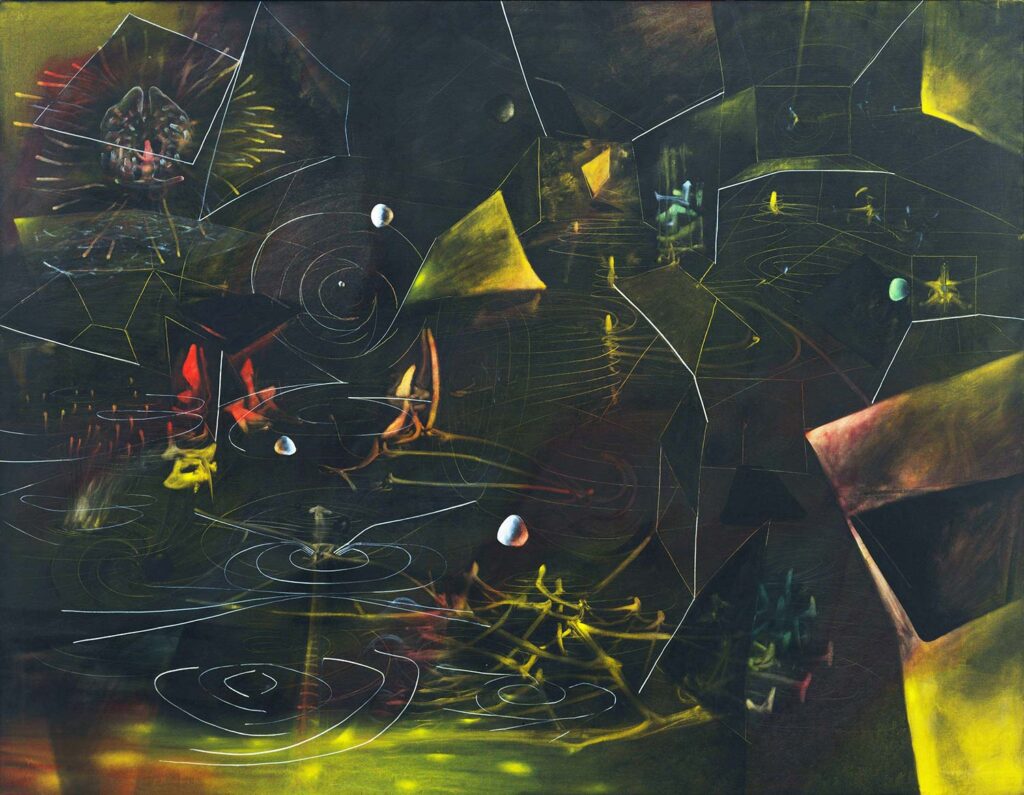
The Vertigo of Eros is like putting on a spinning hat; your head will spin, and you will like it. This work was painted during a time of emotions and uncertainties and Matta painted it. In The Vertigo of Eros waves of reds, greens, and blues crash together and clash as if the canvas itself were moving.
It’s not a painting you can capture in one glance. It’s all about feeling: a sense of being lost in love, or something like that. Looking at the swirling lines and energetic colors you get that ‘vertigo’ or dizzying spin that you would expect in a good desperate title. Matta seems to have captured the very passion itself, a feeling of highs and lows.
What Makes The Vertigo of Eros So Special?
What makes The Vertigo of Eros so incredible is that it doesn’t rely on images of people or places to capture powerful feelings. Instead, Matta wanted to show us what emotions look like when they’re completely unleashed. Through his vibrant use of color and shape, we feel as if we’re falling into an intense, emotional world. This world is not only dense but also deeply mysterious, pulling us in with each glance.
This painting was created during World War II, reflecting the chaotic emotions of that time. Along with personal feelings, Matta was also watching global fear, hope, and change.
Interesting Facts about The Vertigo of Eros
Colors as Emotions: Matta used color as a language in this painting. Each shade reflects a different feeling – fiery reds, deep blues, and vibrant greens swirl together to create a visual symphony.
Born of a Difficult Time: Painted in the 1940s, The Vertigo of Eros came to life in the middle of World War II. This context adds a layer of tension and rawness to the painting.
Psychological Art: Matta described his style as “psychological morphism,” meaning he wanted to capture emotions and thoughts as if they were physical spaces. You can feel this in the way the shapes seem to move and connect in The Vertigo of Eros.
No Boundaries: Unlike many artists, Matta didn’t follow strict shapes or forms. His style is all about freedom, which you see in this painting’s wild, flowing lines.
Part of a Unique Collection: Housed in the Museum of Modern Art in New York, The Vertigo of Eros is part of a collection that showcases Matta’s deep and often mysterious style. It’s a place where the painting feels right at home.
Artwork Spotlight: L’eau est Mana

L’eau est Mana by Roberto Matta is available on Singulart. In this artwork, he treated water as a powerful life force. His fascination with the elements adds depth to his surreal, often dreamlike scenes.
Are you looking for a piece of artwork from Roberto Matta?
Singulart has limited edition prints of Roberto Matta. If you are looking for a piece of Matta‘s artwork for sale, simply click on the artwork or the button below to discover more!
FAQs
1. What is Roberto Matta known for?
One of the greatest Surrealists, Roberto Sebastián Antonio Matta Echaurren, also known as “Matta,” is highly regarded for his critical and catalytic impact on the evolution of Abstract Expressionism.
2. Did Roberto Matta win any awards?
Matta was awarded the Praemium Imperiale painting prize by the Japan Art Association in 1995.
Conclusion
The Vertigo of Eros invites us to dive into a world rich with emotion, mystery, and vibrant energy. There’s something deeply personal in Matta’s work, a quality that makes each viewer feel they’re discovering it anew. Whether you find peace, excitement, or a hint of bonheur, the painting seems to linger in your mind. Matta had a unique gift for creating pieces that feel alive and constantly evolving. Returning to The Vertigo of Eros, we’re left with a question: What do emotions truly look like?