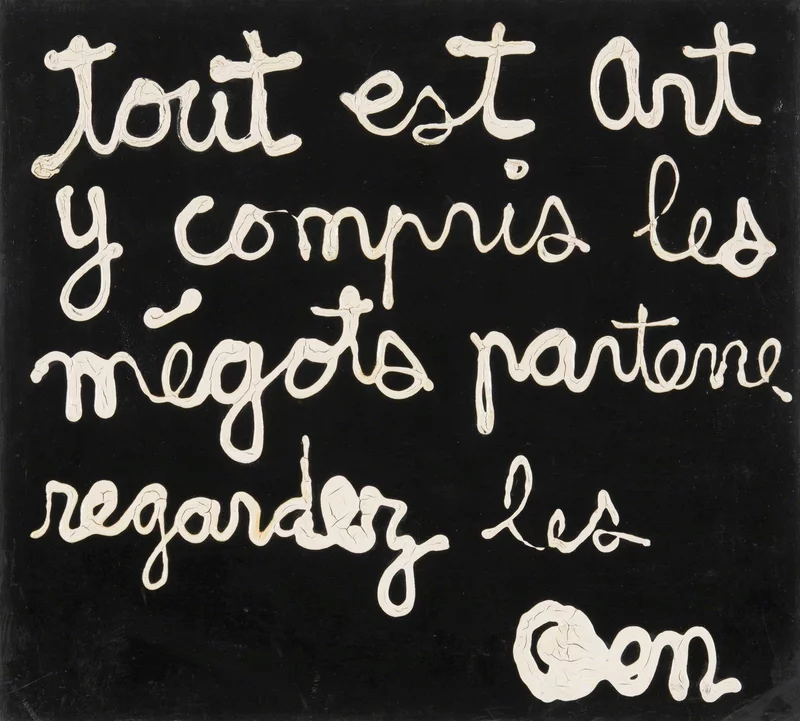
Have you ever stopped to think: what makes something art? Tout est Art by Ben Vautier has the answer. It’s simple, bold, and tells us in three little words: “Everything is art.” Ben, with his fantastic handwriting, challenges the idea of art.
But who exactly is Ben Vautier? Why does he think everything counts as art? And why are those words so special? Let’s explore how Tout est Art shakes up what we believe about creativity and what makes art, well, art.
Who was Ben Vautier?

Ben Vautier is a major voice in the art world, using simple words to make big statements. He was born in Naples, Italy, in 1935. Later, he grew up in Switzerland and France before settling in Nice. During his early days, he ran a small shop in Nice. He quickly became famous, not for what he sold, but for what he wrote. Ben used his shop windows to display clever and bold phrases that grabbed people’s attention.
By the 1960s, Ben became part of the Fluxus movement, whose artists believed art could be everything and anything. Ben worked alongside other big names who wanted to destroy the old rules and join art with everyday life. Ben’s art would always be loud and playful, with a message to think differently, whether he was painting onto canvas, making performances, or creating installations.
FUN FACT: He once turned his entire store window into a public art piece filled with bold phrases and quirky messages, making it one of the earliest examples of his signature style.
His Career
Ben Vautier’s career is very about pushing the limit. The 1950s saw him writing bold phrasing on signs in Nice. Soon, the word “Ben” became a signature that was recognizable to people in town. Ben’s art didn’t seek fame or the applause of the masses. He became part of the Fluxus movement, a gang of rule breakers who didn’t believe that art should be about any rules at all. But these artists believed art didn’t have to stay in galleries—instead, it should be seen everywhere, including your day-to-day life.
Ben was a rebel and wanted to work collaboratively with people. Ben worked with people like Nam June Paik, and George Maciunas, challenging the art world to loosen up. His art is simple to look at, but full of meaning, and humor, with a little bit of a surprise.
What is Happening in Tout est Art?
| Artist | Ben Vautier |
| Date Created | Circa 1980s |
| Medium | Ink or paint on various materials (canvas, signs, etc.) |
| Genre | Conceptual Art |
| Period | Contemporary |
| Dimensions | Vary based on version and display |
| Series / Versions | Often shown as part of larger text-based or manifesto works |
| Where is it housed? | Displayed in different galleries and public spaces worldwide, often as part of Ben Vautier’s retrospectives |
When you first see Tout est Art, it looks simple: Written in Ben’s own handwriting, three words: “Everything is art.” This phrase exudes power. Ben wants us to ask ourselves: “What is art?” Can it only be paintings at a museum? Is art within everyday things, like a coffee stain, a funny conversation, an instant we otherwise overlook?
By writing “everything is art,” Ben is saying that even the simplest thing can be art if you’ve got eyes. It’s everywhere and belongs to everyone. It’s powerful because it tears down the notion that only ‘special’ things can be art. It demonstrates that the little things must be seen as creative and meaningful.
What’s So Special About Tout est Art?
The great thing about Tout est Art is that it makes the world of art accessible to everyone. Ben doesn’t care to paint fancy art that is outside of reach. Rather, he wishes us to recognize that everyday things can be creative. Your messy desk? How does rain hit a window? Ben will say that art can be those moments too.
This artwork also has a feel of playfulness and friendliness to it, making you think. Think of walking down the street, saying everything is art. One day you will start to see things you simply didn’t see before. Ben teaches us that a piece of art doesn’t have to be difficult or heavy to understand. Sometimes it’s just a new way to look at the world around you.
Interesting Facts About Tout est Art
Ben Vautier never sticks to one thing. Tout est Art has appeared on different materials and in different places, keeping it fresh and surprising.
He uses simple words, but his art always makes people think deeply. Sometimes, the most straightforward things have the biggest impact.
This phrase challenges experts in the art world. Who decides what is art, anyway? Ben wants everyone to have a say.
Ben’s art is often interactive, meaning you become part of it just by reading it or reacting to it.
While some of his works can be serious or shocking, Tout est Art is fun and makes you smile—just by looking at it.
Artwork Spotlight: Fluxholes

Fluxholes by Ben Vautier is available on Singulart. This artwork pushed people to see gaps and boundaries from new angles, always making sure you couldn’t just walk by without a second thought.
Are you looking for a piece of artwork from Ben Vautier?
Singulart has limited edition prints of Ben Vautier. If you are looking for a piece of Vautier‘s artwork for sale, simply click on the artwork or the button below to discover more!
FAQs
1. What is Ben Vautier known for?
Ben Vautier is known best for his text-based artworks that experiment with traditional art concepts. Simple, handwritten phrases such as ‘Tout est Art’ (Everything is Art) are typical of his works, which challenge the limits of creativity and propose that art is everywhere, and everyone should see art in the simplest things.
2. How did Ben Vautier influence the art world?
Ben Vautier made the art world more accessible and less elitist. With simple words and phrases, he encouraged everyone, especially those who weren’t traditional art enthusiasts.
Conclusion
Tout est Art isn’t just another artwork—it’s a way to see life differently. Ben Vautier’s words remind us to find art in everyday moments and see beauty in the unexpected. So next time you’re going through your day, take a moment to pause. You might just discover that art is all around you. After all, Ben would say, everything is art.