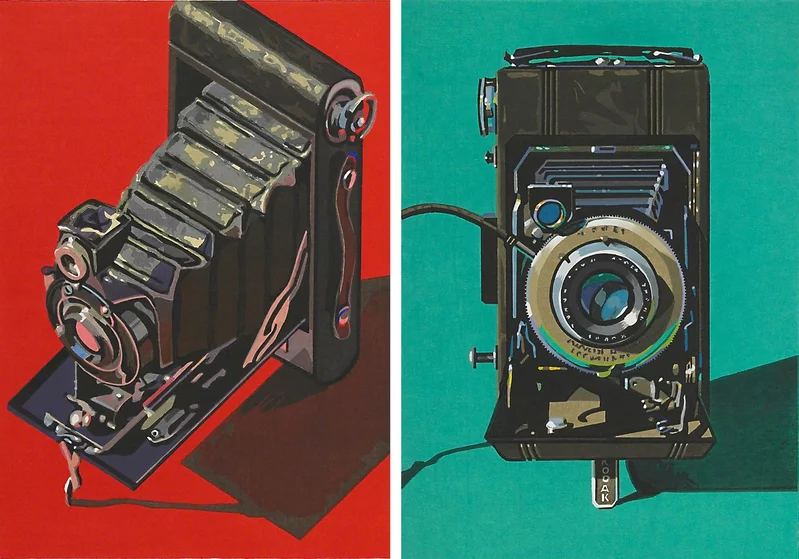
Imagine this: three old school cameras next to each other, posing for their big moment. That’s Three Cameras by Robert Cottingham. This isn’t just a painting; this is a trip back in time to when cameras were things with charm.
This piece was created by the artist Robert Cottingham, a fan of changing everyday things into well-surprising objects. With Three Cameras, he sees us right into vintage photography and wants us to take note of how beautiful the simplest of things can be. So let’s dive into what makes this painting so fascinating.
Who was Robert Cottingham?
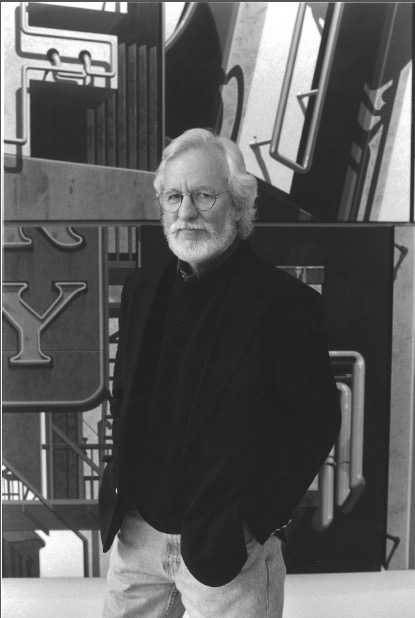
Robert Cottingham was born in 1935 to a native Brooklyn family, where city noises are always blaring, streets always rumbling, and always glowing signs to gawk at. He would later use these sights as his artistic focus, and they stuck. Cottingham didn’t begin his career as a full-time artist. Initially, he got involved in advertising where he perfected the art of giving designs and words a place. It gave him his artistic eye, and by the 1970s he left advertising to paint.
As the Photorealism movement’s key figure, Cottingham painted scenes so detailed that they looked like photographs. For Cottingham, it wasn’t simply about painting in beautiful detail. He wanted to write about everyday things, like signs and buildings, things that most of us just don’t see. His art evokes memories and conjures up new ideas.
FUN FACT: Robert Cottingham didn’t originally plan to be an artist. He actually studied advertising design in college and worked as an adman before transitioning to full-time painting.
His Career
Cottingham used his advertising background to know how to get people to pay attention and tell them a story with just words and graphics. The skill followed him into his art, which focuses on old signs, neon lights, and other city details. He tends to get to work on his paintings by first taking a photograph of a sign or similar building that catches his eye. After that, he paints it up again in oil paint with incredible precision, paying close attention to the way light hits metal or falls into a shadow.
Although he’s well known for Photorealism, Cottingham always seemed to put his spin on things. But he didn’t just copy what he saw—he made us feel something about it.
What Is Happening in Three Cameras?
| Artist | Robert Cottingham |
| Date Created | 1980 |
| Medium | Oil on Canvas |
| Genre | Photorealism |
| Period | Modern Art |
| Dimensions | 60 x 60 inches |
| Series / Versions | Part of his “Cameras” series |
| Where is it housed? | Smithsonian American Art Museum |
Three Cameras at first may appear to be a photograph. But it’s not—it’s a painting. He painted three vintage cameras, all very painstakingly detailed to look as authentic as could be found. It’s almost as if you could almost feel the cold metal and the smooth lenses and little knobs and buttons.
The cameras are always on, so your eyes settle immediately on the background. They are lined up in neat rows, displaying their shapes and textures. Every camera feels like it has a story. Who used them? What were the moments that they recorded? The magic is that Cottingham lets you imagine.
What’s So Special About Three Cameras?
This painting does something to you — it pulls you in. It might be the lighting, it’s shining off of the cameras and they look like they’re glowing. Perhaps it’s nostalgia, for a time when photography wasn’t easy or possible.
Cottingham was incredibly detail-oriented. The metal is shiny, the shadows fall in the perfect way. The cameras have little brand names. It is warm, it is thoughtful, it feels like a quiet celebration of these old tools.
Interesting Facts About Three Cameras
Part of a series: Cottingham didn’t stop at three cameras—he painted several works featuring vintage photography gear.
Inspired by real objects: He used actual cameras as models to make sure every little detail was accurate.
It feels like an ad: Thanks to his advertising background, the painting looks like it could be part of a 1950s camera ad.
It’s more than realistic: Cottingham doesn’t just paint what he sees. He adds warmth and character, making the cameras feel alive.
Nods to Hollywood: Some people think his love for cameras comes from a fascination with old movies and the tools used to capture them.
Artwork Spotlight: Fox

Fox by Robert Cottingham is available on Singulart. This artwork is a painting of a glowing theater sign. It’s bright, bold, and full of nostalgia.
Are you looking for a piece of artwork from Robert Cottingham?
Singulart has limited edition prints of Robert Cottingham. If you are looking for a piece of Cottingham‘s artwork for sale, simply click on the artwork or the button below to discover more!
FAQs
1. What kind of art is Robert Cottingham best known for?
Robert Cottingham is well-known for his prints and paintings of metropolitan American landscapes, especially neon signs, cinema marquees, storefronts, and building facades.
2. Is Robert Cottingham considered a Photorealist?
Robert Cottingham is indeed one of the leading artists of the Photorealism movement that arose in the late 1960s. Cottingham’s degree of precision and detail is amazing, but his approach is far from simple replication.
Conclusion
Cottingham took something as simple as three cameras and turned it into a celebration of design and craftsmanship. It’s not just about the past; it’s about how art can make the ordinary extraordinary. So, next time you see an old camera, take a closer look. You might just see a masterpiece waiting to happen.