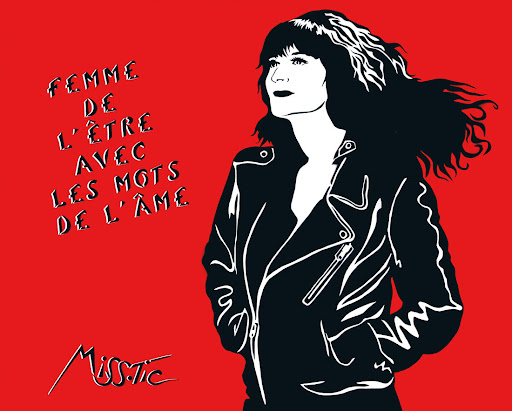
Miss Tic’s Femme de l’être isn’t street art isn’t anything but a declaration of intent shrouded in poetry and simplicity. This artwork plays with our perception of womanhood with a Parisian touch, mixing words and visuals amidst all of the images.
Miss Tic’s mark on the walls of Paris also found its way to the hearts of those who saw her work. Her pieces are quite open about identity, gender, or themes of societal norms, and they often challenge questions about these elements. In Femme de l’être, she enjoys playing with the French language in order to celebrate femininity and individuality.
Who Was Miss Tic?

In Parisian street art, she was a pioneer. Radhia Novat grew up in Montmartre, a genteel section of Paris where intellectuals and artists live. She lost both parents when she was young and life wasn’t always easy. Instead, she was stronger in art than being defeated.
From the 1980s Miss Tic began painting the streets of Paris. Her style was simple but powerful. These pieces weren’t just pretty to look at, these pieces made you stop and think.
Miss Tic’s art became quickly iconic. Her work reflected life and themes such as love, freedom, and identity. She figured out how to reach everyone, leaving everyday walls as galleries.
FUN FACT: Miss Tic wasn’t just an artist; she was also a poet at heart! She described her work as “poetry for the streets.”
Her Career
Miss Tic started by painting on the walls of Paris. It was a rebellious act, an act to get her voice heard. However, as her work grew in prominence, she became a renowned figure in the art world.
Miss Tic didn’t stay confined to the streets. She did work with big names like Dior and even showed up in galleries. However, she never abandoned her roots, making art for both artists and collectors at the same time.
What is Happening in Femme de l’être?
| Artist | Miss Tic |
| Date Created | the 2000s (specific year unknown) |
| Medium | Stencil and spray paint |
| Genre | Street art |
| Period | Contemporary art |
| Dimensions | Variable (depends on location or reproduction) |
| Series / Versions | Part of a broader collection of feminist-themed works |
| Where is it housed? | Various locations, originally on the streets of Paris |
Miss Tic keeps it simple but powerful in Femme de l’être. The word piece features a woman in silhouette with a phrase behind her that reads as poetic as the woman. The phrase alone isn’t decoration, it’s the heart of the piece and it breaks down the idea of identity and freedom.
Femme de l’être is a wordplay. In French, “femme de lettres” refers to woman of letter or writer. Miss Tic replaces lettres with être (to be), changing the meaning from being to existence.
The woman in the artwork is strong looking and thoughtful. She seems to be asking the viewer, “Who are you anyway?” This is not art to gaze at, it’s art to experience.
What’s So Special About Femme de l’être?
This artwork is different for being simple but also has a lot to say. It doesn’t sweat too much in trying to impress you, but it leaves a lasting impression.
Miss Tic was capable of giving her work double meaning. Visually striking on the surface, with clean lines and a bold design, Femme de l’être is also technically neat — and as soon as you take it apart.
This piece is even more special because it is so personal. The artwork connects with you no matter whether you’re a feminist, an art lover, or just someone walking past it on a Paris street.
Why We Love Femme de l’être?
We love Femme de l’être because it is art that talks to everybody. Concise, and powerful, with strong visuals and meaningful texts.
The clever wordplay in the title makes you read for a little bit. There’s a message in the artwork which has nothing to do with a woman’s image—her essence, her identity, and her strength.
Interesting Facts About Femme de l’être
Playful Words: The title, Femme de l’être, is a twist on the phrase “femme de lettres” (woman of letters). It’s a clever nod to intellect and identity.
Parisian Roots: This artwork, like much of Miss Tic’s creations, was originally painted on a wall in Paris. The city’s energy is part of the art itself.
A Voice for All Women: The woman in the image isn’t based on a specific person. She represents every woman—strong, confident, and unapologetic.
More Than Graffiti: Miss Tic called her art “poetry that walks the streets.” It’s not just something you see; it’s something you feel.
Different Versions: Miss Tic often reworked her themes, creating new versions of her pieces with subtle changes. Femme de l’être might look slightly different depending on where you see it.
Artwork Spotlight: Trop heureuse pour être peureuse

Trop heureuse pour être peureuse by Miss Tic is available on Singulart. This artwork is a perfect example of her creativity. In just a few words, she delivers a message that’s both clever and empowering.
Are you looking for a piece of artwork from Miss Tic?
Singulart has limited edition prints of Miss Tic. If you are looking for a piece of Tic’s artwork for sale, simply click on the artwork or the button below to discover more!
FAQs
1. Why is Miss Tic considered an important figure in street art?
Miss Tic was the pioneer of Parisian street art in the 1980s. Her use of stenciled figures with poetic text put a fresh urban art twist.
2. What inspired Miss Tic’s poetic style in her artworks?
Miss Tic’s literary manner owed not a small part to her associations and her love of letters. She was born and raised in Paris, where she grew up listening to art and culture, which ultimately defined her voice.
Conclusion
Femme de l’être is more than a piece of art. This artwork is a celebration of being yourself and your identity. Miss Tic tells us that art doesn’t have to exist in the gallery. The best art sometimes is found by accident and happens out on the street.
Next time you see Femme de l’être, take a moment. Let it sink in. Because it’s not just about what you see—it’s about what you feel.