
When collectors browse art online, they weigh subject, color, and price. But one factor often shapes the final decision more than artists expect: size. Whether a piece fits above a sofa, in a hallway, or within a budget can determine whether it sells at all. To better understand this, we reviewed more than 6,000 sales on Singulart over a nine-month period in 2025, spanning nine mediums and 56 countries.
The overall picture
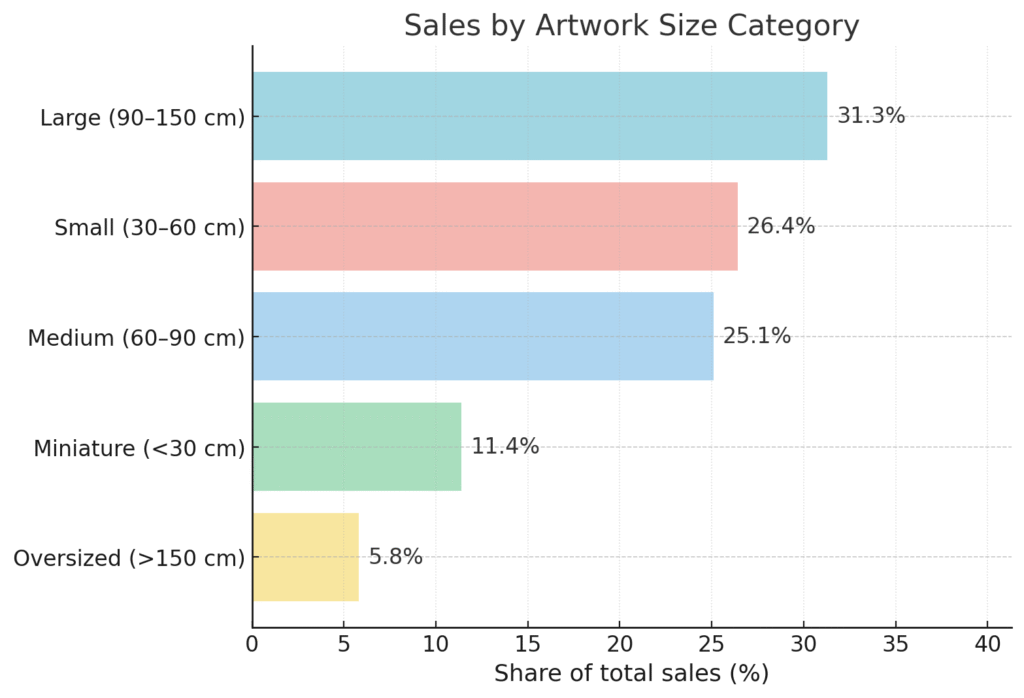
Large artworks (90–150 cm) clearly lead the market, representing nearly a third of all sales (31.3%). Small (26.4%) and medium (25.1%) sizes follow closely, while miniatures (11.4%) and oversized works (5.8%) remain niche segments.
Large works not only sell most often but also achieve the highest average sales per transaction, confirming their status as statement pieces. At the same time, small and medium hold steady appeal as versatile formats that fit most homes and budgets.
Market concentration in paintings
Paintings dominate across all size categories. Together, small, medium, and large paintings alone account for nearly two-thirds of all sales (63.5%). Large paintings stand out in particular, representing 28.2% of the entire art market on their own. Paintings also command near-total dominance of premium formats, with 90.3% of large artwork sales and an extraordinary 95.1% of oversized artwork sales.
For artists, this means paintings remain the strongest driver of market demand, especially when scaled up.
Medium-specific preferences
The data also reveals how collectors respond differently to size depending on medium:
– Prints: strongest in medium size (40.6%), balancing accessibility with impact.
– Sculptures: thrive in miniature size (43.4%), aligning with the collectible market where space matters.
– Photography: sells best in small size (39.2%), appealing to entry-level collectors.
– Drawings: overwhelmingly small size (60.2%), consistent with their intimate feel.
These distinctions point to the collector psychology behind each category – prestige in large paintings, affordability in photography and drawings, and collectibility in sculptures.
Large paintings not only dominate volume but also achieve the highest sales per transaction, reinforcing their position at the luxury end of the market.
What this means for artists
– Balance your portfolio: Offer small, medium, and large works to capture different buyers.
– Lean into your medium: If you paint, large formats are especially effective. If you sculpt, miniatures sell best.
– Be strategic with oversized artworks: They can be powerful but may take longer to place.
Closing thought
Size is not the only factor in sales – but it frames how collectors imagine your work in their lives. The data shows that collectors gravitate toward pieces that balance impact with practicality. By aligning your portfolio with these preferences, you increase the chance that your work will not only fit a wall, but also move into a collector’s home.
Put these insights into action – join Singulart and start selling your art to collectors worldwide.