Claude Monet was one of the first impressionists, and the paintings he completed at his house in Giverny are some of his most beloved works. Towards the end of his life, Monet developed cataracts in both his eyes, leading to a departure from his bright, soothing color palette into the more rich, robust colors seen in The Japanese Footbridge. Singulart…
-
-
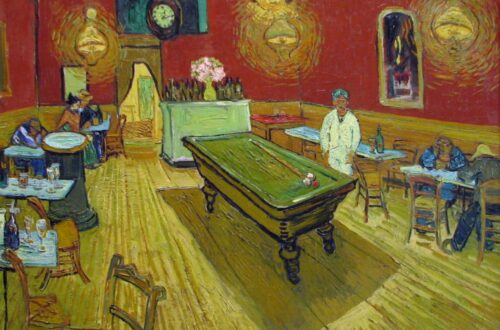
Vincent van Gogh called The Night Café “one of the ugliest paintings I have ever done.” The artwork depicts a desolate café scene at quarter past midnight in violently contrasting colors. In a letter to his brother Theo, Van Gogh described the café as “a café de nuit… staying open all night. Night prowlers can take refuge there when they…
-
Viewing Willem de Kooning’s Woman I is an arresting experience. Drawing inspiration from woman in all her forms, from Paleolithic fertility goddesses to American billboard bombshells, de Kooning presents us with a powerful image that is both intimidating and intriguing. As de Kooning himself said, “Beauty becomes petulant to me. I like the grotesque. It’s more joyous.” In this article,…
-
Les Demoiselles d’Avignon is a prime example of Pablo Picasso’s mastery of cubism. The artwork caused an uproar when it was exhibited, as it depicted nude females in a nontraditional manner. These females are angular, unfeminine, and unflinching in their nudity. With this piece, Picasso aimed to establish himself as one of the great painters of his time, and the…
-
It’s one of the quintessential images of pop art: a girl surrounded by swirling water, thinking “I don’t care! I’d rather sink – than call Brad for help!” Drowning Girl is one of pop artist Roy Lichtenstein’s defining images, his masterpiece of melodrama, displaying his skill for reproducing comic book images and giving them a deeper, more complex meaning. Singulart…
-
Frida Kahlo’s name has become synonymous with her striking, bold self-portraits. A celebrated Mexican artist, Kahlo used her life as inspiration for her art, resulting in deeply personal pieces like The Wounded Deer. In this article, Singulart explores the colorful life of Frida Kahlo, as well as the interpretations surrounding The Wounded Deer. Who was Frida Kahlo? Frida Kahlo was…
-
Michelangelo Merisi da Caravaggio led a turbulent life, consisting of murder charges, ambushes by knights, and a death that is shrouded in mystery to this day. He poured his passion into his artwork, producing realistic high renaissance pieces that had an incredible amount of detail. His use of light and dark contrast, or chiaroscuro, was incredibly influential to fellow artists…
-
Guernica is not only a masterpiece of Pablo Picasso’s cubism, but it is also an important political statement, perhaps the most iconic anti-war image of the twentieth century. After he was commissioned to paint a mural for the Paris World Fair, Picasso eschewed the prompt of ‘technology’ and instead chose to shine a spotlight on the aftermath of the Guernica…
-
Vincent Van Gogh painted a number of portraits throughout his artistic career, but this 1889 version, painted only months before his death, is one of the greatest. The undulating background, contrasted with the fixed, rigid expression on Van Gogh’s face, provides a fascinating contradiction. In this article, Singulart examines the life of Van Gogh, his passion for painting self-portraits, and…
-
The Triumph of Galatea is a fresco by renaissance artist Raffaello Sanzio da Urbino, also known as Raphael. It depicts the character of Galatea, who appears in Greek mythology as a sea-nymph in love with a mortal. Raphael has immortalized the moment of Galatea’s apotheosis, when she becomes a being of the most divine level. The fresco is a testament…