Raoul Dufy stands out among them as a visionary, having his heart bursting with an explosion of colors to the sound of his very own artistic vision. Born on June 3rd, 1877, in Le Havre, France, Dufy’s first step from a small shop to the École des Beaux-Arts marked the beginning of a successful career. Dufy’s transformation from Impressionism to Fauvism, and then to a fusion of Cubism and abstraction, manifests his talent.
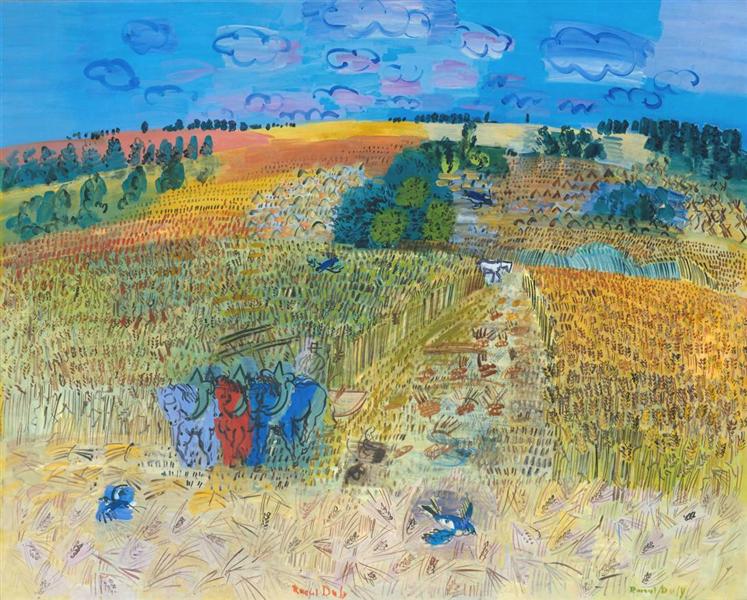
This article will focus on one of Dufy’s best works, which is “The Wheatfield,” painted in 1929. Through the examination of dimensions, colors, and the particular relationship between nature and humanity here, we will uncover what makes Dufy’s works unique. Besides, we’ll explore the fascinating portrait of the artist’s career. In this light, we’ll discuss the importance of “The Wheatfield” within the overall artistic legacy of Dufy.
Who was Raoul Dufy?
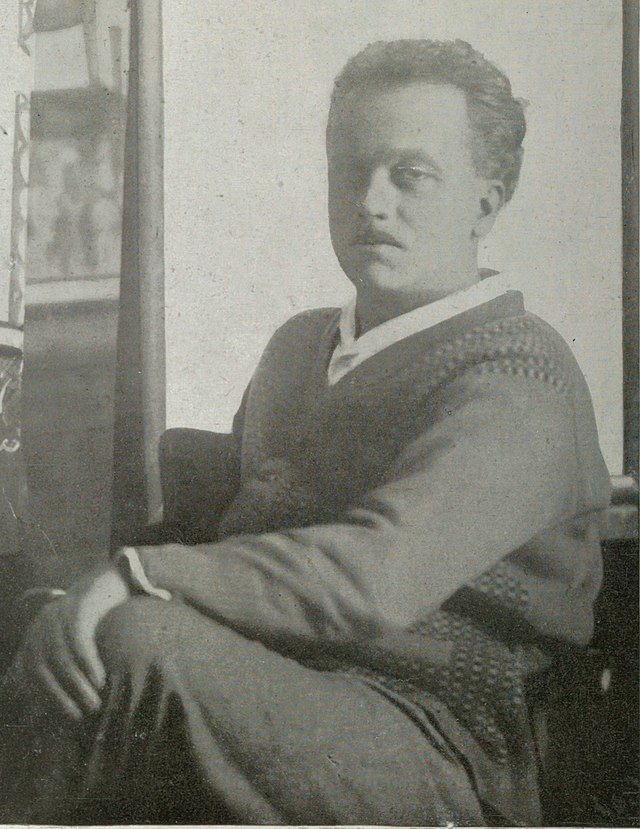
Raoul Dufy’s artistic career took its roots in the windy lanes of Le Havre. Born in a modest family, Dufy displayed his natural talent by joining evening classes at École des Beaux-Arts where the flame of his great career began to burn. His artistic path ranged from the brushwork of Impressionism to the vivid colors of Fauvism and the combination of Cubism and abstraction. This transformation symbolized more than the evolution of an artist but also the unveiling of a century that was a scene of both stability and chaos.
FUN FACT: Raoul Dufy was known for his distinctive use of bold, vibrant colors and loose, expressive brushstrokes. This unique style, often characterized by its joyful and lively aesthetic.
His Career
Dufy’s life went through the same lines as a beautiful painting, each line being a page of a novel by a modernist avant-gardist. He revealed his willingness to work in different mediums, including painting, drawing, printmaking, and textile design, to find aesthetic expression. Dufy stood out in the Fauvist movement because of his unique ability to use brilliant colors and free brushstrokes. His legacy was to create dynamism and emotion in art.
What is Happening in “The Wheatfield”?
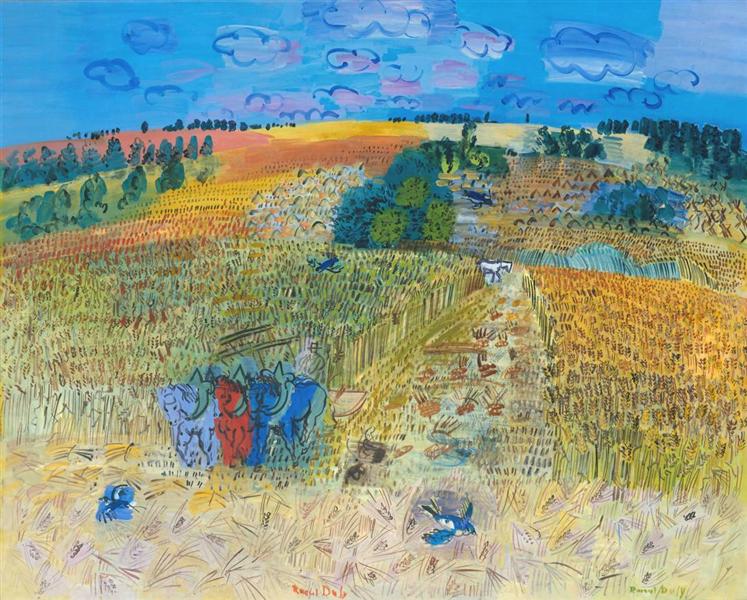
| Artist | Raoul Dufy |
| Date Created | 1929 |
| Medium | Oil on canvas |
| Genre | Landscape painting |
| Period | 20th-century Modernism |
| Dimensions | 54.6 cm × 73.6 cm (21.5 in × 29 in) |
| Series / Versions | Single painting |
| Where is it housed? | Musée d’Art Moderne de la Ville de Paris, France |
In the core of Dufy’s art area, there is “The Wheatfield,” a show of his talent to go beyond the canvas and show the world around him. Completed in 1929, this classic artwork captures the perfect sense of serenity that the rural way of life offers. Dufy moves his brush across the canvas, capturing golden wheat stocks bending under the embrace of wind against the view of smooth hills and a fine, blue sky.
The main character is a lone figure who stands in the middle of the wheat field. Humanism is presented in a way that the person is tiny compared to the whole landscape. However, the subject is not of isolation but a pleasant coexistence between humanity and nature, which Dufy portrayed in his masterpieces. Through “The Wheatfield,” the interplay of the littleness of mankind given the majesty of nature and the beautiful harmony in this rural paradise come together into one area.
Interesting Facts about “The Wheatfield”
Dufy’s embrace of Fauvism, evident in “The Wheatfield,” involved a departure from naturalistic colors. Instead, he opted for bold, non-realistic hues to evoke emotion and expression, a hallmark of the Fauvist movement.
While seemingly portraying an idealized rural setting, “The Wheatfield” subtly reflects Dufy’s fascination with modernity. The lone figure amidst the wheat may symbolize humanity’s place in the natural world amidst the rapid industrialization of the early 20th century.
Dufy’s proficiency in textile design is reflected in the intricacies of his brushwork in “The Wheatfield.” Decorative elements and patterns subtly interwoven within the composition add a layer of complexity and visual interest.
The play of sunlight on the wheat stalks and the nuanced variations in color attest to Dufy’s mastery of capturing light and atmosphere. “The Wheatfield” radiates with a sense of movement and life, drawing the viewer into its enchanting embrace.
Artwork Spotlight: Le Prince de Joinville à bord d’une frégate anglaise
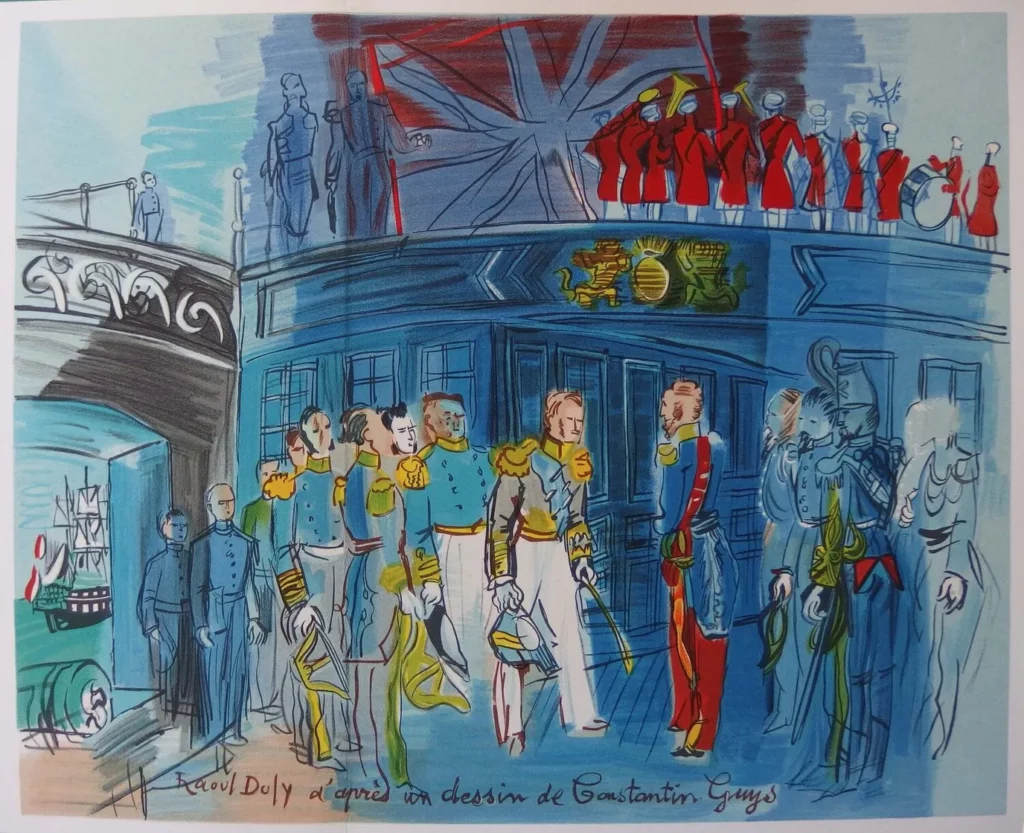
“Le Prince de Joinville à bord d’une frégate anglaise” is available on Singulart. It is a striking artwork by Raoul Dufy, creating the sensation of adventure and maritime grandeur by means of striking colours and expressive brushwork.
Are you looking for a masterpiece from Raoul Dufy
Singulart presents exclusive limited edition pieces by Raoul Dufy. To discover and acquire Dufy’s art, click on the artwork or the button below for more information!
Frequently Asked Questions
Who was Raoul Dufy inspired by?
Motivated by the realistic manner and works of Claude Monet. Dufy was awarded a scholarship to study at the École Nationale Supérieure des Beaux-Arts in Paris in 1900. The next year saw the opening of his debut show.
How much is a Raoul Dufy painting?
Raoul Dufy’s artwork has been up for auction on several occasions; the artwork’s realized values have varied based on its size and media, from 5 USD to 7,941,112 USD.
Conclusion
Raoul Dufy’s “The Wheatfield” offers us a glimpse into his extraordinary talent – a subtle celebration of color, shape, and time. As at the sight of this artwork, we are enveloped in the crossing of nature and humanity, done within the dispositions of a modernist mastermind. Dufy’s spirit remains alive, in the endless series of his works and the perpetual joy evoked by the legacy of his art to this day.