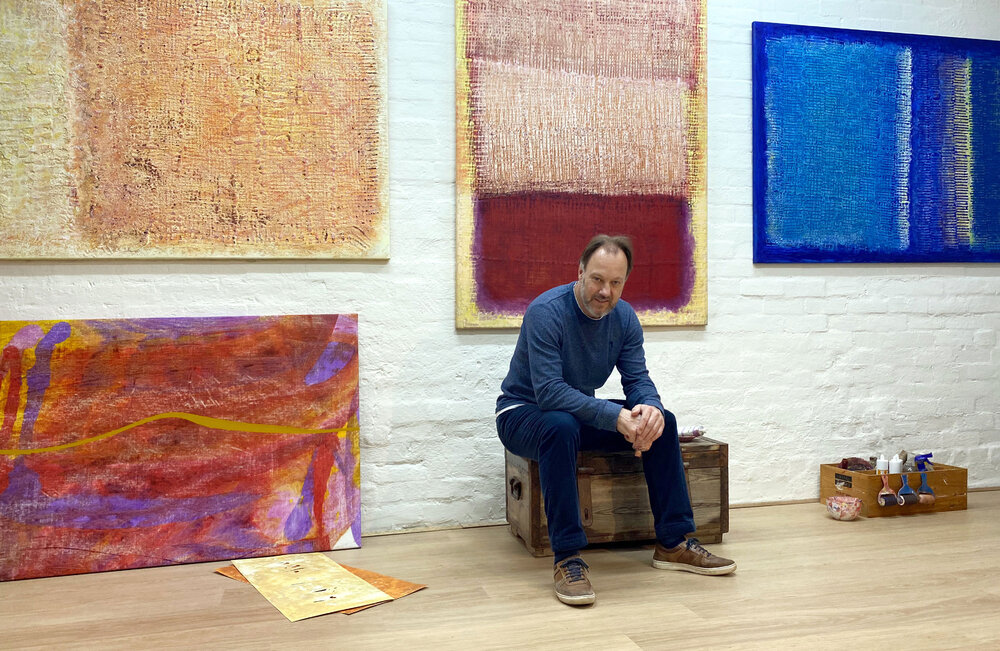
Australian artist Malcolm Koch shares his copper-based Membrane Art, blending scientific curiosity with artistic form to reveal hidden connections between nature, geometry, and higher dimensions.
What is your newest series?
The Copper Project
Tell us about the inspiration or concept behind this new series?
I have been evolving a distinctive expressive style that I call Membrane Art since 2004. This latest work builds on that idea. Using copper surfaces to provide the concept with a renewed sense of solidity and purpose. It combines the approaches, subtleties, and experience made on my oil paintings and synthetic surfaces onto a copper substrate, with surprising results.
What’s the message behind your new series?
Everything you see flat was created in three-dimensional space.
My genuine concerns relate solely to aesthetics. Curves exist everywhere in nature – my objective is to flatten a geometric curve to zero curvature after producing an ‘event’ on it. The marks shown on the flat picture plane could not occur without this.
The reason I work this way is because I believe curves provide us with an insight into the possibility of visualizing higher dimensions, which is an important concept in understanding physical science. My mark-making process requires working in 3D at first, the two-dimensional picture plane which traditionally serves as a portal into illusionistic space is the end goal. Thus, the experience is different for the observer. I hope that my work initiates a further process of in-depth thought or deep reflection about higher dimensions.
Since 2004, my ‘Membrane Art’ approach has evolved over time to become more instinctual than deliberate, which has allowed unexpected outcomes to occur. I know that the basic structure of the artwork will be determined by the curvature of a membrane surface and how it came to be, which allows me to reinterpret nature with a hint of quantum eccentricity.
So the overall curve remains the foundation of my most recent work.
What’s your personal highlight of the series?
I enjoy a challenge. It’s satisfying to work with a new material. It has been a learning process to figure out chemical reactions and how to control their effects. The highlight is the artwork I titled ‘Collapsed Wave’. It has a great deal of depth and intricacy as a consequence of countless experiments. It was a piece that I wasn’t sure would survive the journey. Now, I think it is the heart and soul of the series. The experience gained from it will support me as I move the Copper Project forward.
Moreover, is there a particular piece in the series that you’re most fond of? Why?
Aside from the previously mentioned, there are three that come to mind for different reasons.
1. Quantum Legs
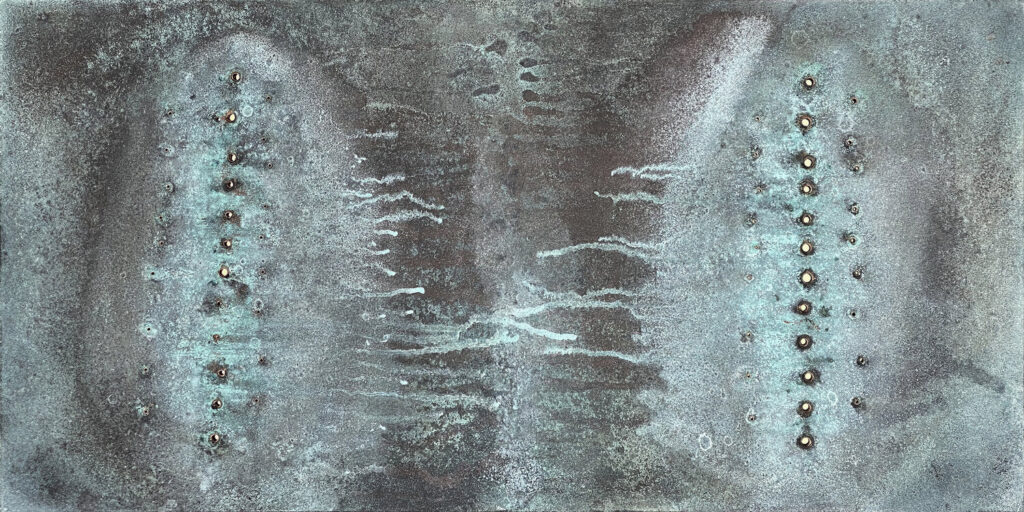
In Quantum Legs, I experimented with creating oxidized markings that became structural to the copper substrate, ie not flake off as sulfate often does in its blue crystalline form. This meant I could use the chemical process like paint drops, working one under the other. This was a revelation and may form the basis of future work.
2. Quantum Pathway
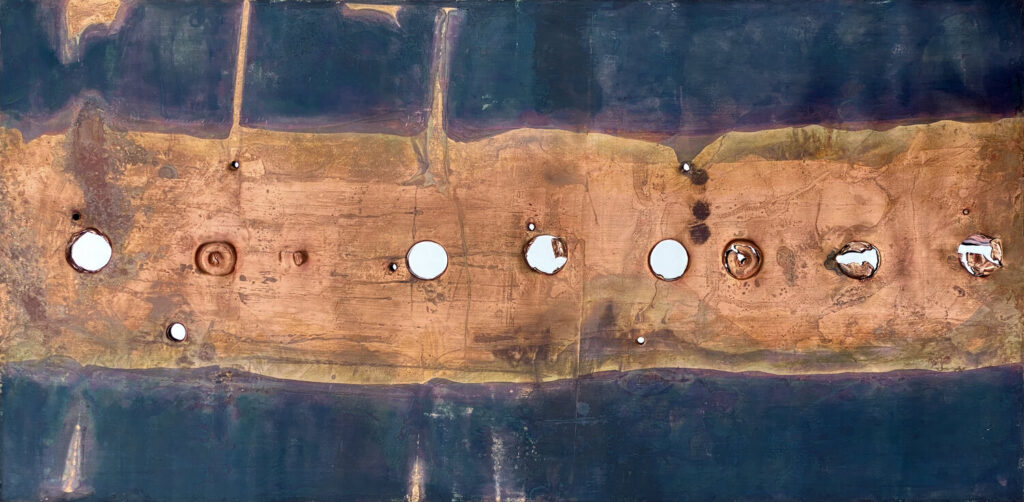
Quantum Pathway is a concept inspired by Roger Penrose, one of my favorite physicists. He and Stuart Hameroff propose that the human brain’s use of microtubules for signal transmission plays an important role in the creation of consciousness. There needs to be an uncomputable element in what the brain does which is likely to lead to the collapse of the wave function in quantum mechanics. I set out to imagine what this could look like. This is the switch – from 3D to 2D (unconsciousness to consciousness) or when the rolled-up copper sheet is finally unfurled and revealed for observation. The sequence of large puncture marks in either depressions or impressions is three drill holes that happen to reciprocate 3 times along the path (9 in total). So, if you look closely you can see how they connect to each other.
3. Duality of Marks
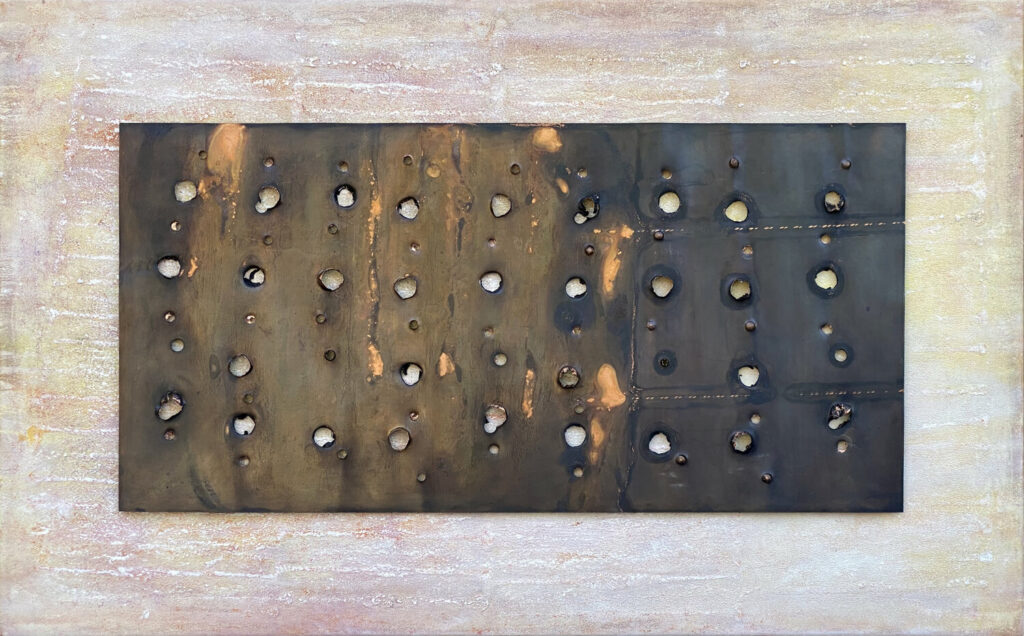
Duality of Marks, a copper sheet and an oil painting are combined to create a three-dimensional piece. It’s not the curled-up or undulating work that each was created in, but a 3D piece nonetheless. The oil painting serves as a background, similar to electromagnetic field background noise, so that the copper sheet, with its wave-like drill holes and staining, can be highlighted. This combination may form the basis of a future series.
If you encountered any challenges during the creation of this series, how did you manage to tackle and overcome them?
Since my mark-making process requires working with curved space, there are limitations with this approach, such as not being able to view the complete medium. However, over the last twenty years, I’ve learned to overcome this partial blindness through trial and error. Now my approach is instinctual rather than a deliberate action. This allows for unexpected outcomes and challenges me to let go.
When I first considered doing this series, I could have simplified my approach to produce only reciprocating saw cuts and drill holes. And after that, keep the luster intact by applying a sealer to the copper surface. However, that didn’t align with my notions of what happens organically in nature, so I rejected this. The challenge became how to create patinas that could only happen on a curve but that could also connect through the reciprocating holes. The patina had to be an integral part of the work otherwise there would be no point going down that path. I spent a lot of time experimenting and figuring out the most effective ways to get results.
There was also the challenge of controlling the chemical processes. To make sure the chemical processes I used would be sufficiently robust and didn’t flake off or oxidize in a direction I didn’t want it to go. Stopping or slowing the oxidization process without destroying the patina’s natural luster was key. This is where the micro-crystalline wax became an ideal solution.
As with all artists, keeping the studio areas organized is another issue. Even though I’m lucky enough to have two studios, everything takes time – only one is exclusively set up as my workshop and for chemical procedures.
How would you recommend a visitor to experience your creation?
There’s no substitute for seeing the work in the flesh. A picture taken from a particular angle does not capture the essence of the work because of the naturally occurring luster of copper and the highly reflective mirrors behind it. Also in a residential setting, as we move through a space and light shifts over the seasons, I think this series is visually rewarding.
What kind of engagement or interaction do you hope to have with your audience?
The response to my most recent exhibition has been perfect thus far. I’ve been able to sell one painting, others have expressed interest and one is an exhibition finalist. In addition, I’ll be working with a conference organization to create content for their mid-year “Copper To The World” event in 2025.
What’s next for you? Are you already working on a new series or project?
I’ve already mentioned in question 8 some of the directions I could be taking this project. Nevertheless, the extent depends on available resources and time.
Singulart Insight
At Singulart, we feel inspired by Malcolm Koch’s Copper Project and the expansion of his Membrane Art. His unique approach explores geometric curves and higher dimensions on copper, expressing art with rare technical skill. Drawing from physics and natural curvature, Koch’s series integrates dynamic chemical reactions, creating intricate patterns that challenge flat perspectives. Signature works like Quantum Pathway and Duality of Marks evoke themes of consciousness and dimensionality.
Through this interview, Koch’s stories, challenges, and hands-on methods offer a deeper understanding of his transformative process.