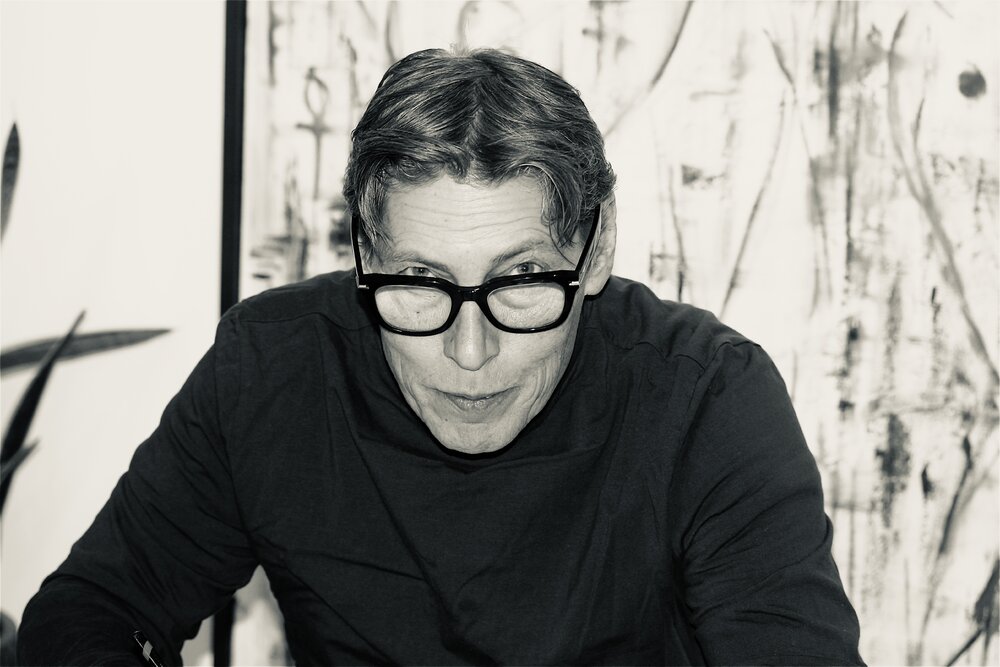
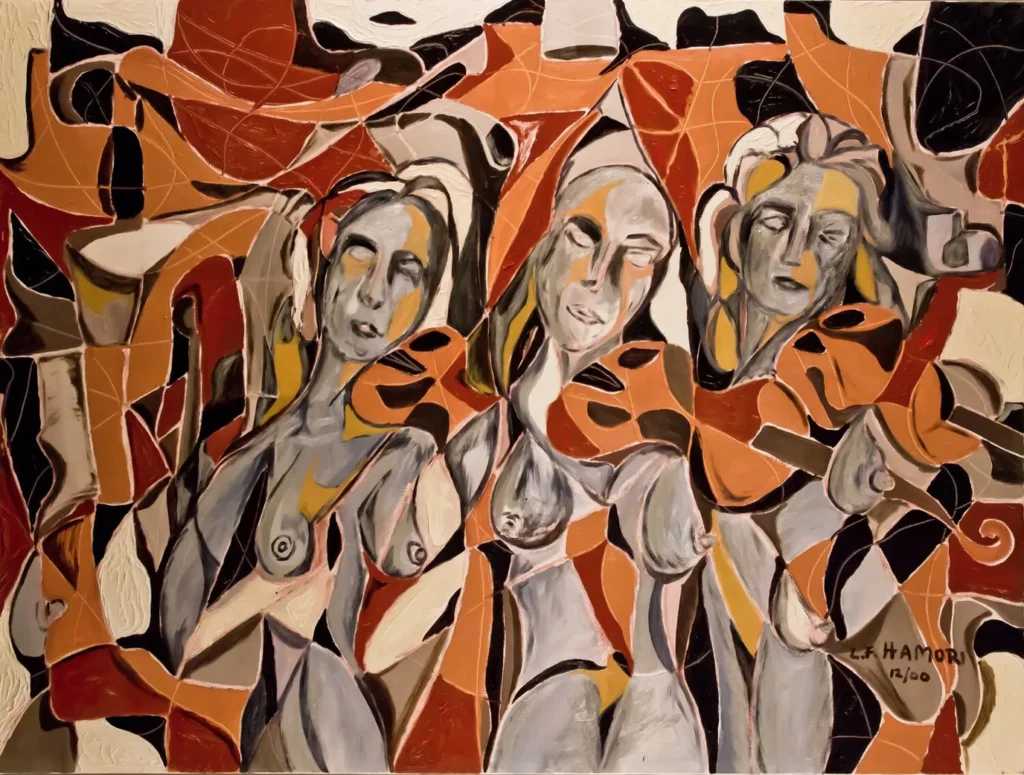
The artistic journey of Laszlo-Hamori is shaped by his early exposure to art, particularly, his father’s drawings, which would adeptly manipulate oil on canvas, intertwining gold and silver leaf in mixed media masterpieces. In his own work, Hamori, redefines classic techniques, pushing boundaries with kinetic sketches that evolve into intricate, layered creations, echoing the timeless dance of tradition and innovation. His pieces resonate with the complexity of the human condition, inviting viewers to glimpse the divine in a fluctuating world and to find beauty amidst turmoil.
Describe a typical working day:
The morning starts with an espresso and a cigarette on the balcony, watching the world as it starts to come to life. Streets are starting to fill up with people, cars, and school buses picking up children, and I take a deep breath of the beautiful morning. Sure after, I enter the studio. I start staring at the canvases that are in progress or complete and of course, an empty canvas, which is one of the most beautiful things. And then I either continue to sketch up a new project or destroy a perfectly good painting that I should not have touched but the energy seems to floor and I begin creating new images. In the late afternoon, I continue staring at the work accompanied by a glass of wine. Again this is a process that could be 30 minutes. Could be a couple of hours. Then resume regular life interaction with family and friends.
Do you have a favorite space for creating your artworks?
My studio, which is in a corner of my house with plenty of natural light is very quiet. It is a place where I allow myself to be carefree and chaotic.
How does an ideal day of creating look like?
The ideal day of creating in the studio is one in which I can tap into a certain energy and just paint for hours and hours, it’s almost like your frequencies in the creative flow and the outside does not exist.
Who and what inspired you to be an artist?
Watching my father draw, paint and sketch was a great influence for me to become an artist.
Name three inspirations for your work right now
World events, every day, people around me, ever-changing society, inspiration, and new ideas.
Is there a particular color palette that you prefer to work with, and what inspires your choice?
I do not follow any particular color theories, I choose the color according to the piece I’m working on, proceeding as I feel.
Tell an interesting story behind a piece you’ve created…
When I was around 10 years old, walking home from school in Budapest, I found a small statue of a Madonna, I picked it up, took it home, cleaned it up, and gave it to my grandmother. She placed the statue on her night table and it remained on the table till the day she passed. Forward 15+ years I received a Christmas card with a similar depiction of the Madonna. That’s when I decided I was going to create a series of paintings depicting the Madonna the way I see the image.
… and one interesting piece you own. Why did you buy it?
It is an Inuit sculpture called 10 Faces, it’s a multi-dimensional sculpture. I purchased it because the sculpture breaks down reality, It hurts the energy of the belief system of the Aboriginals in Canada.
We imagine that inspiration could strike anytime. How do you separate work from free time?
To me creating art is my free time, and the rest is the socially conditioned time.
Conclusion
Laszlo-Hamori’s artistic journey draws deeply from memories of his father’s artwork. Throughout his career, he has explored blending tradition and innovation. His path features bold experimentation and ongoing refinement. He captures the essence of found objects in his work, like the Madonna statue. This statue inspired a series of paintings that hold personal significance for him. Each day offers a new chance to access the creative flow he values. To Hamori, this flow blurs the line between work and freedom. His art invites viewers to find beauty in chaos, seeking balance in an unpredictable world. His canvases feature layered, intricate designs.